Tag: John Paulsen (Page 5 of 10)

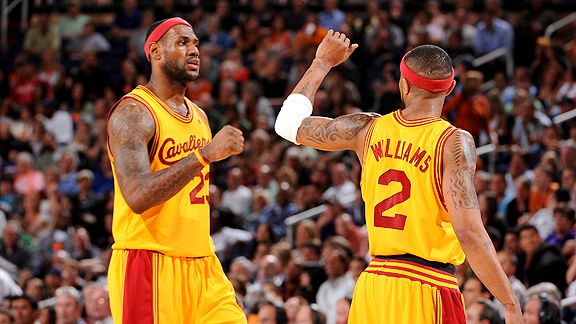
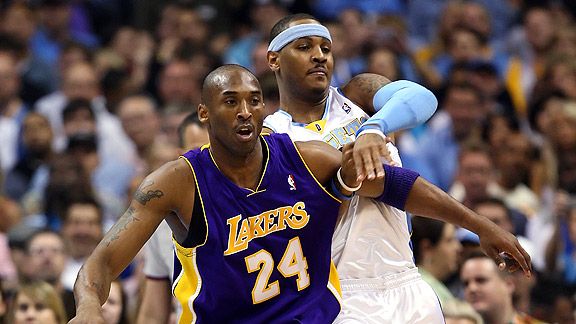
There’s a lot on the line for Kobe, LeBron, Melo and Dwight Howard

Duh.

There’s always a lot on the line in the Conference Finals. But this year it seems like there is more at stake for the superstars still standing. Let’s start with…

KOBE

Kobe Bryant has made it abundantly clear that his #1 priority is to win another title. This focus is not unusual for players that haven’t won a ring, but Kobe has three, so why is he so determined to win a fourth? Simply stated, for the sake of his own legacy, he has to win a title without Shaq.

If he fails, he will be viewed by history as a great player who won a few titles as Shaq’s sidekick. This is not the legacy that Kobe wants to leave. Barring a two- or three-peat, he’s not going to be able to catch Michael Jordan, but if he is able to win a ring this year — and he’s the first to admit that this is his best chance — then he’ll do it as “The Guy” on a championship team. There’s no Shaq wreaking havoc in the middle, just a collection of players deemed too soft (Pau Gasol, Lamar Odom) or too young (Andrew Bynum, Jordan Farmar, Trevor Ariza) that Kobe led to the Promised Land.

And the clock is ticking. Kevin Garnett could come back strong next season, LeBron is getting better by the year, and there are a few up-and-coming teams (Orlando, Houston, Portland, etc.) that are looking to knock Kobe off of his perch.

The time is now. Kobe’s window is closing, and he knows it.

Continue reading »

2009 NBA Mock Draft Version 1.0

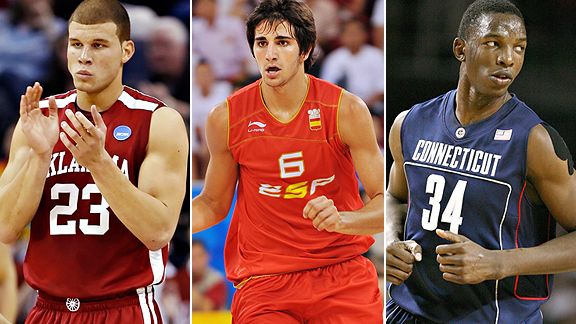
With the NBA Draft Lottery behind us, we now know the exact order of the first 14 picks. The Los Angeles Clippers hit paydirt when they won the right to draft Oklahoma forward Blake Griffin with the first overall pick. The Grizzlies moved up from #6 to #2, and the Thunder moved up one spot to pick #3. The big losers Tuesday night were Sacramento and Washington, who had the best and second-best shot at the top pick, but instead fell to #4 and #5, respectively.

Mock drafts are tough for me because I’m usually thinking about what teams should do instead of trying to predict what they will do. This mock will be more predictive, but if I disagree with a selection, I’ll say so. Over the next few weeks, I’ll update this mock to jive with the latest news from around the league. It’s still very early in the process so things are very fluid. One mock has a player going #11 while another may have him going #29.

I’m just going to make picks for the first fourteen slots on the first go-round and then provide the picks of a few different mocks that I respect for #15-#30, along with a short writeup for each team.

#1 LOS ANGELES CLIPPERS
Even Mike Dunleavy can’t screw this one up. Barring something obscenely out of the blue, Oklahoma’s Blake Griffin will be the first overall pick. The Clippers could use a power forward to replace Elton Brand, and Griffin is the only “sure thing” in this draft. He’s strong, skilled and athletic, and he has an improving offensive game. He has star written all over him.
Pick: Griffin, PF

#2 MEMPHIS GRIZZLIES
The Grizzlies were reportedly one of the few teams more interested in UConn’s 7’3” center Hasheem Thabeet than they were in Blake Griffin. The Grizzlies already have 7’1” Marc Gasol, so Thabeet wouldn’t fill a need like Jordan Hill, Ricky Rubio or Brandon Jennings would (assuming the team isn’t sold on Hakim Warrick or Mike Conley), but Thabeet has the potential to become a dominant defensive center along the lines of Dikembe Mutombo. But will he be willing to put the work in to become an effective post player?
Pick: Thabeet, C

Continue reading »

The Conference Finals: The four trades that got us here

We’re down to four teams…Cavs/Magic…Lakers/Nuggets…

What do they have in common? Star power, efficient offense, pretty solid defense, good coaching…check, check, check and check.

But how about an aggressive front office?

Each of these four teams made a major trade in the last two years.

July 11, 2007: The Magic sign Rashard Lewis
This was a sign-and-trade, not a straight free agent signing, but the Magic only had to give up a conditional second round pick. The upside for the then-Seattle Supersonics was a trade exception worth $9 million. The contract (six years, $110 million) seemed outlandish at the time, and Lewis is still overpaid, but the Magic did what they had to do to get him. He’s a great fit for what Orlando is trying to do. They are built like the Rockets were in the Hakeem Olajuwon era — find a big man who commands a double-team, and surround him with great shooters. Lewis is the Magic’s version of Robert Horry in that he’s a lanky, versatile, sharpshooting big man. Strength-wise, he’s not built like a typical power forward, but since the NBA has gotten smaller and quicker over the past few years, he can get by against most teams. Offensively, he creates all sorts of problems for opposing power forwards as he can drill the long ball (career 39% from 3PT) or take it to the rack. He’s also pretty good in the post when teams try to defend him with a smaller player.

Sure, the Magic overpaid on that contract, but I think it’s safe to say that if they hadn’t, they wouldn’t be in the Eastern Conference Finals right now. Lewis is a big, big part of Orlando’s recent success. GM Otis Smith deserves a lot of credit for having the cojones to pull the trigger on this deal.

Continue reading »

Which NBA teams will have cap space this summer?

The NBA free agency period starts July 1st, and as that date approaches I’ll preview this year’s free agent class in more detail. But for now, I’d like to take a look at which teams have the cap flexibility to be major players in free agency this summer. (Mind you, just because a team has cap space, it doesn’t necessarily mean that they’ll use it. Just sayin’.)

Not familiar with the NBA salary cap? Here’s a quick primer…

1. The cap for the 2008-09 season was $58.7 million. The general consensus is that the cap will stay flat or decrease slightly. We’ll assume it sticks at $58.7 million.

2. If a team is over the cap, the only free agents they can sign are their own, unless they elect to sign a player to the mid-level exception (~$5.8 million per season), the bi-annual exception (~$2.0) or to a minimum contract. (The bi-annual exception may not be used in two consecutive years.)

3. If a team is under the cap, they can sign any free agent they want as long as they do not exceed the cap. They can also take on salary via trade up to the cap, so a team like the Grizzlies (with almost $20 million in cap space) could conceivably trade their first round pick to the Suns for Amare Stoudemire or to the Raptors for Chris Bosh.

Here’s a list of the bigger names in the free agent pool this summer:

Unrestricted: Carlos Boozer, Ben Gordon, Ron Artest, Lamar Odom, Andre Miller, Shawn Marion, Jason Kidd, Hedo Turkoglu, Allen Iverson, Mehmet Okur, Rasheed Wallace, Mike Bibby, Anderson Varejao, Grant Hill, Kyle Korver, Trevor Ariza, Brandon Bass, Chris Andersen, Zaza Pachulia, Chris Wilcox and Drew Gooden

Restricted: David Lee, Paul Millsap, Ray Felton, Josh Childress*, Marvin Williams, Glen Davis, Ramon Sessions, Charlie Villanueva, Nate Robinson, Leon Powe, Hakim Warrick, Linas Kleiza, Jarrett Jack and Shannon Brown

* It appears that if Childress does return to the NBA, the Hawks still hold his rights, so he would be a restricted free agent.

There are eight teams that project to have more than $5.8 million (the value of the mid-level exception) in cap space this summer:

Memphis Grizzlies
Projected Cap Space: $19.7 million
Memphis has been reluctant to spend for several years now and is probably one of the franchises that’s struggling the most in the current economy. I lived in Memphis for three years, and given its small size and overall lack of wealth, I always thought that it would struggle to support a professional sports team. With a core of Rudy Gay, O.J. Mayo and Marc Gasol, the Grizzlies have to feel pretty good about what they have at off guard, small forward and center. The big decision this summer is what to do with restricted free agent Hakim Warrick. When dealing with bad teams, numbers can be deceptive, because no matter what, somebody has to score and rebound, right? Warrick’s PER (16.91) is #24 amongst power forwards, so ideally he’d be coming off the bench for a playoff team. The Grizzlies projected cap space assumes they make the qualifying offer to Warrick ($3.0 million). Memphis is one of those teams that could really use the services of a Carlos Boozer, David Lee or Paul Millsap, but in this economy, are the Grizzlies willing to make that kind of a commitment? They could try to make a run at Chris Bosh or Amare Stoudemire next summer, but the odds are long that either guy would want to play for the Grizzlies.

Continue reading »
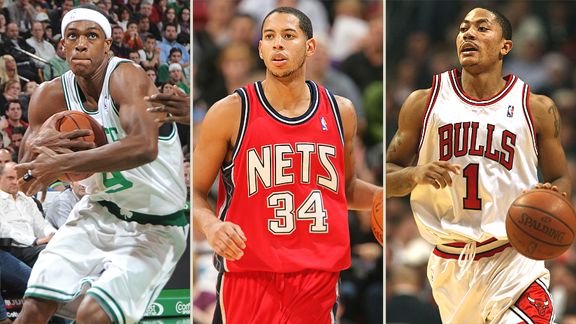
What kind of point guard is he?

We hear it all the time. NBA analysts call one point guard “pass-first” and another “shoot-first.” Or they say one guy is “turnover-prone” while another “takes care of the ball.” But really, what makes a player a “pass-first” point guard? How carefree must he be with the ball to be considered “turnover-prone”?

Taking an analytical approach to these questions, I decided to bust out an Excel spreadsheet and try to come up with some answers. Below you’ll see a graph that attempts to classify the top point guards in the league. But first, a little background…

I chose to categorize each player based on two stats. First, to determine if he’s “shoot-first” or “pass-first,” I calculated the shot-to-assist ratio for each player. The bigger the number, the more of a “shoot-first” mentality the player has. Second, to determine whether or not a player is “turnover-prone,” I calculated each player’s assist-to-turnover ratio. I thought about using turnovers per 48 minutes, but I like the idea of including assists so that playmakers are rewarded for the positive as well as the negative. Next, I calculated each player’s Efficiency Per Minute (EPM) to see if there is any correlation between these other statistics and the overall efficiency of the player in question.

Continue reading »

« Older posts Newer posts »