Tag: Linas Kleiza (Page 1 of 2)

Kleiza headed to Greece

Olympiakos has plucked another young NBA player in his prime. Denver’s Linas Kleiza is headed to Greece.

Per Yahoo Sports…

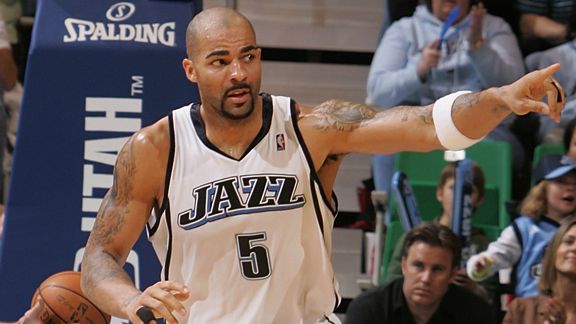
Denver Nuggets restricted free-agent forward Linas Kleiza(notes) has agreed to a two-year, $12.2 million contract with Greek team Olympiakos, his agent Bill Duffy told Yahoo! Sports on Monday.

The contract has an opt-out clause, which allows Kleiza to again become a restricted free agent next summer.

Duffy said that while Kleiza attracted interest from other NBA teams, his client’s restricted free-agency status limited his options.

I’ve said it before and I’ll say it again — the NBA needs to do away with restricted free agency. Most RFAs are left in limbo for a year, and instead of playing the season for peanuts, guys like Josh Childress and Linas Kleiza are bolting for Europe. If they were unrestricted, they would have probably stayed in the NBA.

The top 10 first round steals of the last 10 years

Everyone loves to focus on the lottery, but there are good players to be had in the late first round as well. A while back, I put together a list of the top second round picks of the modern era, so now I’m going to focus on those players that were drafted between pick #21 and pick #30 in the first round. (Note: If a player was drafted in the second round, even if they were taken with the #29 or #30 pick overall, they are ineligible to make the list. Sorry, Gilbert.) Since there are more star-quality players available in the 20’s, I’m limiting this list to the last ten drafts (i.e. 1999 through 2008).

It is sometimes tough to rank older players with newer players, but even if a younger player holds more trade value right now, I am going to take into account each player’s entire career. For the young guys, I have to project a little bit, so keep that in mind as you read and react. I feel great about the top eight guys, but there are a few players that missed the list that are pretty interchangeable with #9 and #10.

On with the list…

10. Aaron Brooks, Rockets
26th pick in 2007
I had to decide between Brooks and Nate Robinson here and went with Brooks given his fine performance in the playoffs this season (16.8 ppg, 3.4 apg, 42% from 3PT) and how Robinson’s numbers are a little inflated playing for Mike D’Antoni. Brooks is not a natural point guard, but his sharpshooting is a good fit given Houston’s inside-out attack. He’s small, but he’s quick and is able to score at the rim when given some daylight. The Rockets feel good enough about Brooks to trade Rafer Alston away midseason, so you have to like his upside.

9. Kendrick Perkins, Celtics
27th pick in 2003 (drafted by the Grizzlies)
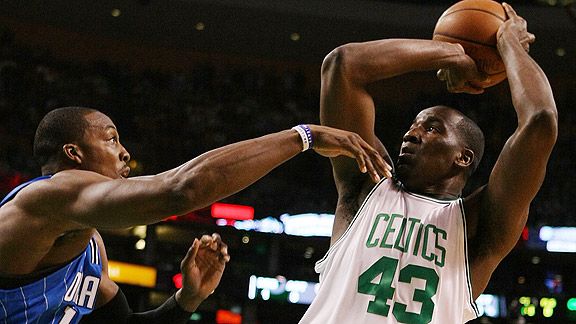
In the world of “big” guys, I also considered Boris Diaw here, but it’s tough to pass on a 6’10” 24-year-old who averaged 8.5 points, 8.1 rebounds and 2.0 blocks per game on a team loaded with vets. Without Kevin Garnett in the playoffs, the C’s needed Perkins to step up his game and he responded with 11.9 points, 11.6 boards and 2.6 blocks per contest. He also did a pretty good job on Dwight Howard, who had his worst numbers of the playoffs against the Celtics.

8. David Lee, Knicks
30th pick in 2005
Isiah Thomas couldn’t make a good trade to save his life, but he could spot talent in the draft. Lee has turned out to be a steal with the last pick in the 2005 draft. He’s an athletic lefty whose best traits are his hustle and smarts. In just his fourth season, Lee averaged 16.0 points and 11.7 rebounds per game, which made him one of the most consistent double-double guys in the league. His stock is so high right now that the Knicks might be able to use him as trade bait in order to land Chris Bosh or Amare Stoudemire. Maybe they’d be better off sticking with Lee…

Continue reading »

Resilient Nuggets take Game 2, 106-103

After their tough, emotional loss in Game 1, conventional wisdom said that the Nuggets would be reeling and wouldn’t be able to put up much of a fight in Game 2. But these aren’t your father’s Nuggets. With the addition of Chauncey Billups and Carmelo Anthony’s transformation after playing in Beijing with Team USA, these Nuggets are tough-minded.

It took a while for Denver to get going. The Lakers came out like gangbusters and had a 13-point lead with 2:40 to play in the second quarter. But the Nuggets went on a 14-2 run over the last 160 seconds to narrow the lead to one at halftime.

The Lakers built a seven-point lead in the middle of the third quarter, but once again, the Nuggets responded and cut the lead to one at the end of the period. In the fourth quarter, it was the Nuggets turn to build a seven-point lead with 9:06 to play. At this point, I was a little perplexed by George Karl’s decision to go with J.R. Smith (1-6, 3 points) instead of Linas Kleiza (5-8, 16 points, 8 rebounds) down the stretch. Smith didn’t play horribly in the final minutes, but he didn’t do anything positive either. The Lakers fought back, and with 1:00 to play and the Nuggets up two, Smith turned the ball over (his third of the night). Karl obviously knows his team far better than I do, but Kleiza simply played much, much better tonight and probably should have been in the game.

There were a couple of missed calls down the stretch. Kobe traveled before he made his three to tie the game at 99-99 and during a jumpball with 0:18 to play, the refs missed Smith slicing through the circle before the ball was touched. That should have been Laker ball out of bounds, but since the refs missed Kobe’s travel, things evened out.

Chauncey Billups made 5 of 6 free throws down the stretch to seal the 106-103 win. Derek Fisher had a shot from the corner to tie the game at the buzzer but he missed the rim.

Carmelo Anthony had another great game, posting 34 points, nine rebounds (five offensive) and four assists. Chauncey Billups had 27 points, while Kleiza and Kenyon Martin chipped in with 16 apiece. Kobe led the Lakers with 32 points, while Trevor Ariza added 20 points (on 6 of 7 shooting) and four steals. Pau Gasol added 17 points and 17 rebounds.

I know that Phil Jackson and Kobe Bryant have a long history with Derek Fisher, but he went just 1 of 9 from the field tonight, and is shooting under 30% in the last two playoff series. It might be time to give Jordan Farmar a few more minutes.

Which NBA teams will have cap space this summer?

The NBA free agency period starts July 1st, and as that date approaches I’ll preview this year’s free agent class in more detail. But for now, I’d like to take a look at which teams have the cap flexibility to be major players in free agency this summer. (Mind you, just because a team has cap space, it doesn’t necessarily mean that they’ll use it. Just sayin’.)

Not familiar with the NBA salary cap? Here’s a quick primer…

1. The cap for the 2008-09 season was $58.7 million. The general consensus is that the cap will stay flat or decrease slightly. We’ll assume it sticks at $58.7 million.

2. If a team is over the cap, the only free agents they can sign are their own, unless they elect to sign a player to the mid-level exception (~$5.8 million per season), the bi-annual exception (~$2.0) or to a minimum contract. (The bi-annual exception may not be used in two consecutive years.)

3. If a team is under the cap, they can sign any free agent they want as long as they do not exceed the cap. They can also take on salary via trade up to the cap, so a team like the Grizzlies (with almost $20 million in cap space) could conceivably trade their first round pick to the Suns for Amare Stoudemire or to the Raptors for Chris Bosh.

Here’s a list of the bigger names in the free agent pool this summer:

Unrestricted: Carlos Boozer, Ben Gordon, Ron Artest, Lamar Odom, Andre Miller, Shawn Marion, Jason Kidd, Hedo Turkoglu, Allen Iverson, Mehmet Okur, Rasheed Wallace, Mike Bibby, Anderson Varejao, Grant Hill, Kyle Korver, Trevor Ariza, Brandon Bass, Chris Andersen, Zaza Pachulia, Chris Wilcox and Drew Gooden

Restricted: David Lee, Paul Millsap, Ray Felton, Josh Childress*, Marvin Williams, Glen Davis, Ramon Sessions, Charlie Villanueva, Nate Robinson, Leon Powe, Hakim Warrick, Linas Kleiza, Jarrett Jack and Shannon Brown

* It appears that if Childress does return to the NBA, the Hawks still hold his rights, so he would be a restricted free agent.

There are eight teams that project to have more than $5.8 million (the value of the mid-level exception) in cap space this summer:

Memphis Grizzlies
Projected Cap Space: $19.7 million
Memphis has been reluctant to spend for several years now and is probably one of the franchises that’s struggling the most in the current economy. I lived in Memphis for three years, and given its small size and overall lack of wealth, I always thought that it would struggle to support a professional sports team. With a core of Rudy Gay, O.J. Mayo and Marc Gasol, the Grizzlies have to feel pretty good about what they have at off guard, small forward and center. The big decision this summer is what to do with restricted free agent Hakim Warrick. When dealing with bad teams, numbers can be deceptive, because no matter what, somebody has to score and rebound, right? Warrick’s PER (16.91) is #24 amongst power forwards, so ideally he’d be coming off the bench for a playoff team. The Grizzlies projected cap space assumes they make the qualifying offer to Warrick ($3.0 million). Memphis is one of those teams that could really use the services of a Carlos Boozer, David Lee or Paul Millsap, but in this economy, are the Grizzlies willing to make that kind of a commitment? They could try to make a run at Chris Bosh or Amare Stoudemire next summer, but the odds are long that either guy would want to play for the Grizzlies.

Continue reading »

A look ahead at the free agent class of 2009

With the trade deadline in the rear view mirror and players tied to their current teams at least until the summer, it’s a good time to take a look ahead at the free agent class of 2009. Given the state of the economy and how so many teams are saving up for the class of 2010, some are suggesting that this summer’s free agency could be a “nuclear winter” of sorts, no pun intended. The salary cap and luxury tax thresholds are likely to decline for the first time in years and that has GMs and owners around the league scrambling to cut salary where they can.

There are three types of free agents: players with early termination options (ETO) or player options (PO), restricted free agents and unrestricted free agents.

Players with ETOs or POs

This group includes Kobe Bryant, Jermaine O’Neal, Al Harrington, Jamal Crawford and Mehmet Okur, but it’s highly unlikely that any of these guys will hit the open market given the kind of money they’ll be making by extending their respective contracts. Of this group, Hedo Turkoglu, Anderson Varejao and maybe Carlos Boozer are the only big names that are likely to hit free agency. Boozer has already stated that he’s going to opt out, but he may decide against it if he doesn’t come back strong from his injuries. Turkoglu — the reigning Most Improved Player — is having another nice season, but he’s not playing quite as well as last year. Still, he can command more than the $7.3 million he’s due to make next season. Varejao could stay with the Cavs and make $6.2 million next season, but he and his agent (Dan Fegan) have been looking for more. Varejao wants a long term deal but it seems he and the Cavs disagree on how much he’s actually worth.

For the most part, guys in this group are going to be conservative and play out their contracts.
Restricted Free Agents

RFAs hardly ever change uniforms, but in this economic climate there are teams that are unlikely to match substantial offers for their restricted free agents. The other issue is that once a team signs a RFA to an offer sheet, the player’s team has a full week to match the offer. Most teams know instantly whether or not they’re going to match, but they take the full week so that the other team can’t make any other offers because its money is tied up in the offer sheet. The NBA should reduce this period to three or four days so that teams are more willing to make offers to RFAs. Or better yet, it should eliminate restricted free agency completely to avoid Josh Childress-type cases in the future.

(Stepping down from my soapbox…)

Anyway, the list of restricted free agents includes Childress, David Lee, Paul Millsap, Nate Robinson, Charlie Villanueva, Ramon Sessions (ESPN says he’s restricted though HoopsHype and ShamSports show Sessions as an UFA), Marvin Williams, Raymond Felton, Leon Powe and Linas Kleiza.

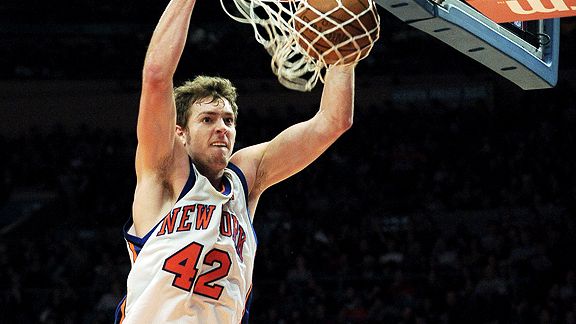
The Knicks can’t afford to keep both Lee and Robinson and sign LeBron or some other max-type free agent next summer, so if someone comes along and offers either player a substantial contract, it is unlikely that the Knicks will be able to match. Millsap played great in Boozer’s absence, and they are very similar players so it is unlikely that Utah can afford to keep both. Millsap looks like a potential All-Star and would be a cheaper option, but only time will tell if the Jazz have the balls to let Boozer walk.

Childress will probably return to the U.S. after a year playing in Greece. I suspect he’ll be a mid-level type guy, which increases the number of potential suitors as teams that are over the cap can still sign a player at the mid-level. The Bucks are in financial trouble and they need to get rid of Michael Redd or Richard Jefferson if they hope to keep both Sessions and Villanueva. Both players are having career years under Scott Skiles, but it’s unclear if the Bucks will be able to keep them. I’d expect Sessions to be a mid-level guy (and should be a solid starter for that price), while Charlie V might command a bit more. There are still questions about his heart, but if he’s thriving under Skiles, could he really be lacking toughness and drive? The Bucks have been hit by injuries to Redd and Andrew Bogut but are still holding onto the #8 playoff spot in the East, so they’d be wise to keep this core together if they can.

The Bobcats’ decision to draft D.J. Augustin made Raymond Felton expendable, so he could probably be had for the right price. I’m guessing that he’s a mid-level guy as well, though he and his agent will probably want more. Leon Powe and Linas Kleiza are both productive bench players and if the offer sheet is big enough, the Celtics and Nuggets (respectively) may decide not to match.
Unrestricted Free Agents

This group includes Ben Gordon, Lamar Odom, Shawn Marion, Allen Iverson, Ron Artest, Mike Bibby, Andre Miller, Jason Kidd, Rasheed Wallace, Trevor Ariza and Brandon Bass. Most of these players are older and on the decline, but they can still play. Veteran players in this group might be shocked by the kind of pay cut that they’re going to have to take in today’s climate. The days of 30+ year-old stars (not superstars) signing max or near-max deals are over, at least for a while. I bet all of these guys sign for less than $10 million per season. (I know…that’s peanuts, right?)

Gordon, Ariza and Bass are younger and could still be on the rise if they find the right team. Gordon seems to think he’s a starter and should be paid as such, but he’s small and doesn’t have a reputation for being a very good defender. He can really score though. If some team wants to pay him starter’s money, he’d be a good match to play alongside a bigger point guard who could cover the opponent’s off guard (Utah, Denver, Detroit?) or he needs to go to a team that doesn’t emphasize the defensive end.

Ariza continues to play well for the Lakers, but since he’s a much cheaper option than Odom, he’s probably going to be staying put. Bass had a terrific season two years ago, and is really coming on after a slow start this season. He’s just 23 and has some upside. I’d expect some team will sign him to a deal averaging in the $3-$4 million range, which would make him one of the best bargains of the summer.

So where will these players end up? Your guess is as good as mine. There are only a handful of teams — Atlanta, Detroit, Memphis (of course), Minnesota, Oklahoma City, Portland, Sacramento and Toronto — with the cap space (~$7 million or more) to sign a good player for another team, so I think there may be quite a few starter-level players/borderline stars signing mid-level deals this season. Playoff contenders that are over the cap won’t be able to pass up a good player for $5 million per season and there should be a number of guys that fit the bill this summer.

« Older posts