Category: Television (Page 16 of 73)

Couch Potato Alert: 3/27

There is less than three weeks left in the NBA season, and teams are fighting to secure home-court advantage for the gauntlet playoff run. And both conferences have highly contested races for the #2 seed. The Boston Celtics and the Orlando Magic are in a virtual tie in the Eastern Conference, while three teams (San Antonio, Houston and Denver) are battling it out in the Western Conference. At stake is the opportunity to play a seventh game in front your raucous fans, and this prize is well worth the grind of the regular season.

All times ET…

NBA
Friday, 7:30 PM: Boston Celtics @ Atlanta Hawks (NBA TV)
Saturday, 10 PM: Memphis Grizzlies @ Portland Trail Blazers (NBA TV)
Sunday, 1 PM: Dallas Mavericks @ Cleveland Cavaliers (ABC)
Sunday, 8 PM: San Antonio Spurs @ New Orleans Hornets (ESPN)

NHL
Saturday, 1 PM: New York Rangers @ Pittsburgh Penguins
Saturday, 7 PM: Boston Bruins @ Toronto Maple Leafs (CBC)
Saturday, 10 PM: Minnesota Wild @ Calgary Flames (CBC)

NCAA Tournament

Friday, 7:07 PM: (12) Arizona vs. (1) Louisville (CBS)
Friday, 7:27 PM: (3) Syracuse vs. (2) Oklahoma (CBS)
Friday, 9:37 PM: (3) Kansas vs. (2) Michigan State (CBS)
Friday, 9:57 PM: (4) Gonzaga vs. (1) North Carolina (CBS)
Saturday, 4:40 PM: (3) Missouri vs. (1) Connecticut (CBS)
Saturday, 7:05 PM: (3) Villanova vs. (1) Pittsburgh (CBS)
Sunday, TBA: Midwest and West Finals (CBS)

PGA
March 27-29, see your local listings for times: Arnold Palmer Invitational, Orlando, FL. (NBC/TGC)

World Baseball Classic needs format changes to become a global event


Entrepreneurs have said that timing is a key ingredient for making a good idea into a successful business venture. Major League Baseball has failed to read its own marketplace in regards to the World Baseball Classic. It is just bad timing to play this tournament at the beginning of spring training.

Commissioner Bud Selig has said that March is the only realistic time of the year to play the WBC. I disagree with him. This tournament needs to be moved to the middle of the summer if the WBC is going to become baseball’s premier global event. If not, then do not expect crisp, memorable games from athletes not yet in game shape.

The United States’ three-run come-from-behind victory over Puerto Rico last Tuesday night should have been the top story the next morning. Instead, the outcome was scrolled underneath a highlight package of a NIT opening round game or copy filler in your local newspaper.

Why?

Well, sport fans are not watching or paying attention to the WBC. No, they’re preoccupied with the NCAA tournament that has firmly established itself as a the major sporting event for this time of the year.

Fans cannot get excited about the WBC if the best players in baseball are not playing in the event. And the ones that are playing, many of them are not ready to compete at a world-class level. Where’s Tim Lincecum or Roy Halladay? They should be anchoring the United States pitching staff in this competition. Team USA should not be relying on the arms of Jeremy Guthrie or Ted Lilly in an elimination game.

Do you think the Netherlands would have defeated the Dominican Republic twice in a competition if they were playing at mid-season? And wouldn’t it be great to see Johan Santana of Venezuela trading strikes with Japan’s Dice-K for all the world to watch. This could happen if the WBC is played every two years in place of the All-Star Game in July. How about a single elimination format, with the finals to be played on Sunday evening in front of a prime time audience? No other sporting event would be competing with baseball for the almighty TV ratings.

Baseball owners might not have any interest in giving up a week’s worth of revenue during the high point of their year, and the idea of scrapping the All-Star game every two years might be enough to give the baseball purist a heart attack, but some playoff contenders might welcome a week off to catch their breath for the second half of the baseball season.

Changes need to take place to make the WBC a world event. Right now, this tournament is nothing more than glorified spring training contest.

Couch Potato Alert: 3/20

Welcome to the longest-running game show on television today, How’s Your Bracket. I heard that there’s going to be college basketball and more college basketball on television this weekend. March Madness is upon us, and the first two rounds of the NCAA tournament really brings out school pride in alumnus all across the country. Today, you can wear your Stephen F. Austin or North Dakota State t-shirt proudly.

All times ET…

NBA
Friday, 8:30 PM: Boston Celtics @ San Antonio Spurs (NBA TV)
Saturday, 8 PM: Boston Celtics @ Memphis Grizzlies (NBA TV)
Sunday, 1 PM: Miami Heat @ Detroit Pistons (ABC)
Sunday, 6 PM: Cleveland Cavaliers @ New Jersey Nets (NBA TV)

NHL
Saturday, 9 PM: Vancouver Canucks @ Phoenix Coyotes (CBC)
Sunday, 12:30 PM: Philadelphia Flyers@ Pittsburgh Penguins (NBC)

NCAA Tournament
Friday, 12 PM-12:30 AM: First round action from various sites (CBS)
Saturday, 1 PM-10:30 PM: Second round action from various sites (CBS)
Sunday, 12 PM-7 PM: Second round action from various sites (CBS)

World Baseball Classic
Saturday, 9 PM: Semifinal: Korea vs. Venezuela from Dodger Stadium (ESPN)
Sunday, 8 PM: Semifinal: Japan vs. United States from Dodger Stadium (ESPN)

Filling out your bracket? I’m here to help. (Updated 3/18)

3/18 Update: I’ve modified a few picks with the news that Ty Lawson may not be able to go tomorrow because of the injury to his toe. This news casts serious doubt about just how healthy he can get over the next three weeks, and I no longer see North Carolina as a Final Four team. I have modified my picks so that North Carolina loses to Gonzaga in the Sweet Sixteen. I project the Bulldogs to go on and beat Syracuse in the Elite Eight, which means that Gonzaga is now one of my Final Four teams. (I know, I can’t believe it either.)

This column is dedicated to the millions of Americans that will be filling out their March Madness brackets over the next few days.

You might be thinking — why should I bother listening to this joker?

Well, this is the third time that I’ve written this column and in the previous two seasons (2007, 2008), I successfully picked the winner both times.*

* Past performance is no guarantee of future results.

I’m still tweaking my method, but the crux of it is simple: Start with Jeff Sagarin’s computer rankings and go from there. Over the past two seasons, teams that had a 2+ point advantage in Sagarin’s “Predictor” category went a combined 82-15 (85%). That’s a good place to start. Even when the teams are closely seeded (within 1-3 seeds), Sagarin’s ratings are solid. Last year, in games that were closely seeded, teams with a 2+ point Sagarin advantage went 14-2 (88%). In 2007, they went 8-4 (67%). So over the last two seasons, that’s a combined 22-6 (79%). Not bad.

LOCATION

Last year, there were five games where tight (< 2 point) Sagarin matchups were won by teams with a distinct location advantage. Davidson beat Gonzaga in Raleigh, Mississipi State beat Oregon in Little Rock, Kansas State beat USC in Omaha, Stanford beat Marquette in Anaheim and Texas beat Stanford in Houston. In fact, there weren’t any tight matchups that were won by the team that was at a distinct geographical disadvantage. This year, I am going to make this my first tiebraker for tight Sagarin matchups.

SEED DIFFERENTIAL

Seed differential is also a consideration, as teams with a four- to nine-seed advantage win at about a 75% clip. The data for the previous 16 seasons was compiled by BostonSportsHub, but since they are no longer updating their site, I added the seed records for the 2008 tournament. Here is a summary of the 17 years worth of data.
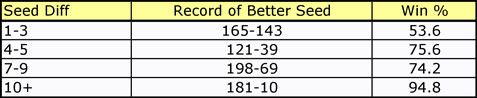
So if Sagarin calculates that the teams are within two points, and there are no geographical considerations, then the next thing I look at is seed. If the differential is four or more, I am going with the better-seeded team barring some overriding factor. In 2008, this methodology was 2-1, winning the Oklahoma/St. Joseph and Purdue/Baylor matchups, while losing the USC/Kansas St. matchup. (Interestingly, all three winners had a slight advantage according to Sagarin, even #11-seed KSU.) Had I gone with KSU’s location advantage, this part of the system would have gone 2-0.

POMEROY RATINGS

Last season, I used Points Per Shot (PPS) to pick seven games and went 3-4. I still believe that PPS is a vital stat, but it doesn’t take into account turnovers, which is key when trying to determine just how good a team is. Ken Pomeroy has offensive and defensive efficiency stats that take into account pace and strength of schedule, and those are compiled to calculate his Pythagorean Winning Percentage.

Here’s how the last few winners were ranked at the end of the tournament in this statistic: Kansas (1), Florida (2), Florida (1), North Carolina (1) and Connecticut (2). Clearly, when picking the overall winner, we don’t want to stray too far from this ranking.

Let’s take a look at the Final Four participants for the last five years and see how they finished, keeping in mind that their final ranking does take into account how they performed during the tournament.

2008: Kansas (1), Memphis (2), UCLA (3), North Carolina (4)
2007: Florida (2), Ohio St. (4), Georgetown (5), UCLA (6)
2006: Florida (1), UCLA (3), LSU (10), George Mason (23)
2005: North Carolina (1), Illinois (2), Louisville (5), Michigan State (7)
2004: UConn (2), Georgia Tech (7), Duke (1), Oklahoma St. (3)

So, excluding the outlier (George Mason), the average Pythagorean ranking for Final Four teams over the last five years has been 3.6. I wish the site showed the pre-tourney rankings, because it would be helpful to know where these teams were ranked when they started the tournament. Since all we have to go by is where they stand now, it would seem unwise to pick a team outside of the top 10 to reach the Final Four.

I used the Pythagorean method back in 2007, and through the second round of the tournament, it had picked 37 of 48 winners. I stopped using it at that point, and I’m not sure why. This year, I’ll keep track of its accuracy throughout the end of the tourney, though I think it’s important to use the static, pre-tourney rankings because that’s all we have to go by when we fill out our bracket.

We’ll see how much I use this statistic as we dig into the bracket.

So, without further ado…

Continue reading »

« Older posts Newer posts »