Tag: Detroit Pistons (Page 5 of 11)

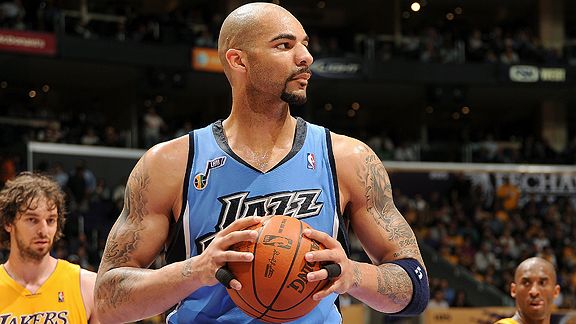
Boozer may stay with the Jazz for another season

For a time, it seemed like it was inevitable that Carlos Boozer would opt out (or not opt in, in this case) and hit the open market as an unrestricted free agent. But the economic climate has changed and the market for his services does not appear to be as strong as it was once thought to be. Boozer might very well play another year in Utah.

Boozer has until 5 p.m. on Tuesday to decide whether to exercise a player option on his contract with the Utah Jazz. The contract is set to pay Boozer $12.7 million next season if he opts in. Could he make more than that on the open market?

For months it was assumed that Boozer would land in Detroit. But last week Pistons sources told ESPN.com that Boozer wasn’t the team’s highest priority and that if they pursued him, they weren’t willing to give him the $13-15 million a year he’s looking for.

The Jazz aren’t in a great position to re-sign him either. Utah has to sign another free agent, Paul Millsap, and possibly a second, Mehmet Okur, if he opts out of his contract. Okur’s agent told The Associated Press on Monday that his client was leaning toward opting out. Those two contracts would put the Jazz near the luxury tax threshold. It’s unlikely they would go over to re-sign Boozer.

“As soon as it looked like the Pistons were the only team with the money and desire to pay him,” one Eastern Conference GM said, “I knew Boozer would be changing his mind. Unless I knew for sure that the Pistons would pay me big bucks, you just can’t make that gamble. I fully expect him to be back with the Jazz next year.”

Earlier this week, I estimated Boozer’s market value at about $12-$13 million per season. I think that if he does opt out, he’d eventually get that kind of a contract because a team willing to spend would work out a sign-and-trade to acquire him. The problem there is that Utah would have to take on near-equal salary for the first year and that would potentially push them over the luxury tax threshold (assuming Mehmet Okur returns and the Jazz sign Paul Millsap to a lucrative deal).

Assuming the Pistons don’t step up with a deal averaging $10-$11 million, Boozer’s absolute worst case is signing a one-year mid-level deal (~$5.8 million), which would cost him about $7 million this season. If he plays another year in Utah, he’ll have the opportunity to prove that he can stay healthy and would join the vaunted free agent class of 2010, where there will be a greater market for his services. Teams are saving up for that summer, so Boozer would be a nice consolation prize for those teams hoping to add Chis Bosh or Amare Stoudemire.

The downside of staying in Utah for another season is the lack of the security. Is it better to sign a five-year deal at a discount (say, $11 million per season) and have a guaranteed $55 million or play another year in Utah and risk a career-ending injury for the prospect of signing for an extra $10-$15 million in 2010? There’s a saying — a bird in the hand is worth two in the bush.

This is the quandary that Boozer is in today. It’s a tough call.

His decision is due in a few hours.

Are the Pistons interested in Boozer?

Not so, at least according to Chad Ford.

Over the past few months, we’ve assumed Carlos Boozer is their primary target, but that might not be the case. A league source told me Tuesday that the Pistons’ free-agent strategy likely would preclude a run at Boozer.

The Pistons want to add several players to the roster and want to keep salaries at or less than $10 million per year. With Boozer likely demanding a deal in the $15 million to $16 million a year range, his contract demands are out of their league. Add in concerns about Boozer’s injury history, and I don’t think the Pistons will make a play for him.

Instead, you can look for them to make a run at Ben Gordon, try to re-sign Antonio McDyess and find one or two other players they can sign for smaller salaries.

That stance in Detroit could put Boozer in a tough position. If he opts out of his contract with the Jazz, he’s going to struggle to find any team far enough under the cap to offer him what he wants. And with the Jazz interested in keeping Paul Millsap, Boozer could be out of luck in Utah, too.

Chad Ford contradicts himself in this piece. He says that the Pistons won’t be willing to pay Boozer’s asking price ($15-$16 million per season), but then says that the market won’t support what Boozer is asking for.

With $23 million in cap space, why can’t the Pistons sign both Boozer and Gordon? I bet Boozer ultimately signs for $12-$13 million per season, while I think Gordon will sign for something in the $8-$9 million range (which may be tough to swallow, since he turned down a contract worth $10 million per season from the Bulls).

Both players are flawed. Boozer is a great power forward, but he’s injury prone. Over the past five years he has only played in 67% of his team’s games. For that reason, he’s not worth a max contract, so I don’t expect him to get one this summer. Gordon is a great scorer, but his shot selection is suspect sometimes and he doesn’t have a reputation for being a good defender. Is he really worth $10-$11 million per season? I don’t think so.

If the Pistons play their cards right, they could sign both players (assuming they want both players) and then move Rip Hamilton to a contender looking for some good outside shooting.

In a smallish move yesterday, the Pistons agreed to trade Amir Johnson to the Bucks for Fabricio Oberto, who has a contract that is only partially guaranteed, potentially freeing up a little more cap space. Still, I don’t understand why the Pistons would give up on the 22 year-old Johnson when they clearly need to bolster their front line. If moving Johnson ultimately results in the signing of Boozer and Gordon, then it will have paid off.

NBA Rumors: Rubio, Boozer, T-Mac and more

Chad Ford writes about why Ricky Rubio is being so selective in his workouts.

First of all, the idea that Rubio is the only one doing it is silly. James Harden has only worked out for four teams. Even the Knicks couldn’t get him in. Hasheem Thabeet will likely only work out for three. DeMar DeRozan has been really selective, and so has Stephen Curry.

It’s pretty simple as to why Rubio is being selective: He is going to have to pay a lot of money for the privilege to play in the NBA next season. His buyout will cost him something between $5 and $7 million of his own money. That’s a lot of money, especially when you consider that Rubio wasn’t making a ton of dough in Spain. He essentially will be signing over his paychecks for the next couple of years to his team in Spain.

The Kings have an obvious hole at point guard on a young team. It seems to be the place his camp wants him to land. If the Kings draft him, I don’t think there’s any question that Rubio would pay the buyout and come. The question is, will the Kings draft him? I think the odds are in Rubio’s favor, but it sounds like some in the organization still need to be convinced.

Rubio’s future might depend on something he has no control over — is Russell Westbrook a point guard? A statistical study I did a few weeks ago revealed that he was turnover-prone and shoot-first, though obviously as a young rookie, there is room for improvement. If the Thunder think he’s a point guard, then I doubt they take Rubio. They’ll take James Harden, who averaged 4.2 assists during his senior year even though he was taking 13 shots per game.

Continue reading »

Which NBA teams will have cap space this summer?

The NBA free agency period starts July 1st, and as that date approaches I’ll preview this year’s free agent class in more detail. But for now, I’d like to take a look at which teams have the cap flexibility to be major players in free agency this summer. (Mind you, just because a team has cap space, it doesn’t necessarily mean that they’ll use it. Just sayin’.)

Not familiar with the NBA salary cap? Here’s a quick primer…

1. The cap for the 2008-09 season was $58.7 million. The general consensus is that the cap will stay flat or decrease slightly. We’ll assume it sticks at $58.7 million.

2. If a team is over the cap, the only free agents they can sign are their own, unless they elect to sign a player to the mid-level exception (~$5.8 million per season), the bi-annual exception (~$2.0) or to a minimum contract. (The bi-annual exception may not be used in two consecutive years.)

3. If a team is under the cap, they can sign any free agent they want as long as they do not exceed the cap. They can also take on salary via trade up to the cap, so a team like the Grizzlies (with almost $20 million in cap space) could conceivably trade their first round pick to the Suns for Amare Stoudemire or to the Raptors for Chris Bosh.

Here’s a list of the bigger names in the free agent pool this summer:

Unrestricted: Carlos Boozer, Ben Gordon, Ron Artest, Lamar Odom, Andre Miller, Shawn Marion, Jason Kidd, Hedo Turkoglu, Allen Iverson, Mehmet Okur, Rasheed Wallace, Mike Bibby, Anderson Varejao, Grant Hill, Kyle Korver, Trevor Ariza, Brandon Bass, Chris Andersen, Zaza Pachulia, Chris Wilcox and Drew Gooden

Restricted: David Lee, Paul Millsap, Ray Felton, Josh Childress*, Marvin Williams, Glen Davis, Ramon Sessions, Charlie Villanueva, Nate Robinson, Leon Powe, Hakim Warrick, Linas Kleiza, Jarrett Jack and Shannon Brown

* It appears that if Childress does return to the NBA, the Hawks still hold his rights, so he would be a restricted free agent.

There are eight teams that project to have more than $5.8 million (the value of the mid-level exception) in cap space this summer:

Memphis Grizzlies
Projected Cap Space: $19.7 million
Memphis has been reluctant to spend for several years now and is probably one of the franchises that’s struggling the most in the current economy. I lived in Memphis for three years, and given its small size and overall lack of wealth, I always thought that it would struggle to support a professional sports team. With a core of Rudy Gay, O.J. Mayo and Marc Gasol, the Grizzlies have to feel pretty good about what they have at off guard, small forward and center. The big decision this summer is what to do with restricted free agent Hakim Warrick. When dealing with bad teams, numbers can be deceptive, because no matter what, somebody has to score and rebound, right? Warrick’s PER (16.91) is #24 amongst power forwards, so ideally he’d be coming off the bench for a playoff team. The Grizzlies projected cap space assumes they make the qualifying offer to Warrick ($3.0 million). Memphis is one of those teams that could really use the services of a Carlos Boozer, David Lee or Paul Millsap, but in this economy, are the Grizzlies willing to make that kind of a commitment? They could try to make a run at Chris Bosh or Amare Stoudemire next summer, but the odds are long that either guy would want to play for the Grizzlies.

Continue reading »

« Older posts Newer posts »