Tag: 2009 NBA free agents (Page 17 of 18)

Cavs’ front line in flux

Ben Wallace is considering retirement, Anderson Varejao is likely to opt out of the final year of his contract, and Zydrunas Ilgauskas will play out the final year of his.

Wallace is guaranteed the money and has every right to come back and accept the checks under terms of the deal. More likely if he couldn’t play, the Cavs would look to perhaps get insurance to cover some of the salary and look to trade him. He’d be a valuable commodity because of the expiring contract and teams looking to dump salaries covet them.

There is also a possibility that Wallace could negotiate a buyout of his deal and take a percentage of what he’s owed. But even in that case it would potentially make him a huge trade asset. A team could trade for him at the value of his contract ($14 million) and then save money by buying him out.

I’m not quite an NBA salary cap expert, but I have a pretty good understanding of the rules. Even so, I’m not sure what the financial impact would be of what Wallace is considering. Without Wallace and Varejao, but with Ilgauskas, the Cavs are on the hook for about $53 million, possibly a bit less since there are a few contracts included that aren’t 100% guaranteed. If Wallace were to come completely off the books, that would put the Cavs about $5 million under the cap, which really doesn’t help them all that much since they can already sign a player at the mid-level for about $5.8 million. Where a team really gains an advantage is when they have substantially more than the mid-level in cap space.

Continue reading »

Boozer headed to Detroit or New Jersey?

That’s the word from Peter Vecsey of the New York Post, anyway.

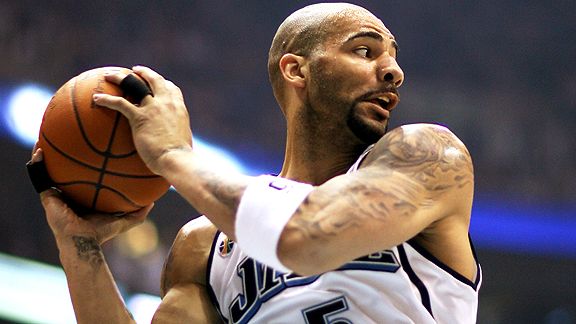
Apparently, rising free agent-of-choice Carlos Boozer is telling confidants he’s either going to Detroit or New Jersey — only way the capsized Nets pull that off is by doing a sign-and-trade.

Utah seems more interested in re-signing Paul Millsap (and justifiably so). It’s not a huge surprise that Boozer is thinking about his next destination, and when he’s healthy, he’s an All-NBA caliber player.

Detroit seems like a good fit. They have a nice set of perimeter players — Tayshaun Prince, Rip Hamilton and Rodney Stuckey — and with Rasheed Wallace likely leaving, they need help up front. They have a ton of cap space, and might elect to use it this summer on Boozer instead of waiting for Chris Bosh or Amare Stoudemire and failing to sign either. Had they found a way to hold onto Chauncey Billups, that would be a formidable foursome, but it was the Billups trade that freed up the cap space to potentially sign Boozer. Depending on how they structured his contract, they could sign Boozer and then re-sign Wallace for another year, which would make them a scary playoff team next postseason.

The Nets are over the cap, but they have Bobby Simmons’ expiring deal (~$11.2 million) that could be used in a sign-and-trade with the Jazz. However, Utah will need some other incentive to take on Simmons; otherwise, they could just let Boozer go if he opts out. The Nets have a few young, mildly interesting prospects — Ryan Anderson, Sean Williams, Josh Boone, Yi Jianlian — but they’d be foolish to give up Brook Lopez for Boozer. Would Simmons plus the #11 pick in the draft be enough to convince Utah to do a sign-and-trade? They’d basically be paying the Nets $11.2 million for the #11 pick — I’m not sure it’s worth it.

Keep in mind that if the Nets find a way to acquire Boozer, it is highly unlikely that they’ll have the cap space to sign LeBron next summer unless they find a way to move Vince Carter before next February’s trade deadline.

What do the Cavs do now?

This is not how it was supposed to go.

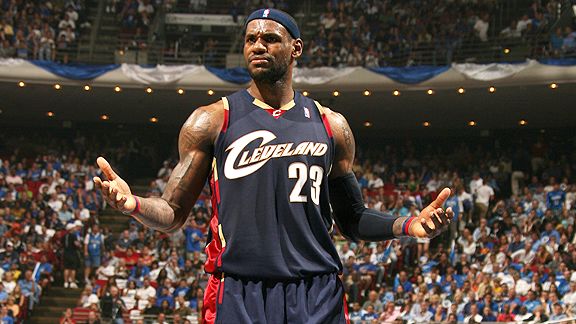
The Cavs were destined to make the Finals and face the Lakers, with LeBron turning in a fantastic Game 7 performance in front of his loyal fans at the Q to bring the city of Cleveland its first championship since 1964. With a title already under his belt, and a few more on the horizon, he would happily re-up for another four or five seasons. Or at the very worst, the Cavs would lose to the more talented Lakers, leaving fans with the feeling that “one more piece” would be all that is needed to finally bring a title to Cleveland. Under that scenario, there would be no way that LeBron could leave, right? Not when the Cavs were thisclose to a title…

Just over a year ago, I wrote that “The Cavs have failed LeBron James,” which was posted about three months before GM Danny Ferry pulled the trigger on the trade that brought Mo Williams to Cleveland. That trade, along with LeBron’s renewed focus and an improved work ethic (which was inspired by his seeing first hand how Kobe prepared during the 2008 Olympics), pushed the Cavs to a league-best 66 wins this season. Williams was named as an alternate to the All-Star Game (after grousing about not being voted in by the coaches) and all was well with the world.

The Cavs received some more good news when Kevin Garnett struggled with injuries down the stretch of the regular season and was eventually shut down for the playoffs. At the time, the Celtics were considered the Cavs’ biggest threat in the East, but KG’s injury might have allowed the Magic, one of four teams that beat the Cavs twice during the year — the Celtics, the Lakers and…um…the Wizards were the other three — to advance to the Conference Finals when they otherwise wouldn’t have survived to face the Cavs. The Magic were a very bad matchup because the Cavs simply didn’t have anyone that could cover Dwight Howard. When they didn’t double-team him, he would make a living on the post, and when they did send another guy, it would free up the Orlando sharpshooters for open jumpers.

Continue reading »

Bucks to exercise “financial discipline”

I’m not sure that this is what I wanted to hear, but Bucks GM John Hammond says he’s going to be careful with the payroll this summer.

The team’s financial discipline will affect the future and, more specifically, restricted free agents Charlie Villanueva and Ramon Sessions, and possibly European player Ersan Ilyasova. It will affect whom the Bucks select in the draft and whether they will be able to sign a free agent this summer, which right now appears highly unlikely.

The upside, though, is that if the Bucks are able to maintain that discipline now, as difficult as it might be, it will afford them the flexibility in a year or two to make some major moves and deal from a position of power rather than with their backs against the wall.

“We need to have discipline moving forward,” said Hammond. “That means that we need to have discipline from the financial side of our decisions. We are a team that is teetering at the (luxury) tax and for us to change our roster and to move the organization in a direction which we feel that we would want to go, we’re going to need some financial flexibility. And in order to get to that position, we have to have discipline here initially.”

In order to maintain the rights to Villanueva, the Bucks will have to present him with a qualifying offer (determined by a formula based on the player’s previous salary and where he was drafted) of $4.5 million. Unless the luxury tax turns out to be higher than anticipated, paying Villanueva that kind of money would take the Bucks into tax territory, which means the Bucks would not make him a qualifying offer. Villanueva would then become an unrestricted free agent and would be able to go to any team with no compensation to the Bucks.

That is where the financial discipline would enter in.

Last season, Villanueva was an asset at the $3.4 million that he was paid. But would he remain an asset at a $4.5 million salary – or even higher, if another team gave him an offer sheet that exceeded that figure – especially if it meant the Bucks would be paying the tax?

The same can be said for Sessions, who was an asset last season at a $712,000 salary. But would he remain an asset if another team offered him a multi-million dollar offer sheet that the Bucks would have to match to keep him?

I have no problem if the Bucks decide to let Villanueva walk. It would be nice to get something in return, but I understand if financial constraints force the team to pass on making him the qualifying offer to retain his rights.

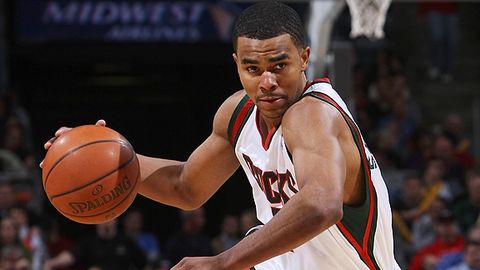
Sessions is another matter. He averaged 12.4 points and 5.7 assists in 27.5 minutes of playing time this season. In 38 games as a starter, he averaged 15.2 points and 7.5 assists in 33.8 minutes of PT. His PER (17.65) is #13 amongst point guards and the fifth-best amongst point guards under the age of 26. His +/- numbers are the best on the team for anyone who played more than 1200 minutes. He has a knack for getting to the rim, which is a skill that has become more and more important since rule changes have reduced the amount of contact defenders can deliver on the perimeter. Since Michael Redd is more of a spot up shooter, Sessions is a good complement.

In short, the Bucks would be nuts to let him go. He’s still flying under the radar, so Milwaukee could probably lock him up for 4-5 years at $3-$4 million per season. If he continues on his current career trajectory, the Bucks could have a top 10 point guard in the next season or two at a very reasonable price.

Which NBA teams will have cap space this summer?

The NBA free agency period starts July 1st, and as that date approaches I’ll preview this year’s free agent class in more detail. But for now, I’d like to take a look at which teams have the cap flexibility to be major players in free agency this summer. (Mind you, just because a team has cap space, it doesn’t necessarily mean that they’ll use it. Just sayin’.)

Not familiar with the NBA salary cap? Here’s a quick primer…

1. The cap for the 2008-09 season was $58.7 million. The general consensus is that the cap will stay flat or decrease slightly. We’ll assume it sticks at $58.7 million.

2. If a team is over the cap, the only free agents they can sign are their own, unless they elect to sign a player to the mid-level exception (~$5.8 million per season), the bi-annual exception (~$2.0) or to a minimum contract. (The bi-annual exception may not be used in two consecutive years.)

3. If a team is under the cap, they can sign any free agent they want as long as they do not exceed the cap. They can also take on salary via trade up to the cap, so a team like the Grizzlies (with almost $20 million in cap space) could conceivably trade their first round pick to the Suns for Amare Stoudemire or to the Raptors for Chris Bosh.

Here’s a list of the bigger names in the free agent pool this summer:

Unrestricted: Carlos Boozer, Ben Gordon, Ron Artest, Lamar Odom, Andre Miller, Shawn Marion, Jason Kidd, Hedo Turkoglu, Allen Iverson, Mehmet Okur, Rasheed Wallace, Mike Bibby, Anderson Varejao, Grant Hill, Kyle Korver, Trevor Ariza, Brandon Bass, Chris Andersen, Zaza Pachulia, Chris Wilcox and Drew Gooden

Restricted: David Lee, Paul Millsap, Ray Felton, Josh Childress*, Marvin Williams, Glen Davis, Ramon Sessions, Charlie Villanueva, Nate Robinson, Leon Powe, Hakim Warrick, Linas Kleiza, Jarrett Jack and Shannon Brown

* It appears that if Childress does return to the NBA, the Hawks still hold his rights, so he would be a restricted free agent.

There are eight teams that project to have more than $5.8 million (the value of the mid-level exception) in cap space this summer:

Memphis Grizzlies
Projected Cap Space: $19.7 million
Memphis has been reluctant to spend for several years now and is probably one of the franchises that’s struggling the most in the current economy. I lived in Memphis for three years, and given its small size and overall lack of wealth, I always thought that it would struggle to support a professional sports team. With a core of Rudy Gay, O.J. Mayo and Marc Gasol, the Grizzlies have to feel pretty good about what they have at off guard, small forward and center. The big decision this summer is what to do with restricted free agent Hakim Warrick. When dealing with bad teams, numbers can be deceptive, because no matter what, somebody has to score and rebound, right? Warrick’s PER (16.91) is #24 amongst power forwards, so ideally he’d be coming off the bench for a playoff team. The Grizzlies projected cap space assumes they make the qualifying offer to Warrick ($3.0 million). Memphis is one of those teams that could really use the services of a Carlos Boozer, David Lee or Paul Millsap, but in this economy, are the Grizzlies willing to make that kind of a commitment? They could try to make a run at Chris Bosh or Amare Stoudemire next summer, but the odds are long that either guy would want to play for the Grizzlies.

Continue reading »
« Older posts Newer posts »