Category: Bullz-Eye Sports Channel (Page 15 of 38)

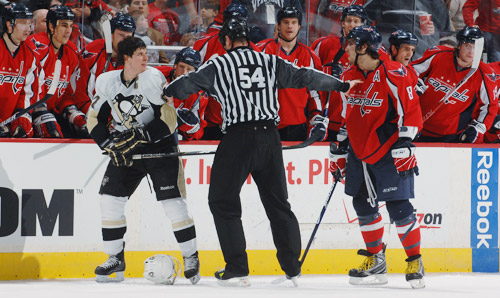
Ovechkin and Crosby begin playoff duel, two teams also play hockey

http://assets.espn.go.com/photo/2009/0224/nhl_g_ovechkin-crosby01_500x.jpg

The NHL is banking a lot on the appeal of the series that started yesterday with a 3-2 win for the Washington Capitals over the Pittsburgh Penguins. The reason, of course, is the presence on the ice of the league’s two current marquee players: Alexander Ovechkin and Sidney Crosby.

– Brian Anders over at THE LOVE OF SPORTS has an opinion a bit less excited than I think the NHL hoped to elicit:

Look at the major sports. With the exception of the NBA, which has an infinitesimal roster, dream matchups involve teams typically in big markets. The NBA thrives on LeBron v. Kobe, because with only five on the floor and seven on the bench, the superstars will go mano-a-mano for the majority of the game.

With 1:30 to 2:00 shifts and four forward lines, star hockey players go toe-to-toe a lot less often in the course of an NHL game. In fact, over the course of a seven-game series, the stars will actually face off less than the stars do in just one NBA game.

Well, I’d say that mathematically speaking, it’s true that face-to-face play time is greater in the NBA than a lot of other sports. But that’s certainly not true for individual sports like tennis or boxing, is it? There’s no way we can compare them to the NHL or NBA, they aren’t even team sports. It’s the nature of the beast that team sports don’t have common individual match-ups.

And that statement right there is also why I’m not entirely comfortable with the comparison Mr. Anders makes. I can’t say it’s wrong, but I won’t say it’s right either. Sure, I gotta admit that some of my favorite basketball games have been duels between opposing players, Jordan vs. Magic or even Jordan/Pippen on Malone/Stockton (guess where my loyalties lie yet?) come to mind quite readily, but even those match-ups were won based on the performances of players in general, not entirely on their crushing of each other.

The NFL’s most popular players, to draw on a new example, are by and large the quarterbacks. So it’s basically impossible for them to ever truly play facemask to facemask. We judge them on their individual stats and their ability to help their team win. Works pretty well for the NFL.

I don’t see that hockey should be particularly different. As a team sport, its raison d’etre is pitting one team against another. I’m excited to see how this series continues because I won’t to know who’s going to help their team out more. Furthermore, the sport does allow for frequent individual acts of brilliance. Just because Ovechkin and Crosby might not both be on the ice at once all the time does nothing to detract from the incredible plays they are capable of making whenever they play.

They both scored a goal in Game 1. Let’s hope that tally only increases over the course of the series. It’s a shame I can’t watch the game without some serious cable TV, but that’s another post by itself…

Top 10 Active MLB Triples Leaders

To hit home runs and doubles usually requires power, but to hit triples requires a bit of power and a lot of speed. Or sometimes, luck, such as when an outfielder misjudges a ball and lets an otherwise slow runner reach third. But the leaders in MLB in this category are seasoned speedsters, and have mostly done it for several years. Here is the active Top 10 in triples, including only players on active rosters in 2009:

1. Johnny Damon, New York Yankees (93)—At age 35 and having battled injuries throughout his career, Damon has lost a step or two. But between 1998 and 2002, this sparkplug reached double digits in triples three times.

2. Jimmy Rollins, Philadelphia Phillies (90)—Rollins is the heart and soul of the Phillies, and is one of the reasons they won a title in 2008. He’s only 30, but has reached double figures in triples five times, including a career high 20 in 2007.

3. Carl Crawford, Tampa Bay Rays (85)—Crawford is a game-changer, and in his still young career has averaged 15 triples and 53 stolen bases per season.

4. Cristian Guzman, Washington Nationals (78)—Still a very good hitter, but Guzman isn’t the triples or stolen base threat he was in his earlier days with Minnesota. His career high, like Rollins, was also 20 triples, set in 2000 with the Twins.

5. Jose Reyes, New York Mets (73)—Arguably one of the two or three fastest players in the game, Jose has averaged 16 triples and 65 steals over the last four seasons. So how in the world do the Mets not score more runs?

6. Omar Vizquel, Texas Rangers (72)—This one is more about longevity, but Omar did have a career best 10 triples with the Giants in 2006, at the ripe old baseball age of 39.

7. Juan Pierre, Los Angeles Dodgers (71)—Ol’ Juan has slowed down just a bit too, but he’s hit double digits in triples four times during his career, including three straight times from 2004-2006.

8. Carlos Beltran, New York Mets (64)—Does anyone remember that Carlos Beltran played seven seasons in Kansas City? I mean, did he really?

8. Ichiro Suzuki, Seattle Mariners (64)—Ichiro bats for average and steals more bases than he does hit extra base hits. But he’s averaged 8 triples per season during his American big league career.

10. Derek Jeter, New York Yankees (57)—Jeter is just a true professional and great baseball player, but his career high in triples, 9, came ten seasons ago.

Source: Baseball Reference

Cars crash at Talladega! Oh, and Brad Keselowski wins

http://www.theage.com.au/ffximage/2008/04/27/svCRASH_wideweb__470x309,0.jpg

With Talladega finished and Brad Keselowski the winner, people have started learning about the big crash, or the key term: “The Big One.” Take notes on that, there’ll be a quiz later. Of greater interest than the winner is of course the fact that a multi-car crash occurred. Jay Hart of Yahoo! Sports writes:

Seven people were injured Sunday at Talladega Superspeedway, victims of the spectacular last-lap crash that saw Edwards’ 3,200-pound race car spiraling through the air, then slamming into the catch fence that separated him from fans only a few feet away.

That, not Brad Keselowski winning his first Sprint Cup Series race, is what will be remembered about the Aaron’s 499. Most who were there left the track ecstatic, even if Dale Earnhardt Jr. did wind up second, because they got to see the best race of the season.

But at what cost?

The injuries to the seven fans were said to be only minor, reportedly a broken jaw being the heftiest price paid. But as Edwards said, it’s only a matter of time before the price of admission goes up.

Since the instituting of restrictor plates at Talladega, each year has been one long wait for someone to make a mistake and send tons of shrapnel and drivers flying into the Alabama sun. The idea behind these restrictor plates is, obviously, to restrict the maximum speed available to those on the track. Since no one can maintain a clear mechanical advantage, it’s a race of pure skill, and luck.

I can see the obvious benefits of this: it’s exciting, the media attention is always greater following a big crash, and it makes for great photos. NASCAR has been in some sore need of that attention lately. As gasoline prices have continued to rise and attendance has dropped, things have been getting tighter off the track too.

But what’s the answer here? If the plates were taken off, though crashes might not be quite so large, they could be much more violent for the few involved. The idea behind of the specific speed calibration is to keep cars from sky-rocketing if turned sideways at 220MPH. I would not like to have a 3,200lb car land on me, potentially crushing my beer, pelvis, face, and corn dog.

I suppose I’m not smart enough to revolutionize the sport today. It’s important that these kind of issues remain in the public eye though, because someone in NASCAR needs to start considering a third option not previously discussed here. Someone who’s not busy watching something else.

Pistons swept and looking to clean house

http://mikedorazio.files.wordpress.com/2008/04/rasheed-wallace-rip-hamilton-480.jpg

First off, pardon the crap pun in the title. With the Detroit Pistons now officially swept by Cleveland, Pistons fans are looking toward next season, as are the columnists. Chris Broussard of ESPN.com writes:

By letting Iverson and his $22 million walk along with Rasheed and his $13.7 million, Detroit will have roughly $17 million in cap space this summer.

With only a few other teams significantly under the cap and most teams trying to cut payroll rather than add it, the Pistons are in terrific position to improve their club. Impact players who are likely to be available as free agents are Carlos Boozer, Paul Millsap, Ben Gordon, Marvin Williams, Hedo Turkoglu, Charlie Villanueva and Anderson Varejao.

On top of that, several teams may be looking to trade good players merely to gain financial relief, as New Orleans attempted to do at the trade deadline with Tyson Chandler. Detroit is in position to take advantage of whatever fire sales may take place around the league.

Detroit will have a very different face in the next season. Since their championship run in 2004, it’s been quite a steady rate of decline for Rasheed Wallace and company. Their victory over the highly favored Lakers was, while admittedly not the most exciting brand of basketball, nonetheless a wonderful series to watch. Despite the obviously overpowering talent of the final year that Shaq and Kobe were together on the court, the Pistons managed to generally outplay and outshine them in all 5 games. Their victory was a great upset and a wonderful example of a team beating individual talent.

Will that same mentality exist in Detroit at the start of next season? I can only hope so. In this time when a superstar seems a necessary component to winning, the Cavaliers for example, it was quite refreshing to see fundamental and basic basketball strategies win the day over the flashier favorites.

This year’s playoffs don’t have much of a hope for something like 5 years ago happening again. The Lakers look like pretty heavy favorites (in fact the only team with a semi-shot at beating them is Lebron James and the four other guys he plays with), but with Joe Dumars still a proponent of the solid-D, pass-heavy team play of past Detroit teams, it may be a great year next time around for Pistons fans, but something of a snoozer for everybody else.

Top 10 active RBI leaders

You want a telling statistic in baseball? How about the good ol’ run batted in (RBI)? This is a stat usually dominated by home run hitters, but it’s also a good indicator of productivity at the plate. The guys on this list have been doing it over time, as well, whether they have been chemically enhanced or not, and to qualify, they must be currently on a major league roster:

1. Ken Griffey, Seattle Mariners (1774)—I can’t think of a classier player in the last 20 years. And how about these numbers….from 1996 to 1999, the last four years of Griffey’s first tenure with Seattle, he had 567 RBI. That’s an AVERAGE of 142 per season. Just sick.

2. Manny Ramirez, Los Angeles Dodgers (1738)—For all the fun we poke at Man Ram for being a goofy, lazy, eccentric superstar, we always temper our joking with “but the guy sure can rake.” You want sick numbers? From 1995 when Manny began playing regularly (okay, it was technically 1994 but that season was cut way short) through 2008, he has averaged 111 RBI per season. Think about that.

3. Gary Sheffield, New York Mets (1634)—It’s hard to believe this guy has been in the big leagues longer than Griffey. And unlike some of the other guys on this list, Sheffield’s 1634 RBI is more about longevity, as his career high is only 132.

4. Alex Rodriguez, New York Yankees (1606)—A-Rod is almost a lock to pass 2000 RBI, and when you hear the other three names that have done that, it will blow your mind….Hank Aaron, Babe Ruth, and Cap Anson.

5. Carlos Delgado, New York Mets (1504)—Another guy with a nice, long career, and he’s topped 100 RBI nine times….so far.

6. Jim Thome, Chicago White Sox (1498)—38 years old and he’s still mashing. I know I’ve written this before, but it’s hard to believe the Indians had Thome and Man Ram in the lineup as well as Albert Belle and Eddie Murray, and didn’t win like five titles.

7. Chipper Jones, Atlanta Braves (1378)—Come to think of it, it’s hard to believe the Braves didn’t win more than one World Series after winning fourteen straight division crowns. But don’t blame Chipper.

8. Garret Anderson, Atlanta Braves (1292)—He’s lost some pop the last few seasons, but still a solid, productive player.

9. Jason Giambi, Oakland Athletics (1285)—He juiced, he admitted it, and everyone still loves this guy. Maybe that’s because he didn’t lie about it. And Giambi’s 32 homers and 96 RBI last year at the age of 37 proves he didn’t need the juice to begin with.

10. Vladimir Guerrero, Los Angeles Angels (1271)—Another freak of nature type hitter who has averaged 117 RBI per season over the course of his career. And Vlad is still only 34.

P.S. Did anyone else notice there are no Red Sox players on this list?

Source: Baseball Reference

« Older posts Newer posts »