Tag: Raymond Felton

Discussing some smaller NBA moves, Part 1

There has been so much focus on the big names in free agency that sometimes the complementary players are overlooked. Here’s a rundown of some of the mid-level names that have changed teams this summer:

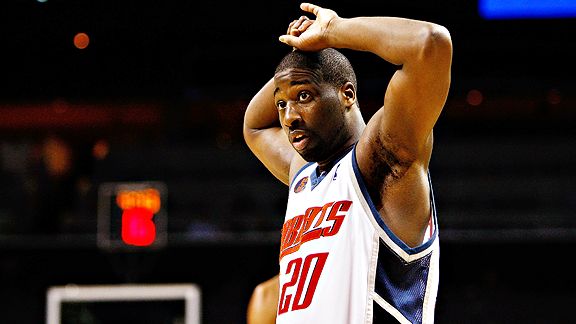
Raymond Felton signs with the Knicks. (2/$15 M)
When life gives you lemons… Donnie Walsh managed to sign Amare Stoudemire, but struck out on LeBron, Wade and Bosh. So instead of overpaying for another big-name free agent, or even re-signing David Lee, Walsh signed a capable point guard in Felton to run Mike D’Antoni’s up-tempo system. Most importantly, he negotiated a short, two-year contract (with a possible third season as a team option) to allow the pursuit of Chris Paul if/when he becomes a free agent in two years. Felton averaged 12-4-6 and shot 46% from the field for the Bobcats last season. His numbers are sure to rise in New York assuming he gets the same run (33 mpg).

Jermaine O’Neal signs with the Celtics. (2/$12 M)
Rasheed Wallace is retiring, so the C’s needed to shore up its front line in order to contend with Dwight Howard, Carlos Boozer and Chris Bosh in the playoffs. O’Neal isn’t the player he used to be, but he averaged 14-7 and shot a career high (53%) for the Heat last season. He’s a big body and decent defender and he’s capable of hitting a face up jumper when given the opportunity. As long as he holds up, this is a nice signing by Boston.

Kyle Korver signs with the Bulls. (3/$15 M)
Chicago lacked three-point shooting last season and Korver fills that need. He hit almost 54% from deep last season and is a career 41% shooter. He should be a nice fit as a spot up shooter with Derrick Rose and Carlos Boozer, but needs to shoot 40%+ from 3PT to justify a starting spot. He’s better defensively as a small forward than as a shooting guard, so it’s not clear how he and Luol Deng will play together. I expected Korver to get a full mid-level deal in this market so the Bulls got him for a relatively good price.

Tiago Splitter signs with the Spurs. (3/$11 M)
This deal happened rather quietly, but San Antonio finally has its 2007 first round draft pick under contract… at a bargain. Splitter is a 25-year-old, 6-11 center who was named the MVP of the Spanish League last season. He averaged 16-7 and shot 58% from the field in 28 minutes a game. While he’s not a great rebounder, he’s good defensively and can take some of the scoring load off of Tim Duncan. At under $4 million a season, he’s a steal.

Al Harrington signs with the Nuggets. (5/$34 M)
Harrington’s 18-6 line from last season needs to be taken with a grain of salt since he was playing for a pretty bad Knicks team that played at a very high pace. The Nuggets outbid the Mavs for Harrington’s services and Denver had to overpay to lock him up. The Nuggets will be without Kenyon Martin and Chris Andersen to start the season and Nene is always a threat to miss time with injury, so Harrington gives the team a big body who can score when called upon. He’s 30, so this contract is not going to look very good in 2-3 years, but such is the market for big men.

Part 2: Tyson Chandler, Brendan Haywood, Tony Allen, Zydrunas Ilgauskas, Kyle Lowry, Steve Blake

Could the Heat sign LeBron, Wade and Bosh and use their mid-level exception?

The short answer is ‘no.’

As I’ve been perusing the internet today, I see a lot of misinformed fans with the impression that the Heat (or any other team with room for a max player) can add a Mid-Level Exception (MLE) player once the cap space is used up. Ray Allen and Raymond Felton are common names that come up in such a conversation.

But per the NBA Salary Cap FAQ, a team that is under the cap (like the Heat) and is hoping to use up all its cap space signing 2-3 big-name free agents does not have the ability to use their mid-level exception once the cap space is used up.

For example, assume the cap is $49.5 million, and a team has $43 million committed to salaries. They also have a Mid-Level exception for $5 million and a Traded Player exception for $5.5 million. Even though their salaries put them $6.5 million under the cap, their exceptions are added to their salaries, putting them at $53.5 million, or $4 million over the cap. So they actually have no cap room to sign free agents, and instead must use their exceptions.

Teams have the option of renouncing their exceptions in order to claim the cap room. So in the example above, if the team renounced their Traded Player and Mid-Level exceptions, then the $10.5 million is taken off their team salary, which then totals $43 million, leaving them with $6.5 million of cap room which can then be used to sign free agent(s).

In the Heat’s case, the salary cap is $56.1 million and with the minimum salary cap holds required to fill out the roster, they have about $44 million to divvy up between Wade, LeBron and Bosh. ($14.7 million each.) But they only have that much cap space because they renounced (or will renounce) their Traded Player and Mid-Level exceptions. However, they could sign the three superstars at those salary levels and then sign a MLE player next summer if they choose to do so. In fact, the MLE can be divvied up amongst a number of players, which is probably how the Heat would handle the flood of veterans that would want to join the Heat in search of a ring.

The same rule applies if a team has enough space for one max free agent. Take the Clippers, who can afford one max contract. The Clips have that much space because they have renounced (or will renounce) their MLE. If they were to use up their cap space to sign Paul Pierce, the MLE would not be available to them until next summer (assuming they are still over the cap).


Photo from fOTOGLIF

Felton, Bobcats not close to a deal

Raymond Felton is having a tough time coming to terms with the Charlotte Bobcats on a new deal.

“We’re definitely not close as far as what we’re discussing and what we think fair market [value] is for Raymond,” Bradbury said Wednesday, a day after the meeting.

While Bradbury declined to discuss numbers, he indicated there was a surprisingly hefty difference in the deals he and Higgins proposed for the restricted free agent point guard.

Felton, the Bobcats’ first-round pick in 2005, has maintained he wants to stay in Charlotte. After averaging 14.2 points and 6.7 assists last season and winning over coach Larry Brown, the Bobcats have made re-signing him a top offseason priority.

The Bobcats could match any offer he receives, and Bradbury said he’s had some informal talks with teams. Felton could also sign the one-year tender of $5.5 million and become an unrestricted free agent next season.

Here’s what I wrote about Felton for our 2009 NBA Free Agency Preview:

Continue reading »

A look ahead at the free agent class of 2009

With the trade deadline in the rear view mirror and players tied to their current teams at least until the summer, it’s a good time to take a look ahead at the free agent class of 2009. Given the state of the economy and how so many teams are saving up for the class of 2010, some are suggesting that this summer’s free agency could be a “nuclear winter” of sorts, no pun intended. The salary cap and luxury tax thresholds are likely to decline for the first time in years and that has GMs and owners around the league scrambling to cut salary where they can.

There are three types of free agents: players with early termination options (ETO) or player options (PO), restricted free agents and unrestricted free agents.

Players with ETOs or POs

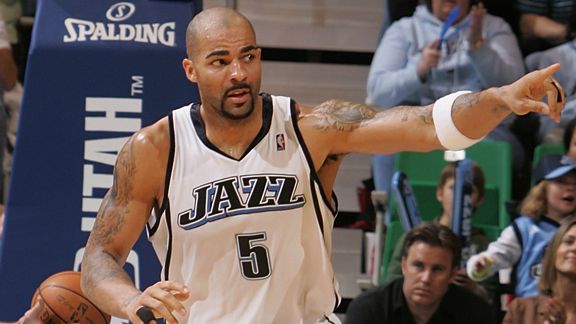
This group includes Kobe Bryant, Jermaine O’Neal, Al Harrington, Jamal Crawford and Mehmet Okur, but it’s highly unlikely that any of these guys will hit the open market given the kind of money they’ll be making by extending their respective contracts. Of this group, Hedo Turkoglu, Anderson Varejao and maybe Carlos Boozer are the only big names that are likely to hit free agency. Boozer has already stated that he’s going to opt out, but he may decide against it if he doesn’t come back strong from his injuries. Turkoglu — the reigning Most Improved Player — is having another nice season, but he’s not playing quite as well as last year. Still, he can command more than the $7.3 million he’s due to make next season. Varejao could stay with the Cavs and make $6.2 million next season, but he and his agent (Dan Fegan) have been looking for more. Varejao wants a long term deal but it seems he and the Cavs disagree on how much he’s actually worth.

For the most part, guys in this group are going to be conservative and play out their contracts.
Restricted Free Agents

RFAs hardly ever change uniforms, but in this economic climate there are teams that are unlikely to match substantial offers for their restricted free agents. The other issue is that once a team signs a RFA to an offer sheet, the player’s team has a full week to match the offer. Most teams know instantly whether or not they’re going to match, but they take the full week so that the other team can’t make any other offers because its money is tied up in the offer sheet. The NBA should reduce this period to three or four days so that teams are more willing to make offers to RFAs. Or better yet, it should eliminate restricted free agency completely to avoid Josh Childress-type cases in the future.

(Stepping down from my soapbox…)

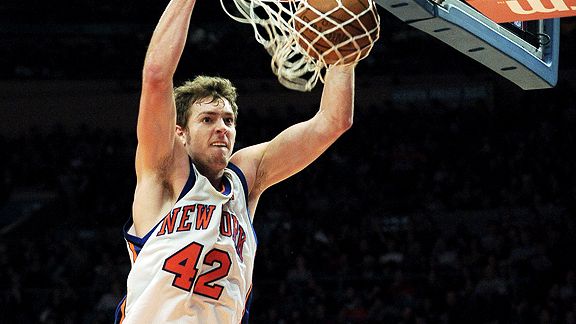
Anyway, the list of restricted free agents includes Childress, David Lee, Paul Millsap, Nate Robinson, Charlie Villanueva, Ramon Sessions (ESPN says he’s restricted though HoopsHype and ShamSports show Sessions as an UFA), Marvin Williams, Raymond Felton, Leon Powe and Linas Kleiza.

The Knicks can’t afford to keep both Lee and Robinson and sign LeBron or some other max-type free agent next summer, so if someone comes along and offers either player a substantial contract, it is unlikely that the Knicks will be able to match. Millsap played great in Boozer’s absence, and they are very similar players so it is unlikely that Utah can afford to keep both. Millsap looks like a potential All-Star and would be a cheaper option, but only time will tell if the Jazz have the balls to let Boozer walk.

Childress will probably return to the U.S. after a year playing in Greece. I suspect he’ll be a mid-level type guy, which increases the number of potential suitors as teams that are over the cap can still sign a player at the mid-level. The Bucks are in financial trouble and they need to get rid of Michael Redd or Richard Jefferson if they hope to keep both Sessions and Villanueva. Both players are having career years under Scott Skiles, but it’s unclear if the Bucks will be able to keep them. I’d expect Sessions to be a mid-level guy (and should be a solid starter for that price), while Charlie V might command a bit more. There are still questions about his heart, but if he’s thriving under Skiles, could he really be lacking toughness and drive? The Bucks have been hit by injuries to Redd and Andrew Bogut but are still holding onto the #8 playoff spot in the East, so they’d be wise to keep this core together if they can.

The Bobcats’ decision to draft D.J. Augustin made Raymond Felton expendable, so he could probably be had for the right price. I’m guessing that he’s a mid-level guy as well, though he and his agent will probably want more. Leon Powe and Linas Kleiza are both productive bench players and if the offer sheet is big enough, the Celtics and Nuggets (respectively) may decide not to match.
Unrestricted Free Agents

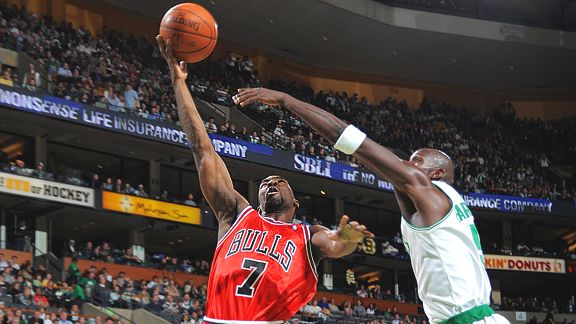
This group includes Ben Gordon, Lamar Odom, Shawn Marion, Allen Iverson, Ron Artest, Mike Bibby, Andre Miller, Jason Kidd, Rasheed Wallace, Trevor Ariza and Brandon Bass. Most of these players are older and on the decline, but they can still play. Veteran players in this group might be shocked by the kind of pay cut that they’re going to have to take in today’s climate. The days of 30+ year-old stars (not superstars) signing max or near-max deals are over, at least for a while. I bet all of these guys sign for less than $10 million per season. (I know…that’s peanuts, right?)

Gordon, Ariza and Bass are younger and could still be on the rise if they find the right team. Gordon seems to think he’s a starter and should be paid as such, but he’s small and doesn’t have a reputation for being a very good defender. He can really score though. If some team wants to pay him starter’s money, he’d be a good match to play alongside a bigger point guard who could cover the opponent’s off guard (Utah, Denver, Detroit?) or he needs to go to a team that doesn’t emphasize the defensive end.

Ariza continues to play well for the Lakers, but since he’s a much cheaper option than Odom, he’s probably going to be staying put. Bass had a terrific season two years ago, and is really coming on after a slow start this season. He’s just 23 and has some upside. I’d expect some team will sign him to a deal averaging in the $3-$4 million range, which would make him one of the best bargains of the summer.

So where will these players end up? Your guess is as good as mine. There are only a handful of teams — Atlanta, Detroit, Memphis (of course), Minnesota, Oklahoma City, Portland, Sacramento and Toronto — with the cap space (~$7 million or more) to sign a good player for another team, so I think there may be quite a few starter-level players/borderline stars signing mid-level deals this season. Playoff contenders that are over the cap won’t be able to pass up a good player for $5 million per season and there should be a number of guys that fit the bill this summer.