Tag: Mehmet Okur (Page 2 of 2)

A look ahead at the free agent class of 2009

With the trade deadline in the rear view mirror and players tied to their current teams at least until the summer, it’s a good time to take a look ahead at the free agent class of 2009. Given the state of the economy and how so many teams are saving up for the class of 2010, some are suggesting that this summer’s free agency could be a “nuclear winter” of sorts, no pun intended. The salary cap and luxury tax thresholds are likely to decline for the first time in years and that has GMs and owners around the league scrambling to cut salary where they can.

There are three types of free agents: players with early termination options (ETO) or player options (PO), restricted free agents and unrestricted free agents.

Players with ETOs or POs

This group includes Kobe Bryant, Jermaine O’Neal, Al Harrington, Jamal Crawford and Mehmet Okur, but it’s highly unlikely that any of these guys will hit the open market given the kind of money they’ll be making by extending their respective contracts. Of this group, Hedo Turkoglu, Anderson Varejao and maybe Carlos Boozer are the only big names that are likely to hit free agency. Boozer has already stated that he’s going to opt out, but he may decide against it if he doesn’t come back strong from his injuries. Turkoglu — the reigning Most Improved Player — is having another nice season, but he’s not playing quite as well as last year. Still, he can command more than the $7.3 million he’s due to make next season. Varejao could stay with the Cavs and make $6.2 million next season, but he and his agent (Dan Fegan) have been looking for more. Varejao wants a long term deal but it seems he and the Cavs disagree on how much he’s actually worth.

For the most part, guys in this group are going to be conservative and play out their contracts.
Restricted Free Agents

RFAs hardly ever change uniforms, but in this economic climate there are teams that are unlikely to match substantial offers for their restricted free agents. The other issue is that once a team signs a RFA to an offer sheet, the player’s team has a full week to match the offer. Most teams know instantly whether or not they’re going to match, but they take the full week so that the other team can’t make any other offers because its money is tied up in the offer sheet. The NBA should reduce this period to three or four days so that teams are more willing to make offers to RFAs. Or better yet, it should eliminate restricted free agency completely to avoid Josh Childress-type cases in the future.

(Stepping down from my soapbox…)

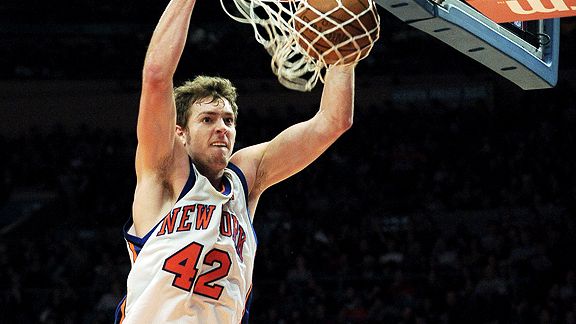
Anyway, the list of restricted free agents includes Childress, David Lee, Paul Millsap, Nate Robinson, Charlie Villanueva, Ramon Sessions (ESPN says he’s restricted though HoopsHype and ShamSports show Sessions as an UFA), Marvin Williams, Raymond Felton, Leon Powe and Linas Kleiza.

The Knicks can’t afford to keep both Lee and Robinson and sign LeBron or some other max-type free agent next summer, so if someone comes along and offers either player a substantial contract, it is unlikely that the Knicks will be able to match. Millsap played great in Boozer’s absence, and they are very similar players so it is unlikely that Utah can afford to keep both. Millsap looks like a potential All-Star and would be a cheaper option, but only time will tell if the Jazz have the balls to let Boozer walk.

Childress will probably return to the U.S. after a year playing in Greece. I suspect he’ll be a mid-level type guy, which increases the number of potential suitors as teams that are over the cap can still sign a player at the mid-level. The Bucks are in financial trouble and they need to get rid of Michael Redd or Richard Jefferson if they hope to keep both Sessions and Villanueva. Both players are having career years under Scott Skiles, but it’s unclear if the Bucks will be able to keep them. I’d expect Sessions to be a mid-level guy (and should be a solid starter for that price), while Charlie V might command a bit more. There are still questions about his heart, but if he’s thriving under Skiles, could he really be lacking toughness and drive? The Bucks have been hit by injuries to Redd and Andrew Bogut but are still holding onto the #8 playoff spot in the East, so they’d be wise to keep this core together if they can.

The Bobcats’ decision to draft D.J. Augustin made Raymond Felton expendable, so he could probably be had for the right price. I’m guessing that he’s a mid-level guy as well, though he and his agent will probably want more. Leon Powe and Linas Kleiza are both productive bench players and if the offer sheet is big enough, the Celtics and Nuggets (respectively) may decide not to match.
Unrestricted Free Agents

This group includes Ben Gordon, Lamar Odom, Shawn Marion, Allen Iverson, Ron Artest, Mike Bibby, Andre Miller, Jason Kidd, Rasheed Wallace, Trevor Ariza and Brandon Bass. Most of these players are older and on the decline, but they can still play. Veteran players in this group might be shocked by the kind of pay cut that they’re going to have to take in today’s climate. The days of 30+ year-old stars (not superstars) signing max or near-max deals are over, at least for a while. I bet all of these guys sign for less than $10 million per season. (I know…that’s peanuts, right?)

Gordon, Ariza and Bass are younger and could still be on the rise if they find the right team. Gordon seems to think he’s a starter and should be paid as such, but he’s small and doesn’t have a reputation for being a very good defender. He can really score though. If some team wants to pay him starter’s money, he’d be a good match to play alongside a bigger point guard who could cover the opponent’s off guard (Utah, Denver, Detroit?) or he needs to go to a team that doesn’t emphasize the defensive end.

Ariza continues to play well for the Lakers, but since he’s a much cheaper option than Odom, he’s probably going to be staying put. Bass had a terrific season two years ago, and is really coming on after a slow start this season. He’s just 23 and has some upside. I’d expect some team will sign him to a deal averaging in the $3-$4 million range, which would make him one of the best bargains of the summer.

So where will these players end up? Your guess is as good as mine. There are only a handful of teams — Atlanta, Detroit, Memphis (of course), Minnesota, Oklahoma City, Portland, Sacramento and Toronto — with the cap space (~$7 million or more) to sign a good player for another team, so I think there may be quite a few starter-level players/borderline stars signing mid-level deals this season. Playoff contenders that are over the cap won’t be able to pass up a good player for $5 million per season and there should be a number of guys that fit the bill this summer.

Picking the 2009 NBA All-Stars

The NBA All-Star Game is part meritocracy and part popularity contest. First, the fans vote, and the top five vote getters – two guards, two forwards and a center – from each conference are the starters. Then the coaches vote on the remaining seven reserves for each team.

The current vote count can be seen here, but I thought I’d put together my own list – five starters and seven reserves – for each team. To me, when it comes to naming All-Stars a winning record is just as important as great stats, so given two players with similar numbers, I’m probably going to give the nod to the guy on the better team. I’ll list the player’s Player Efficiency Rating, which gives a nice overview of the guy’s per-minute statistical production this season.

And off we go…

EASTERN CONFERENCE STARTERS

Dwyane Wade, Heat
PER: 29.14
D-Wade is back with a vengeance. He’s averaging 29.0 points, 7.1 assists and 5.1 rebounds, and is (almost) single-handedly keeping the Heat in the playoff hunt. With 24% accuracy, I don’t know why he’s shooting so many threes (3.0 per game), but that’s just nitpicking. He’s third in the league in steals (2.25).

Joe Johnson, Hawks
PER: 19.84
JJ is averaging 22.3 points, 6.1 assists and 4.6 rebounds, and has the Hawks in a battle for the #4 spot in the East. His three-point shooting is down two points, but his overall FG% is up a point. Remember when everyone laughed at the Hawks for giving up future MIP Boris Diaw and two first round picks for him?

LeBron James, Cavs
PER: 32.04
LeBron is the front-runner for the MVP thus far. He’s posting 27.7 points, 6.6 assists and 6.6 rebounds a game. His numbers are down, but that’s because the Cavs can afford to rest him an additional four minutes per game. It’s great to see his FG% over 50% (50.8%) and FT% approaching 80% (78.8%). LeBron has always been a statistical stud, but it’s the Cavs’ stellar record that has him leading the MVP race.

Kevin Garnett, Celtics
PER: 20.87
KG’s scoring is down, but given the Raptors’ struggles, he’s still the most deserving PF (over Chris Bosh) in the East. His numbers are virtually identical to last season other than a mysterious drop in free throw attempts per game (-2.1). Is KG still taking the ball to the hole?

Dwight Howard, Magic
PER: 25.71
I’d like to see Howard’s free throw accuracy (57.3%) improve, but it’s hard to argue with Orlando’s success this season. Howard is averaging 20.1 points and leads the league in rebounding with 13.8 per game. He also leads the league in blocks (3.28).

EASTERN CONFERENCE RESERVES

Devin Harris, Nets
PER: 24.88
From a statistical standpoint, Harris is outplaying all other Eastern Conference guards save for Dwyane Wade, so he is deserving of a spot in the starting lineup. However, Joe Johnson’s Hawks are playing quite a bit better, so Harris will have to settle for a spot on the bench.

Chris Bosh, Raptors
PER: 23.37
The Raptors are struggling this season but it’s not the fault of Bosh, whose numbers are virtually identical to last season. He has averaged at least 22.3 points and 8.7 rebounds in each of the last four years.

Paul Pierce, Celtics
PER: 18.32
Despite the Celtics recent struggles, The Truth is still a no-brainer All-Star pick. He’s averaging 19.0 points, 5.6 rebounds and 3.7 assists and while his FG% is down a smidgen, he’s over 40% from long range for the first time since the 2001-02 season.

Danny Granger, Pacers
PER: 21.93
Granger is clearly one of the league’s best young small forwards. He’s averaging 26.4 points, 5.2 rebounds and 3.4 assists, while shooting a solid 46% from the field. The Pacers aren’t great, but they’re competitive, and Granger is the main reason why. Moreover, he’s averaging an eye-popping 33.3 points per game in January.

Tayshaun Prince, Pistons
PER: 16.37
The Pistons have the fifth-best record in the East right now and deserve to have a player on the All-Star team. Prince’s numbers aren’t eye-popping, but he averages 7.3 points per game and contributes in all areas despite having to cover the opponent’s best perimeter player every night.

Jameer Nelson, Magic
PER: 19.91
Given that Orlando has virtually the same personnel as last season, it’s a bit of a surprise at how much better Nelson is playing. His ppg jumped from 10.9 to 16.4 and his FG% jumped from 46.9% to 50.4%, which is tremendous for a guard. His three-point shooting (43.8%) is outstanding. Rashard Lewis (PER: 18.05) may get the nod, but I think Nelson is more deserving.

Vince Carter, Nets
PER: 21.89
I’m not a huge fan of Vinsanity, but he’s averaging 22.7 points, 5.1 rebounds and 4.9 assists while shooting better than 40% from long range. Truthfully, this spot could go to a number of guys from better teams – Rajon Rondo, Mo Williams, Allen Iverson, Mike Bibby, Zydrunas Ilgauskas, Rashard Lewis – but Carter smokes them all numbers-wise.

Bubbling under: Rajon Rondo, Mo Williams, Allen Iverson, Caron Butler, Zydrunas Ilgauskas, Mike Bibby, Jose Calderon, Rashard Lewis

WESTERN CONFERENCE STARTERS

Chris Paul, Hornets
PER: 30.53
After a rough 5-5 start, Paul has the Hornets back in the thick of the hunt for the #2 playoff spot in the West. He has the second-highest PER in the league and is averaging 20.4 points and 11.3 assists per game. He also leads the league in steals (2.82) and is on the short list of serious MVP candidates.

Kobe Bryant, Lakers
PER: 25.48
Kobe’s minutes are down 3.0 per game, which explains why his numbers have taken a bit of a dip. Still, he’s averaging 27.0 points, 5.2 rebounds and 4.6 assists, and his FG% is up over 48% for the first time in his career. The Lakers have the best record in the West and Kobe would be favored to win his second consecutive MVP if not for the Cavs’ winning ways.

Dirk Nowitzki, Mavericks
PER: 23.78
If Carmelo Anthony hadn’t gotten injured, he might have earned this spot, but Dirk’s Mavs are just three games back of the Nuggets in the standings and he’s having another great season. He is averaging 25.3 points and 8.4 rebounds, and is shooting better than 40% from the field.

Tim Duncan, Spurs
PER: 24.33
Two words: sustained excellence. TD is averaging 20.4 points and 10.1 rebounds while shooting almost 52% from the field. Plus, he’s one of the best (if not the best) defensive big men in the game.

Yao Ming, Rockets
PER: 22.67
Yao has had to play without Tracy McGrady for a good portion of the season, but the Rockets are right in the thick of the playoff hunt in the West. He leads the Rockets in scoring, rebounding, blocks and is shooting almost 87% from the free throw line.

WESTERN CONFERENCE RESERVES

Brandon Roy, Blazers
PER: 25.06
Roy’s scoring is up to 22.8 points per game this season (from 19.1 ppg last season) in no small part due to his increased accuracy (+2.1%) from the field. The Blazers look like a playoff team and Roy is a big reason why.

Carmelo Anthony, Nuggets
PER: 18.18
‘Melo’s Nuggets are playing well even though his FG% has taken a dive to 43.7% this season. His scoring is down, but he’s rebounding well (7.3) and his three-point accuracy is up to 42%, which is a huge improvement.

Tony Parker, Spurs
PER: 23.23
Parker is setting career highs in points (21.3) and assists (6.7), he’s never been more accurate from long range (40.0%) or from the charity stripe (81.5%). Manu Ginobili has been solid, but Parker is the second-most deserving Spur this season.

Pau Gasol, Lakers
PER: 22.49
Despite the return of Andrew Bynum, Gasol’s rebounding (9.4) as well as he ever has, and he’s continuing to thrive in his role as Kobe’s sidekick. He’s averaging 17.8 points and is shooting over 55% from the field.

Amare Stoudemire, Suns
PER: 22.44
Stoudemire is averaging 21.8 points and 8.5 rebounds, and is shooting almost 55% from the field. Even though the Suns have slowed the pace down, Stoudemire’s numbers are still stellar.

Chauncey Billups, Nuggets
PER: 20.98
Billups is averaging 18.7 points and 6.8 assists for the Nuggets, but more importantly he has brought a defensive culture to Denver (and that’s not easy to do).

Shaquille O’Neal, Suns
PER: 23.75
A revitalized Shaq is producing 17.4 points and 9.0 rebounds in just 30.1 minutes. There are a number of players that could replace him on the All-Star team, but I think everyone around the league recognizes just how good Shaq is when he’s motivated.

Bubbling under: Manu Ginobili, Al Jefferson, David West, Paul Millsap, LaMarcus Aldridge, Deron Williams, Andrei Kirilenko, Mehmet Okur

Voting continues at NBA.com through January 19th.

1/22/09 Update: The starters have been announced.

Is the NBA ’09 free agent class better than ’10?

When I saw the headline — “’09 free agents may be better than ’10 class” — I was ready to jump all over David Aldridge for saying that any free agent class could be better than the one that will likely feature LeBron James, Dwyane Wade, Chris Bosh and Amare Stoudemire. But as I read the full article, he made some sense. I still don’t agree with him, but I see his point.

Here’s a look at the possible free agents in ’09:

Those with asterisks either have options for ’09 or can terminate existing contracts for ’09, and many are expected to do one or the other, for one reason or another:

Kobe Bryant*, Carlos Boozer, Shawn Marion, Ron Artest, Lamar Odom, Hedo Turkoglu*, Mehmet Okur*, Andre Miller, Mike Bibby, Jason Kidd, Allen Iverson, Rasheed Wallace, Kyle Korver*, Anderson Varejao*, Drew Gooden, Stephon Marbury, Grant Hill, Brandon Bass, Joe Smith, Wally Szczerbiak, Zaza Pachulia and Anthony Parker. Jermaine O’Neal could join the group if he walks away from $23 million next season. (Don’t hold your breath. There’s no asterisk by Boozer because he’s already said he’s opting out next summer.)

Aldridge has four major arguments:

1. 2010 is fool’s gold.

It doesn’t take a rocket scientist to figure out that unless seismic changes take place, James is either going to stay in Cleveland in 2010 or go to New York. Maybe Los Angeles. Wade will almost certainly choose between Miami, New York, L.A. and Chicago. Bosh will choose between the preceding cities and, perhaps, Detroit. And that’s it.

Without the Big Three on the market for most NBA cities, the ’10 class loses a good bit of its luster. That’s going to leave a lot of teams with max money to spend on mostly not-max players.

2. Given the recession, owners will not want to spend.

Only seven or eight teams are going to be over the luxury tax threshold this season. That number isn’t going up any time soon. Fewer teams contributing luxury taxes to their fellow competitors will further erode many teams’ bottom lines.

“People have spent (in recent years) not to be a tax payer,” says a CEO of a major market team. “Indiana really can’t afford to spend up to the tax based on their local economy. But they do, because everyone else is doing it … now, I think you’re going to see teams having to make a lot of tough decisions on spending.”

3. Since fewer teams have cap space this summer, ’09 will have more opportunity.

The point is, there will be far fewer ’09 suitors than ’10 teams. And while Bryant is equally not likely to leave L.A. for smaller-revenue teams this summer, those teams are nonetheless in a buyer’s market similar to that of Major League Baseball. There will be solid, veteran players available who may well have to settle for cents on the dollar instead of bigger paydays. A wise team will likely get a whole lot more bang for its reduced buck in ’09.

Says one extremely high-ranking team executive: “This is going to be a nuclear winter for free agents. I would not want to be one this summer. So, if the point is that this summer will be great because there will be bargains galore, you are on the money.”

4. ’10 is loaded with wings, while ’09 has better point guards and bigs.

The ’10 group is lousy with wings — big wings, small wings, fast wings, shooting wings. But so is the whole NBA. The worst teams in the league — Oklahoma City, Washington, Minnesota, Memphis — all have perfectly fine wing players. It’s the point guards and centers that most of them lack, and so does the 2010 class.

Point guards available in two years: Nash. He’s it. And he’ll be 35 on opening night, 2010.

Point guards available next year: Kidd (who, granted, will be 36 on opening night, 2009), Miller and Bibby.

Quality bigs under 35 in two years: Bosh, Nowitzki and Chandler.

Quality bigs under 35 next summer: Boozer, Okur, Varejao, Wallace. Not-great-but good ones include Dallas’ Bass, Chicago’s Gooden and Atlanta’s Pachulia.

I don’t disagree with any of his individual points, but I don’t believe that they combine to make the ’09 class better than the ’10 class. To say that one class is better than another is to say that the collection of talent in one is greater than the other. That’s simply not the case here. It doesn’t matter if only a few cities have a shot at LeBron, D-Wade, Bosh and Amare — those four players hold more value than the entire ’09 class. (All right, maybe they don’t, but you get my point.) Just because the Grizzlies won’t have a shot at LeBron, it doesn’t make the ’09 class better. It might make it better for the Grizzlies, or for any other team with cap space in ’09 and no shot at LeBron, but it doesn’t make ’09 a better class on the whole.

And just because there may more bargains in ’09 than ’10 doesn’t make the former better, it just means that there may be better value available.

Aldridge’s points are all valid, it’s just his conclusion that I don’t agree with. When comparing two free agent classes, the one with more talent is the one that’s better. The other class may have a few traits that will make it appealing to certain teams, but that only makes it better to those individual teams.

2008 NBA Preview: #5 Utah Jazz

Offseason Movement: The Jazz exercised a couple of no-brainer contract options on Ronnie Brewer and Paul Millsap, and signed Deron Williams to a long-term deal. The other main acquisition was center Kosta Koufos via the draft.
Keep Your Eye On: Carlos Boozer
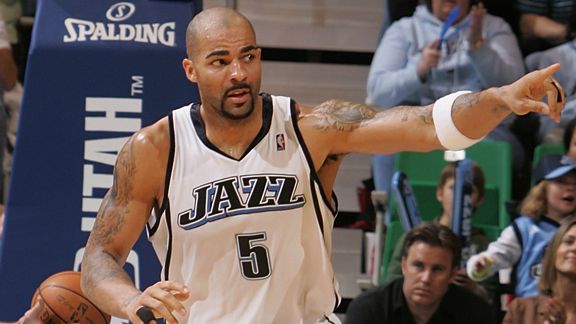
Boozer has another year on his deal, but it’s a player option, and considering he can make more on the open market, he’ll probably opt out. That doesn’t mean that he’s leaving Utah, but given Boozer’s history, the team is justifiably worried. Utah has a lot of money tied up in Andrei Kirilenko (three years, $49 million) and it would be much better spent on a new deal for Boozer. Complicating matters is Mehmet Okur, who can also opt out next summer. The good news is that the Jazz locked up Deron Williams, so that should encourage both Boozer and Okur to stay.
The Big Question: Is this group good enough to get over the hump?
Utah has a nice roster, but it’s unclear if the current core – Williams, Boozer, Okur, AK-47 – is good enough to get past the West’s elite. Can Williams and Boozer raise their respective games? Will another player (Brewer, Koufos) turn into a star?
Outlook: The Jazz are right on the cusp and they’ll always play hard for Jerry Sloan, so they’ll be in the thick of things come playoff time. That means that they’re likely to advance to the Western Conference Semis or Western Conference Finals and meet a roadblock like the Lakers, Hornets or Spurs. I’d like to see Jerry Sloan make another trip to the Finals, but the odds are against that happening this season.

Newer posts »