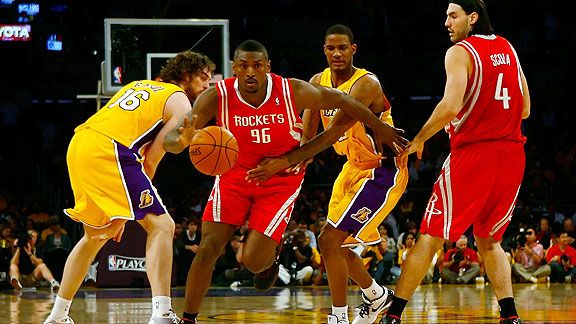
Tag: Ron Artest (Page 7 of 12)

The Top 10 Head Scratchers of the 2009 NBA Offseason

The NBA offseason is by no means over, but the lion’s share is behind us, so it’s a good time to take a look back at a few of the…um…let’s say “questionable” decisions of the summer. Here are my Top 10, in no particular order. Feel free to add to the list if I missed something.

1. Trevor Ariza plays spiteful hardball…and loses.
Let’s get this straight — the Lakers offered Ariza the same deal he was getting on the open market, and he refused since the Lakers could have offered more, but didn’t? Um, okay. David Lee (the agent, not the Knicks forward) says that Ariza wanted to go somewhere where he’d be “appreciated.” Lee overestimated the market for his client, and the Lakers quickly moved on to acquire Ron Artest. Now instead of playing for the world champs, Ariza is stuck in Houston on a team that faces a very uncertain future. Lee now says that Ariza turned down a deal worth $9 million more, but still picked Houston. It sounds to me like he’s just trying to save face.

2. Grizzlies acquire Zach Randolph.
Once the Clippers traded for Randolph (and his toxic contract) last season, I thought the bar for NBA general managers had hit a new low thanks to Mike Dunleavy and his wily ways. But Dunleavy proved that he wasn’t the dumbest GM in the league when he convinced the Memphis Grizzlies to take on the final two years Randolph’s contract at the tune of $33.3 million. Remember that $25 million or so of cap space that the Grizzlies were going to have next summer? Yeah, that’s down to about $8 million with this brilliant move. Just when it looked like Chris Wallace was going to rehab his image after the Pau Gasol trade — Marc Gasol panning out, trading for O.J. Mayo — he goes and does this. Sigh.

Continue reading »

Was the Artest/Ariza swap good for the Lakers?

artest

Yes? Like the majority of Laker fans, I really liked Trevor Ariza. In his previous five NBA seasons of virtual anonymity, Ariza never seemed to fit into the chemistry with his teams. Chalk it up to inexperience or the adjustment from college to the pros. Enter the 2008-9 season, and Ariza blossoms, playing in every regular season game, and averaging nearly nine points, four rebounds, and two steals in every one of them. Come the playoffs and he’s easily the most integral player outside of Kobe Bryant and Pau Gasol, providing consistently strong defense and clutch steals. While the numbers mentioned above may not “wow” anybody, remember that Ariza has always been considered an average player, and that last season could be considered his breakout year. Is it all that strange that he should ask for a multi-year deal at about $6 million a season? No, it’s not, considering his role on a championship team, but in this market you can’t fool yourself into thinking the already penny-pinching Lakers will bite.

Perhaps large-market teams are getting smarter, refusing to award talent with big contracts after one successful season. Prior to last season, Ariza hadn’t made much of an impression in the NBA, and then out of nowhere he’s starting in the NBA Finals. And where did that shot come from? Given the economic climate, I think it would’ve been a wise decision to give Ariza a one-year deal, worth a little more than what he was making the previous season. If he could then replicate his success, then by all means, secure the guy for the next few seasons. But this didn’t happen, and maybe this is to the fault of Ariza’s agent, David Lee, who seemed to attack the Lakers from the onset. While Ariza was valuable to the Lakers, value is measured in worth. There’s an old story about a woman who unknowingly bought a Van Gogh at a garage sale. She used it as a window shade and it became all faded from the sun. She even cut off a piece of the painting to make it fit. When it became obvious what she had, all these experts came to investigate. When they asked her why she had cut the painting she responded, “It was just a little piece of the sky.” (Thanks to Tom Waits for the anecdote.) Value is obviously subjective, and obviously Ariza wasn’t as valuable to the Lakers as he thought. He was a piece to their championship puzzle, but one that was apparently replaceable in the mind of Lakers GM Mitch Kupchak. The Rockets, however, saw much worth in Ariza, to the tune of five years and $33 million.

It comes down to math really, in a crazy algorithm that involves money, the length of the contract, the player’s age, their agent’s delusion, and talent. It’s enough to make one frustrated, and sometimes you wish these negotiations weren’t made public. In the end, Artest did the Lakers a huge solid. Like Ariza, he’ll be making roughly $6 million a season. However, Artest only signed for three years, and as a player about to turn 30, that’s all he should get playing for the Lakers.

So, what it comes down to is this: is three years of Artest leaving his prime better for the Lakers worth more than having Ariza for five years while he is just entering his? The answer to that question is “yes.” For the next three years Artest will put up better offensive numbers and play a bit better defensively than Ariza. This makes sense to me since the Lakers will be paying a better player just as much as they would have had to pay Ariza.

Those in support of keeping Ariza will say his willingness to quietly wait in the wings and commitment to team-play were worth his price tag. But when have the Lakers ever been about being a team? The Lakers are a team in theory, but the offense obviously runs through Kobe and it will continue to be that way as long as he is in the purple and gold. Last season, with Kobe, Lamar Odom, Pau Gasol, and Andrew Bynum all on the roster, the Lakers were possibly the most star-studded team in the league. At the beginning of the season, Odom immediately expressed frustration with having to come off the bench, a sure sign of a bloated ego and unwillingness to change for his team. Over time, he took on his diminished role as it became clear that the team was winning with coach Phil Jackson’s new plan. This is the same mold Artest will have to fit into. The Lakers are becoming a team of aging stars (Kobe, Odom, Artest) amid unproven talent (Farmar, Bynum). The older players are exiting their prime and the Lakers’ championship window is closing. Artest, the better player, was thought to increase their chances of winning titles within this period of time more so than Ariza. Case closed.

As for those who think Artest is a team cancer who will cause problems behind the scenes, I wouldn’t worry. At this point in his career, it appears to be all about the championship. Still, if he ever brushes off Phil, or especially if he gets into it with Kobe, L.A. will eat him alive. He knows better, but if it turns out he doesn’t, we always have Josh Powell!

Artest to L.A., Ariza to Houston

In a surprising sequence of events, Ron Artest has agreed to a three-year deal with the Los Angeles Lakers, while Trevor Ariza is headed to Houston with a five-year deal. Both contracts are of the mid-level variety, which are expected to start at about $5.8 million per season.

J.A. Adande writes…

Just as telling is the Lakers’ decision to go with Artest instead of younger Trevor Ariza. It shows they’re putting everything into these next three years and not worrying too much about the future. Ariza would have wanted a five-year contract; Artest was willing to come for three. The end of Artest’s contract coincides with the reported opt-out clause for Bryant. We don’t know whether Kobe will choose to leave in 2012, but we do know this: He’ll be 33 that summer, turning 34 in August. The three years with Artest probably represent Bryant’s last stages of physical superiority over the opposition. He’ll still be ahead of the pack in knowledge and determination, but we’ve already seen some slipping in his athletic ability and it will only decline from here.

So the Lakers are thinking short-term and trying to squeeze in a couple more championships right now. Lakers GM Mitch Kupchak was even willing to increase his roster’s average age and let one of his best acquisitions walk away, two things general managers are generally loath to do.

Artest gives the Lakers the same qualities as Ariza — perimeter defense and toughness — plus the ability to get his own shot, and a dash of crazy. Ariza wound up in Artest’s old spot in Houston, where he’s actually a better fit. With Yao Ming’s career on pause — at best — the Rockets have to position themselves to be good in a couple of years, perhaps by bringing in a major free agent in 2010 and/or having Yao return from treatment on his feet that might hinder him for the better part of two seasons. Amazing how quickly a team that seemed on the rise in these playoffs now finds itself retooling.

We’ll never know if Ariza was just playing hardball when he expressed frustration that the Lakers wouldn’t offer more than the mid-level because the team called his bluff and moved on. I like this signing for the Rockets, who were originally interested in Orlando big man Marcin Gortat. But when the “Polish Hammer” reportedly made a verbal agreement to join the Mavs, the Rockets moved on to the 24-year-old Ariza.

Artest is a little nutty, and he has the potential to sabotage the Lakers’ season, but it’s not like the team is championship-caliber because they have great chemistry. They don’t. They have more talent than anyone, and when Ariza became irritated with the Lakers’ unwillingness to go over the mid-level, they quickly moved on to their backup plan. Artest will accept his role in L.A. and should fit in just fine, at least defensively. But three years is a long time for him to behave; I expect he’ll have at least one dust up before it’s all said and done.

2009 NBA Free Agency Preview: The top unrestricted free agents

Once the draft is over, the next step of the NBA offseason is the free agency period. Negotiations start July 1, but players have to wait until July 8 to actually sign on the dotted line. Due to the economy, this promises to be an interesting summer, as more franchises seem to be trying to cut payroll than add talent. There are eight teams with significant cap space this summer, and there’s no guarantee that they’ll be willing to use it. Teams that are over the cap can add good players in two ways: 1) they can sign a player to the Mid-Level Exception (MLE), which will be around $5.8 million per season (and can be split up between two or more players), or 2) they can work out a sign-and-trade with the player’s old team.

Below is a list of the top unrestricted free agents this summer. These are players who can sign with whomever they like. They’re ranked in order of total value, which is based on overall talent, age, injury history and cost.

For each player, I’ll provide his position, age, Player Efficiency Rating (PER) and an estimate of what kind of contract he’s likely to sign.

1. Carlos Boozer, PF (27 years-old)
PER: 17.28
At press time, Boozer hasn’t officially opted out, but he is expected to. He can play another year for $12.3 million, but he thinks he’s due for a raise, and I don’t think he’s going to get the kind of raise he’s expecting. Boozer is one of the top 20 players in the league when healthy, but it’s that whole “when healthy” part that’s the problem. Over the past five seasons, he has missed a third of his team’s games. At 27, he’s in his prime, and assuming he has the right supporting cast, I think he can be one of a twosome or threesome on a championship-caliber team. Boozer may not get a raise this summer, but he could get long-term security. The Pistons, Raptors, Kings and Thunder all have the space to make a run at him, but Sacramento and OKC might consider themselves too far away from contending to add a big piece like Boozer. The Pistons seem like the best fit, but they are rumored to have more interest in Ben Gordon. There’s always the possibility that another team works out a sign-and-trade with Utah, but I don’t think anyone is going to give him a max deal, not in this economy.
Value: $12.0 – $13.0 million per year

Continue reading »

« Older posts Newer posts »