Tag: New York Yankees (Page 36 of 52)

Report: Yankees, Pettitte closing in on incentive-laden contract

According to ESPN.com, the Yankees and starter Andy Pettitte are close to agreeing to an incentive-laden, one-year contract.

Andy PettitteThe deal, sources told Olney, could be done as soon as Monday afternoon. It would pay Pettitte nearly $6 million, with incentives that could make it worth as much as $12 million.
Pettitte was 14-14 for the Yankees last season with a 4.54 ERA. He started 33 games. Pitching with a sore shoulder, he was 2-7 with a 6.23 ERA in his final 11 starts and missed his last turn of the season.
It was his second season back in New York after three seasons with the Houston Astros.

Pettitte began his career with the Yankees, pitching his first nine big league seasons in pinstripes. After last season, indications were that Pettitte and the Yankees wanted to make a deal, but were unable to come to terms on a dollar figure — until talks heated up this weekend.

Pettitte earned $16 million last season.

If he signs, Pettitte would join a projected starting rotation featuring CC Sabathia, A.J. Burnett, Chien-Ming Wang and Joba Chamberlain.

So a $10 million, one-year contact wasn’t good enough for Pettitte two weeks ago, but an incentive-laden one-year contract is good enough now? I don’t get it.

Pettitte’s greed cost him $4 million in guaranteed money. He thought he was worth more and could get more than what the Yankees were offering, but he must have realized that pitchers who go 14-14 with a 4.54 ERA (on a great offensive team by the way) don’t earn a lot on the open market.

The Yankees won this battle if Pettitte signs.

Hot Stove League: Lots of little movement

You know it’s a slow week in MLB again when the big news is that Jeff Kent has announced his retirement. And just like Kent does with ease himself, the news stirred up controversy. This volatile player has never quite been a media darling, and has often gotten into it with teammates. But there is now debate about the guy’s Hall of Fame credentials. Okay, he may have the most homers for a second baseman in history, but you can’t tell me this guy is in the same class as a guy like Joe Morgan. He’s just not. And while a .290 career batting average is nothing to sneeze at, 377 homers over 20 years is not exactly Babe Ruth-esque.

Anyway, as Manny Ramirez remains unemployed, there were a few other smaller signings and moves this past week….

Okay, this isn’t small but just announced on Friday, Prince Fielder has agreed to a 2-year, $18 million deal with the Brewers that will keep him firmly entrenched (and who could move the guy?) on first base in Milwaukee through 2010. I’m glad for the Brew Crew since they lost out to the mighty Yankees in the CC sweepstakes.

Catcher Gregg Zaun re-signed with the Orioles, the team that drafted him back in 1989. The journeyman player signed a deal worth $1.5 million with a $2 million option for 2010.

The Phillies signed outfielder Jayson Werth to a two-year, $10 million contract and also inked reliever Chad Durbin to a one-year deal worth $1.635 million.

Young right fielder Nick Markakis of the Orioles came to terms on a six-year, $66.1 million deal, covering his first three arbitration-eligible years as well as his first three free agency eligible seasons. Clearly the O’s believe in this kid and want to keep him away from the Yankees and Red Sox.

Two other catchers signed this week—Brad Ausmus reached agreement with the Dodgers on a 1-year, $1 million deal; and Henry Blanco signed a $750,000 deal for one year to back up Padres’ catcher Nick Hundley.

Shortstop Omar Vizquel, who at 41 still looks like he’s 25, has been invited to spring training by the Texas Rangers. Vizquel signed a minor league deal that will allow him to mentor 20-year old Elvis Andrus, and to possibly become the team’s utility infielder. In order to make room for Andrus on the field, the Rangers are planning to move all-star shortstop Michael Young to third base. In addition, the Rangers are said to be casually wooing free agent pitcher Ben Sheets, who lives in Dallas.

Meanwhile, Tom Covill of Yahoo Sports posted this great summary of the remaining big name free agents still looking for work. It’s really kind of mind-boggling, but looking at these tiny deals being signed this past week, it’s clearly about economics and nothing more.

Why are MLB owners so scared of Mark Cuban?

Long-time Cubs fan (and billionaire) Tom Ricketts is the winning bidder for the Chicago Cubs and if the sale goes through (which would also include a 25 percent interest in a regional sports network), he would buy the club from the Tribune Co. for around $900 million.

Woo-ho.

Ricketts seems like a solid choice considering he’s a long-time fan and would likely try a hell of a lot harder than the Tribune Co. did in putting a winner on the field. (Outside of the years when the Tribune spent money on free agents in efforts to up the value of the club so they could eventually sell it, of course.)

But Ricketts is not Mark Cuban.

Had Major League Baseball allowed Cuban to buy the Cubs, he would have stopped at nothing to put a winner on the field. He wouldn’t have gone through years of mediocrity before trying to build a World Series contender – he would have tried to win from Day 1.

So the question becomes: Why are baseball owners so petrified of Cuban? He would presumably bring excitement to the game, he would challenge the Yankees in terms of spending and he would be a hero in Chicago, which oh-by-the-way is the type of big city market that baseball would love see make the World Series on a consistent basis so TV ratings would skyrocket.

I’ve always been under the assumption that owners didn’t want Cuban the owner because he would challenge the Yankees and therefore, smaller market teams wouldn’t make as much off the luxury tax as they would if the Bombers spent big all the time. But thanks to TSR teammate John Paulsen (who did a quick Google search because my dumbass didn’t think to), I realized that the money from the luxury tax (also called the ‘Competitive Balance Tax’) isn’t distributed to smaller market teams to promote competitive balance.

So therefore, it doesn’t matter if Cuban came in and spent as much as the Yankees because smaller market teams get paid from baseball’s revenue sharing program, which is completely independent from the luxury tax. (In fact, it would help smaller market teams if the Cubs’ revenue was close to the Yankees’ because they would get a bigger cut from the revenue sharing program.)

If owners keeping Cuban out has nothing to do with the luxury tax payout, then again – why treat him like the Ebola Virus? Below are two opinions as to why. There are probably more, but in my opinion, none bigger than the two below.

1. Baseball has become the “good ol’ boy” network in terms of its owners. Change is bad. And Mark Cuban owning the Cubs would be the epitome of change – radical change. He does everything first class with the Mavericks and he would presumably do the same with the Cubs. He would upgrade Wrigley Field, treat the players like kings and probably sit right behind home plate so he’s within earshot of the umpire. Baseball owners don’t want a young, hip outsider coming in and having the media focus be on him and the way he does things. He would rock the boat every chance he got, just like he does now in the NBA. Owners are supposed to sit in their seats or boxes and watch from afar. They’re not supposed to be in your face and as recognizable as Cuban is in the NBA.

2. MLB teams already have their hands full trying to keep up with the Yankees every offseason. If Cuban buys the Cubs, he would compete with the Evil Empire and drive up the price for free agents even more. The player’s union would love for Cuban to buy the Cubs, but the owners would rather deal with one monster than two. (Granted, the Mets and Red Sox compete with the Yankees’ spending on a consistent basis, too, but nothing compared to what Cuban would presumably do.)

Some might note that the owners also don’t want to be associated with someone, who, in November of last year was accused of insider trading. But don’t forget that Cuban was being turned away by MLB owners well before the SEC report came to light. And by the way, Cuban would have paid $1.3 billion for the Cubs, which is a good bit more than the $900 million Ricketts is ready to dole out. So it has nothing to do with money.

The bottom line is that baseball is seemingly making a mistake. Cuban would do a lot for the Cubs’ organization and baseball on a whole, but for whatever reason he’ll never have the chance to become an owner. It’s sad really, because in the end, baseball fans are the ones who suffer the most.

Hot Stove League: Pitchers Flying Off Shelves

This past week, John Smoltz officially signed with the Red Sox and the Braves inked Derek Lowe to a four-year, $60 million deal, something Atlanta’s rival New York Mets could not match. Imagine that. But what runs deeper here is that the second and even third tier of pitchers continue to be signed and many position players remain team-less.

Less than a month before pitchers and catchers report, here are some of the big names still available: Manny freaking Ramirez, Adam Dunn, Bobby Abreu, Ken Griffey, Orlando Hudson, Frank Thomas, and to a lesser extent, Kevin Millar (20 homers last season) and Orlando Cabrera. To put this in perspective, the Astros signed pitcher Russ Ortiz to a minor league deal a few days ago, the Dodgers signed reliever Guillermo Mota, the Angels inked Darren Oliver for one year, and the White Sox brought back a Bartolo Colon who is on the downside of his career. Clearly, it’s a pitchers’ market this off-season, and it’s almost mind-boggling that Ramirez has gone almost three full months without being signed.

Part of the problem here is that the big spenders (ahem, New York teams) have blown their collective load on the likes of CC Sabathia, AJ Burnett, Mark Teixeira, Francisco Rodriguez, etc., leaving a team like the Dodgers the likely scenario for Man-Ram in 2009, which at the end of the day is probably best for both sides anyway. But some of those other guys are going to have trouble finding work, or they are going to take a recession-friendly deal from a team they wouldn’t have signed with otherwise. It’s already happened with Pat Burrell in Tampa and Jason Giambi with Oakland.

In other more recent news, the Red Sox avoided arbitration with Kevin Youkilis on Thursday, agreeing to terms on a four-year deal. And the Dodgers finally released beleaguered outfielder Andruw Jones, who the Braves are considering bringing back for the league minimum salary. The Braves are also mulling over whether to bring back injury-plagued LHP Tom Glavine for one more season.

Yankees want taxpayers to chip in for new stadium

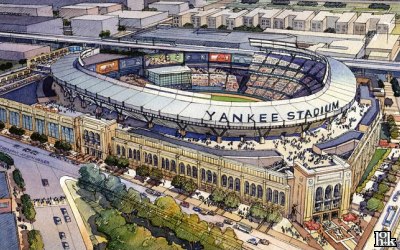
The Yankees are reaching out to New York tax payers to help cover the cost of their brand new stadium, which is set to open this season.

New Yankee StadiumBut the same team that was so generous with its players now wants New York taxpayers to be even more generous than they already have been in helping fund for a stadium built for the singular purpose of making the Yankees even more money.

The Yankees are going back hat-in-hand this week to ask the city for another $259 million in tax-exempt bonds on top of the $940 million in similar bonds they’ve already gotten for the new stadium, saying the extra money is needed, among other things, to pay for a state-of-the-art big screen and to properly finish off the stadium’s luxury suites.

Now I’m no economist, but doesn’t something seem a little off here?

Just weeks after committing some $423.5 million for Sabathia, Teixeira and A.J. Burnett, the Yankees need to float nearly that much in bonds at taxpayer expense just to finish the stadium? Couldn’t they reach out to their new players and get a loan from them instead?

Yankees president Randy Levine insisted Wednesday in a contentious hearing that the team is paying for its own stadium and that grandstanding politicians are to blame for even making an issue out of the latest request. Although he’s right about the issue becoming a political, er, football, the fact remains that the city of New York and its taxpayers are heavily subsidizing the stadium, too.

They’re hardly setting a precedent. Since the Baltimore Orioles soaked taxpayers for the first retro stadium, Camden Yards, in 1992, baseball owners have managed to con the public in 17 other cities for new parks of their own. In almost all cases, the majority of the money spent on these new stadiums has come from taxes or fees imposed for just that purpose.

In the case of Yankee Stadium, it will be the Yankees paying off the bonds. But because they’re tax free, it means the bonds will carry lower interest rates and the team will avoid spending tens of millions of dollars it would have otherwise had to pay on the borrowed money.

When everything is included, it adds up pretty quick. Figures released by the city’s Independent Budget Office tallied a whopping total public subsidy at more than $500 million, with another quarter billion dollars or so for the Mets’ new stadium in Queens.

Like the writer, I don’t live in New York so I can’t be outraged over the fact that taxpayers have to chip in to help with the cost of the Yankees’ new stadium. And it’s hardly fair to criticize only the Yankees for doing this when 17 other teams are doing the same thing.

But in a time of economic hardship, this doesn’t seem right. Baseball needs a cap. If teams like the Yankees didn’t spend millions of dollars on free agents every year, maybe they could foot the entire bill for a new stadium.

« Older posts Newer posts »