Tag: New York Yankees (Page 35 of 52)

Alex Rodriguez admits to using steroids

In the wake of this weekend’s SI.com report that claimed he tested positive for performance-enhancing drugs in 2003, Yankees’ third baseman Alex Rodriguez admitted to ESPN.com’s Peter Gammons that the report is in fact true.

His voice shaking at times, Alex Rodriguez met head-on allegations that he tested positive for steroids six years ago, telling ESPN on Monday that he did take performance-enhancing drugs while playing for the Texas Rangers during a three-year period beginning in 2001.

“When I arrived in Texas in 2001, I felt an enormous amount of pressure. I needed to perform, and perform at a high level every day,” Rodriguez told ESPN’s Peter Gammons in an interview in Miami Beach, Fla. “Back then, [baseball] was a different culture. It was very loose. I was young, I was stupid, I was naïve. I wanted to prove to everyone I was worth being one of the greatest players of all time.

“I did take a banned substance. For that, I’m very sorry and deeply regretful.”

Sources who know about the testing results told SI that Rodriguez tested positive for testosterone and Primobolan, an anabolic steroid. In his ESPN interview, Rodriguez said he did not know exactly which substance or substances he had taken. In 2003, there were no penalties for a positive result.
“I am sorry for my Texas years,” the New York Yankees third baseman said. “I apologize to the fans of Texas.”

“The more honest we can all be, the quicker we can get baseball [back] to where it needs to be,” he said.

Rodriguez said he stopped taking substances after injuring himself at spring training in 2003 with the Rangers.

“It wasn’t a real dramatic day. I started experimenting with things that, today, are not legal,” he said, “that today are not accepted … ever since that incident happened, I realized that I don’t need any of it.”

Whether you like him or not, you have to admit Alex Rodriguez has more balls than Barry Bonds, Mark McGwire, Roger Clemens, Sammy Sosa and all of the other players that took performance-enhancing drugs and lied about it or danced around the topic. He got caught and fessed up and at the very least, we should be satisfied that he didn’t drag this situation out. Any player that knowingly took steroids and were caught should follow A-Rod’s lead because if there is one thing we’re know for in America, it’s forgiving and moving on.

That said, A-Rod better be telling the truth that his Yankee years have be clean. There’s nothing worse than admitting your mistake only to lie again. And one can’t help but wonder if he’s just using the “I was naive” excuse to dodge more bullets. He was 26 in 2001, it’s not like he was a 20-year-old kid who was pressured into taking steroids.

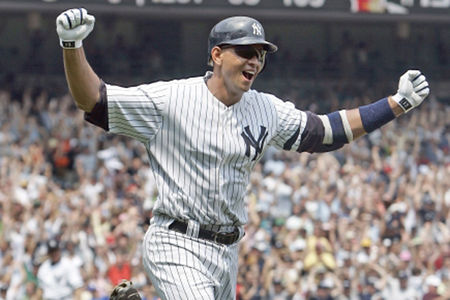
Let the A-Rod bashing begin

Alex RodriguezNational sports writers rejoice to hammer A-Rod in the wake of SI.com’s report that he tested positive for steroids in 2003:

Jayson Stark says that Rodriguez has destroyed the game’s history. (ESPN.com)

Bruce Jenkins writes that even tarnished stars like A-Rod will shine in the Hall of Fame. (San Francisco Chronicle)

Bill Madden says the Yankees should cut Rodriguez loose no matter the cost. (New York Daily News)

Tom Verducci breaks down how the steroid report will affect A-Rod, the Yankees and Major League Baseball. (Sports Illustrated.com)

Todd Jones plays devil’s advocate in this situation and tells fans to think about some things before condemning Rodriguez into steroid/baseball hell. (Sporting News)

So much for Rodriguez legitimizing the home run record writes Tim Cowlishaw. (Dallas Morning News)

Bob Klapisch writes that Derek Jeter better not fail us, too. (The Record)

Drew Sharp goes as far as to say that we can’t even call baseball a sport anymore. (Detroit Free Press)

Tim Marchman notes that nobody like A-Rod before the report and nobody likes him now. (Slate)

SI.com: Alex Rodriguez tested positive for steroids 2003

According to Sports Illustrated.com, Yankees’ third baseman Alex Rodriguez tested positive for two anabolic steroids when he was a member of the Rangers in 2003.

Rodriguez’s name appears on a list of 104 players who tested positive for performance-enhancing drugs in Major League Baseball’s ’03 survey testing, SI’s sources say. As part of a joint agreement with the MLB Players Association, the testing was conducted to determine if it was necessary to impose mandatory random drug testing across the major leagues in 2004.

When approached by an SI reporter on Thursday at a gym in Miami, Rodriguez declined to discuss his 2003 test results. “You’ll have to talk to the union,” said Rodriguez, the Yankees’ third baseman since his trade to New York in February 2004. When asked if there was an explanation for his positive test, he said, “I’m not saying anything.”

Though MLB’s drug policy has expressly prohibited the use of steroids without a valid prescription since 1991, there were no penalties for a positive test in 2003. The results of that year’s survey testing of 1,198 players were meant to be anonymous under the agreement between the commissioner’s office and the players association. Rodriguez’s testing information was found, however, after federal agents, armed with search warrants, seized the ’03 test results from Comprehensive Drug Testing, Inc., of Long Beach, Calif., one of two labs used by MLB in connection with that year’s survey testing. The seizure took place in April 2004 as part of the government’s investigation into 10 major league players linked to the BALCO scandal — though Rodriguez himself has never been connected to BALCO.

Does this news seriously surprise anyone? It’s come to the point now where fans should just assume that most players either are or were on some type of performance-enhancing drug from the mid 90s on.

As the SI article notes, Major League Baseball did not have a penalty for anyone who tested positive for steroids up until 2004 when it began its random testing program. It was simply frowned upon and now there’s nothing that the league or anyone else can do about it in order to punish those players who tested positive before ’04. The league is at fault for A-Rod, Roger Clemens, Mark McGwire and Barry Bonds because it allowed these players to gain an edge off the field and pollute the game without the threat of consequence.

Did these players make a conscious choice to gain an edge using performance-enhancing drugs? Yes – and they are just as much at fault as MLB is. But it all starts with the league. Bud Selig and all of these players soiled a great game and now we all can’t look at a player after he hits a home run without thinking, “I wonder if he’s on steroids.”

It’s sad.

McNamee to appear on Howard Stern, but will not talk about Clemens. Riiight.

Roger Clemens’ former trainer Brian McNamee is set to appear on the Howard Stern Show, but apparently plans on not discussing his former client.

Brian McNamee Roger ClemensHardin will get to listen to more of McNamee’s statements. The trainer is scheduled to appear on The Howard Stern Show on Monday.

McNamee is not expected to talk about Clemens but he could react to being called a “gate crasher” and a “hustler” by former pitcher David Cone in The Yankee Years. The just-published book is by former manager Joe Torre and Tom Verducci of Sports Illustrated.

“Brian is tired of walking on egg shells,” said Steve Cardillo, a friend of the trainer’s. “He won’t discuss the ongoing stuff with Clemens, but there is no reason why he can’t talk about Joe Torre driving the bus over him. He’s a little tweaked at that. He’s a little tweaked at (David) Cone, too.”

Does McNamee truly believe that Stern is going to have him on his show and not talk about Roger Clemens? Why even have Brian McNamee on a radio show (any radio show) and not talk about Roger Clemens?

Stern is going to pick this fool apart.

Nadal-Federer renew their rivalry at the Australian Open

Their epic Wimbledon final from last summer seems like a long time ago but Rafael Nadal and Roger Federer will renew their rivalry once again this evening as they vie for the men’s title at the Australian Open. This will be their seventh showdown in a Grand Slam final and it’s quickly becoming a must-see rivalry not unlike the Red Sox-Yankees or Lakers-Celtics for all sports fans.

Losing his #1 ranking in the world after Nadal’s thrilling victory in England has been a major catalyst in the revitalization of Federer’s career. He has added intensity and motivation to his smooth, effortless return volley game and hasn’t lost a match at a Grand Slam tournament (including a U.S. Open title last September) since Wimbledon.

Federer will be making his 18th appearance in a Grand Slam final and a victory Sunday evening in Melbourne will put him even with Pete Sampras at 14 Grand Slam tournament victories. His hard-court surface record is also very impressive, as Federer has won seven of the last eight Grand Slam tournaments played on that surface, including winning five straight U.S. Open titles.

The tennis world anointed Nadal as the new king of the sport last summer. The young Spaniard emerged at a time when tennis needed someone to challenge Federer’s dominance. Nadal will never emulate Roger’s play on the court, his sweating and grunting and his fist-pumping, emotional style are all big parts of his game. His top spin forehand shot will be taught to future generations for years to come.

The key to Nadal’s long-term success will be his play on hard-court surfaces. On clay, he has no equal, but Nadal’s improved play on the hard court and grass last year helped him take over tennis’ #1 ranking. Winning Wimbledon was a memorable moment in Nadal’s career, but winning on the hard-court in Melbourne tonight would be just as impressive.

The tennis world was bracing for an unknown to knock off Nadal or Federer, but for the past two weeks they reminded everyone just how good they are. The match is on in the wee hours of Sunday morning (3:30 AM ET) on ESPN2 here in the U.S., but the network is replaying the match later in the morning.

« Older posts Newer posts »