Category: MLB (Page 224 of 448)

Fan catches Chris Coghlan’s first home run. Fan receives arm, demands leg.

SPORTSbyBROOKS has a great piece up about Nick Yohanek and his adventures with the Florida Marlins’ Chris Coghlan. Apparently, there’s a great start-up business here: Selling home run balls back to the guys who hit them out. After Coghlan hit his first in the majors, he was approached by Yohanek (who had caught the ball) after the game. Upon giving the fan a signed game bat and photo-op, Coghlan was surprised to learn that that just wouldn’t be enough to get Yohanek to fork over his ball (the identity of the preceding pronoun is anybody’s guess). Let’s hear from Yohanek and Brooks now:

Yohanek, not surprisingly, has a different view of things. We’re a little more suspicious of his version of the facts, mainly because he’s got far more reason to lie and even in his quotes, he comes off as an unholy prick:

“I explained that ballhawking is my hobby and that what I was asking in return was fair,” Yohanek said Thursday, in an e-mail to the Associated Press. “I told him I make $50,000 a year working in law enforcement and that I didn’t feel like I was asking for too much. He responded, ‘Good for you.’ Real classy. Way to respect law enforcement. Way to respect a fan.”

Yes, exactly. Clearly his tone was indicative of a disrespect for law enforcement and fans, and in no way affected by annoyance when a grown man makes demands for what should be a treasured keepsake. Real classy, Yohanek.

I can’t help but agree with my esteemed colleague on this one. While it is true that modern athletes make an exorbitant amount of money, it’s simply a matter of capitalism: if someone’s willing to pay that amount, then make them pay it, right? Supply and demand and such…Wait a sec, I may have just agreed with Yohanek here.

Continue reading »

What’s most important about Zimmerman’s streak…

maggio

…is that it reminds us how phenomenal Joe DiMaggio’s 56-game hitting streak really was. Legendary reporter Art Spander has written a nice column for Real Clear Sports looking closely at Zimmerman’s streak, DiMaggio’s record, and how fans respond to these hitting achievements.

The best part is we may understand how good Ryan Zimmerman is going to be. The second-best part is we may again understand how good Joe DiMaggio was.

Zimmerman, the kid from the Washington Nationals, caught our attention there for a month. He hit in 30 consecutive games.

The streak ended Wednesday against the Giants. The streak ended with a standing ovation. From fans of the visiting team.

The streak ended with greater appreciation for Joe DiMaggio.

We don’t know much very about Joltin’ Joe these days. He came before ESPN and CNN and Twitter. He retired 58 years ago. But Ryan Zimmerman, age 24, knows all he needs to know about DiMaggio.

Watching from the press box Wednesday was 85-year-old Charlie Silveria, who grew up here, who as a 10-year-old watched DiMaggio, then with the San Francisco Seals, hit in a Pacific Coast League record 61 straight games in 1933.

Silveria joined Joe on the Yankees in the late 1940s and was Yogi Berra’s backup catcher. They talked about the old days. They didn’t talk much about streaks. “He was private,” reminded Silveria.

We never learned what DiMaggio thought of hitting in 56 straight major league games. We did learn what Ryan Zimmerman thought of hitting in 30.

Personally, I don’t think DiMaggio’s streak will ever be broken. When the Yankee Clipper hit for 56 straight games in 1941, the complexion of Major League Baseball was much different. Nowadays, hitters may face three or different pitchers in a game. When DiMaggio played, it was common that a team would only use one or two different pitchers. This makes it much harder on a hitter to make the proper adjustments after “studying” a pitcher from a previous at-bat. Even more so, rosters are much larger and contain many more pitchers than they did in the ’40s. Thus, it’s tougher for hitters to get a feel for pitchers over time since they really may not face them all that often in the grand scheme of things. On top of that, players are bigger babies than they were back when DiMaggio was around. Team management is so quick to act on a precautionary measure rather than have their guys man up and take the field. It’s also rare that a guy even plays 56 games in a row. I really like ballplayers like Zimmerman, Longoria, and Utley because they are multi-talented athletes that remind me of DiMaggio. Still, Joltin’ Joe was simply that much better than those guys. They just don’t make ’em like him anymore and even if they did, it would be hard for DiMaggio to eclipse his own record if he played in these times.

Manny apologizes to Dodgers, Torre calls it “uncomfortable”

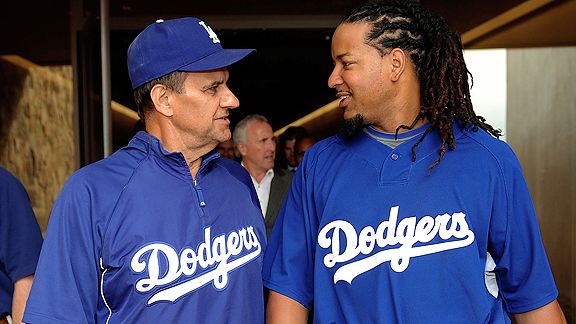
Manny Ramirez officially apologized to his Dodger teammates for the first time since being suspended 50 games for testing positive for a performance enhancing-drug.

“It was uncomfortable. He was a little anxious,” Torre said of Ramirez, who according to players and coaches went around the room greeting teammates with a handshake or a hug. “I sensed an uneasiness that I hadn’t seen before from Manny.”

Although Torre refused to discuss specifics of what took place behind closed doors in a fourth-floor conference room at the Trump International Beach Resort in Sunny Isles Beach, he said Ramirez — who has a house in South Florida — was contrite and apologetic about his suspension, which will keep him on the sidelines until at least July 3.

“He’s remorseful. And embarrassed,” Torre said. “He just wanted to let the team know how sorry he is for that and for the fact that he’s not there for them.”

And while his teammates accepted the apology, many said it wasn’t necessary.

“Nobody needed it or expected it,” said third baseman Casey Blake, who considered Ramirez’s apology “heartfelt.”

“He made a mistake and stood up to it and we all understand that. We just greeted him, shook his hand and said ‘what’s up?’ “

Although some of his teammates said the apology was unnecessary (and maybe it was), it probably didn’t hurt. Manny is human and he made a mistake. That doesn’t mean all should be forgiven, but I think it would have been worse had he crawled in a hole until the suspension was over and then acted as if nothing happened when he returned. I don’t see a downside to Manny doing this.

Top 10 MLB active free passes

There are some batters that no pitcher wants to face, especially in a crucial situation with runners on base, or with first base open. But some guys are intentionally walked with regularity, and in some cases, even with the bases loaded to give up one run instead of four. Here is the current Top 10 among active players in intentional walks. Pitchers, proceed at your own risk…..

1. Ken Griffey, Seattle Mariners (244)—Of course this guy has always been a feared slugger, but he had a career high 25 intentionals in 1993, and the year he slugged 56 homers with 147 RBI on his way to winning the AL MVP (1997), Griffey was intentionally walked 23 times. Yikes. But before we get all excited about that, consider that Barry Bonds was given the free pass 120 times in 2004, a league record that surely will never be broken.

2. Vladimir Guerrero, Los Angeles Angels (240)—He’s topped 20 seven times and 30 once. Is he that feared or are pitchers tired of looking at that crap on Vlad’s helmet?

3. Manny Ramirez, Los Angeles Dodgers (199)—‘Roids, no ‘roids, hormones, no hormones, whatever. This is the one guy in baseball I am never pitching to if I don’t have to.

4. Carlos Delgado, New York Mets (186)—As a Mets fan, I’m just glad my team doesn’t have to face this guy. There is always the potential to hit one 600 feet the opposite way.

5. Todd Helton, Colorado Rockies (172)—You don’t give a guy like Helton anything to hit, not with a .329 lifetime batting average, as well as an average of 30 homers and 109 RBI per season.

6. Albert Pujols, St. Louis Cardinals (160)—Oh yeah, screw what I said about Manny. I forgot about Albert. He’s only 29 years old and should easily hit 700 homers or more. THIS is the guy I don’t ever pitch to if it’s not necessary.

7. Jim Thome, Chicago White Sox (159)—It’s interesting to note that in the ‘90’s Thome and Ramirez typically had single digits in free passes. That’s because if you put them on, you still had to face Albert Belle or Eddie Murray.

8. Chipper Jones, Atlanta Braves (143)—It’s kind of funny that Chipper’s intentional walks are declining as he’s becoming a better and better hitter.

9. Ichiro Suzuki, Seattle Mariners (129)—This one baffles me. Why put a guy on who averages 40 steals per season?

10. Gary Sheffield, New York Mets (128)—A nice, long career, and sheer intimidation at the plate, even today at age 40.

Source: Baseball Reference

The current (sad) state of card collecting

Thanks to Big League Stew, I stumbled upon this little eight-minute documentary about modern-day card collecting. Anthony Stalter watched it as well, so we’re going to discuss how card collecting has changed throughout the years.

John Paulsen: For me, card collecting started with basketball. I was never really into baseball as a kid (mostly because my dad preferred basketball and football, which he played in college), so my focus was on other sports. I had some old Topps football and basketball cards from the late ‘60s and ’70s, but I don’t really remember how I acquired them. Basketball cards were defunct for a while — Michael Jordan’s “real” rookie card could only be found in a regional set produced by Star — and once the mid-90’s hit, the NBA’s popularity blew up, so did the prices of those Star sets from the ’80s. I got into collecting for two reasons: 1) because I liked basketball (and to a lesser extent, football) and 2) I thought it was an investment that I could someday pass onto my son to teach him about the history of the sport (and about investing). Unfortunately, by the time I had some real money to spend on cards (when I was in college), the basketball card industry was so saturated with all the different brands and sets. Instead of going out and buying one or two rookie cards of your favorite player, now there’s 10 or 15 or more amongst all these different brands. The old rookie cards are iconic. I can still picture the first cards for Magic Johnson and Larry Bird, as well as Jordan’s Star rookie and his Fleer rookie, which came a few years later. With so many different brands/lines floating around, rookie cards have lost their appeal. The whole industry has lost its appeal for me, which is depressing because I probably have a few thousand cards stored under my bed that are worth a fraction of what they were 15-20 years ago. I was more of an individual card buyer than a pack or a box buyer. I bought a few packs and boxes in my day, but all those “commons” seemed like a waste. Anthony — how did you get into collecting and what do you think of the industry today?

Continue reading »

« Older posts Newer posts »