It’s safe to say that this past offseason has been one of the worst for Jim Hendry during his tenure as General Manager of the Chicago Cubs. The Los Angeles Dodgers made a mockery of the Cubs’ right-handed lineup in the playoffs by not throwing a single left-handed pitcher at them, and the Cubs responded to this glaring weakness by trading Mark DeRosa, the most versatile and well-liked player on the team – not to mention cheap, since he was in line to make an affordable $5.5 million in the final year of his contract – in order to free up some cash to sign a left-handed power hitter. For God knows what reason, Hendry doesn’t even make an attempt to sign Raul Ibanez, a clubhouse prince who is good for 25 home runs and 100 RBIs year in and year out. Nope, Hendry set his sights on Milton Bradley, a talented but mercurial journeyman (the Cubs are the eighth team he’s played for since his Major League debut in 2000) who just happened to put up career numbers in a contract year. The words “career numbers” sound good, but they come with one big-ass asterisk. Take a look at Bradley’s career year numbers versus the 2008 stat lines of DeRosa and Ibanez:
Raul Ibanez: .292-85-23-110-2
Mark DeRosa: .285-104-21-87-6
Milton Bradley .321-78-22-77-5
It’s a pretty average stat line as career numbers go, and don’t forget that he put up those numbers primarily as a DH, and he still only played 126 games due to nagging injuries. Yep, this is the man that the Cubs hoped would save them, to the tune of three years and $30 million. To add insult to injury, DeRosa now plays for the rival Cardinals.

“Let’s see, if I strike out like that 100 more times this year…I still make $7 million! Ahhhh hahahahahahaha!”
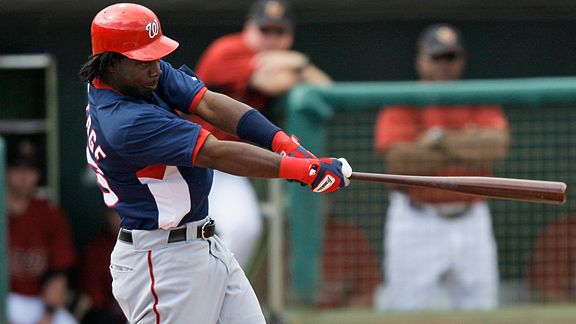
And would you look at that; now that Bradley has his money, he can’t hit water if he fell out of a boat. Well, let’s qualify that – he’s actually hitting .333…from the right side of the plate. He’s hitting .194 as a lefty, has been suspended for bumping an umpire, sent home by his manager after trashing yet another water cooler, and poisoned yet another clubhouse with his unpredictable temper. Bradley said before the season started that he had changed, that those days of flying off the handle (remember when he tore his ACL yelling at an umpire?) were long gone. How on earth did the Cubs believe him? Didn’t they see the “South Park” movie? Bad people always say they’ll change, but they never do.
So what do the Cubs do with Bradley now? He’s expected to take the next two days off to work on his approach from the left side of the plate with new hitting coach Von Joshua. A good start, but we have some other, admittedly extreme suggestions to the Bradley problem that we think the Cubs brass should consider.
Option #1: Release him
Pros: The clubhouse is immediately free of his melodrama, and everyone can finally breathe again. The Cubs are sixth in team ERA, so the pitching is just fine. The hitters, however, are tight as a drum. Lose Bradley, and we’ll bet dollars to donuts that they start hitting again. The move would also send a strong message to both the team and the fans that management is in it to win it, and that they’re willing to put the team’s best interests ahead of everything else, even if it means Hendry wears egg on his face for the foreseeable future.
Cons: The Cubs would be on the hook for the remainder of Bradley’s contract, which will hinder their ability to find a replacement on the free agent market. More importantly, pride always goeth before a fall when it comes to GMs taking responsibility for their bad contracts (see: Matthews, Gary Jr., and Rowand, Aaron), meaning Hendry is unlikely to say “My bad” anytime soon. From our standpoint, though, paying Bradley to disappear isn’t much different than the millions that the Reds are paying Ken Griffey Jr. in deferred money. Besides, who needs free agents when you have kids like Micah Hoffpauir and Jake Fox beating the snot out of the ball?
Option #2: Waive him
Pros: This is the more financially sensible move, since anyone who claims Bradley would assume the remaining money left on his contract.
Cons: No one is going to take on that contract. Bradley didn’t have a single multiyear deal on the table when the Cubs signed him, so there is no chance someone is going to suddenly want him for that many years when his value is at an all-time low.
Option #3: Send him to the minors
Pros: It frees up a roster spot with the big league club while allowing Bradley to get out of the spotlight for a while and figure things out.
Cons: He’s still a Cub. Plus, Bradley would surely have to approve such a move, and something tells us his ego is much too large to accept a demotion with anything resembling grace.
Option #4: Place him on the 15-day disabled list with social anxiety disorder
Pros: This is our personal favorite. Much like a demotion to the minors, this would free up a spot on the major league roster, while sending a loud, clear message to Bradley that management will not tolerate his immaturity for another minute. It’s like a shock collar for a ball player. Punch the water cooler? Boom, you’re on the disabled list, no injury required. Want management to take off the shock collar? Then quit being a jackass. And while Bradley may not be “anxious,” one could definitely make an argument for the man having one social disorder or another. As an added bonus, Bradley would be incensed with the designation, which is sort of the point; it’s not about you, Milton. It’s about the team. If management has to completely destroy your ego in order for you to understand that, so be it.
Cons: Again, he’s still a Cub. And even if the time away improves his attitude, there is no guarantee it will improve his hitting.
Sweet Lou Piniella apologized for sending Bradley home during last Friday’s game against the White Sox. To us, that was a mistake. There are far too many instances these days of management cowtowing to players that have not earned the respect they think they deserve, and few epitomize that better than Bradley. The man doesn’t just need to be humbled: he needs to be broken, like a wild horse. If the Cubs do not want to make the effort to break him, then they should cut him. Cubs fans have waited far too long for a title to be stuck with this clown for another two and a half years.