Tag: Brad Lidge (Page 1 of 2)

With injuries to Blanton, Romero and Lidge, are the Phillies in trouble?

After the club acquired Roy Halladay from the Blue Jays over the offseason, there aren’t too many (if any) media publications that are predicting against the Phillies in the NL East this season.

But with Joe Blanton, J.C. Romero and Brad Lidge set to start the season on the disabled list, should the Phillies be concerned?

Blanton has never been an overpowering pitcher, but he’s been a rock in the middle of the Phillies’ starting rotation since he was acquired from the A’s a couple years ago. He’ll miss anywhere from 3-6 weeks after tweaking his oblique muscle during a recent throwing session and now Kyle Kendrick (who lost out to Jamie Moyer for the club’s fifth starter spot) will take his place.

Romero underwent surgery to repair a torn flexor tendon in his elbow last October and isn’t ready to return, although he is progressing faster in his rehab than Lidge. Both pitchers aren’t expected to return until mid April at the earliest.

Continue reading »

2010 MLB Preview: NL East

In order to help get you ready for the MLB season, we’re doing division-by-division rankings with quick overviews on how each club could fair in 2010. Next to each team, you’ll also find a corresponding number written in parenthesis, which indicates where we believe that club falls in a league-wide power ranking. Be sure to check back throughout the next two weeks leading up to the season, as we will be updating our content daily. Enjoy.

All 2010 MLB Preview Content | AL East Preview | AL Central Preview | AL West Preview | NL East | NL Central | NL West

Next up is the NL East.

1. Philadelphia Phillies (2)
Much like the Yankees in the American League, it’s hard to find bad things to say about the Phillies. They’re the three-time defending NL East champions and considering they’re ready to bring back the same core of players that got them to the World Series the past two years, there’s no reason to doubt them. Oh, and they added Roy Halladay. Roy, I’m going to dominate your face for nine innings, Halladay. If Cole Hamels rebounds and J.A. Happ’s 2009 wasn’t a fluke, the Phillies won’t suffer a setback this season. In fact, the pitching doesn’t even have to be that great with the likes of Jimmy Rollins, Placido Polanco, Chase Utley, Ryan Howard, Jayson Werth and Raul Ibanez taking up the first six spots in the order. The problem, however, is that Hamels might not bounce back and Happ’s ’09 season may have been a fluke. There’s also that nagging Brad Lidge closer issue that could haunt this club as well. That said, odds are that the Fighting Phils will be right back at the top of the NL East again this season. They’re too good, too talented and too experienced to fold and they have a great chance to reclaim their title back from the Yankees.

Continue reading »

Phillies take Game 1 of NLCS

Carlos Ruiz and Raul Ibanez hit three-run homers as the Phillies beat the Dodgers 8-6 in Game 1 of the NLCS on Thursday. Ryan Howard also hit a two-run double and closer Brad Lidge pitched a scoreless ninth to protect a two-run lead.

Since the NLCS moved to a seven-game format in 1985, the team that takes a 1-0 lead has won 16 of 23 series, including 14 of the previous 16. In fact, eight of the 10 National League teams that took a 1-0 lead on the road have reached the World Series, including the past seven times.

Usually teams in the playoffs look to, at the very least, earn a split when they’re on the road. For Philadelphia to jump out to a 1-0 lead in the NLCS is huge, especially considering how good their bats looked.

Game 2 is set for 4:07 p.m. ET on Friday and will feature Pedro Martinez vs. Vicente Padilla. It’s kind of amazing that Martinez is back pitching in a championship series again and hopefully for the Phils’ sake, he produces some of the magic that made him a lights out pitcher in Boston.

2009 Fantasy Baseball Preview: Relief Pitchers

All 2009 Fantasy Articles | 2009 Position Rankings

There are two general schools of thought when it comes to selecting relief pitchers. Some owners zero in on a stud and are willing to select one in the first couple rounds, while others don’t mind cruising the wavier wire on a regular basis during the season after they waited to address the position late in their draft.

Neither approach is bad, although each has its drawbacks. K-Rod racked up 62 saves last season, but switching clubs and leagues this year leads to some uncertainty, plus outside of saves, his ERA and WHIP numbers have been on the decline for years. If you’re the type that burns a high draft pick on a top reliever and a guy like K-Rod fizzles, you obviously would have cost yourself an opportunity to select a position player that could have given you great value at that spot.

Conversely, if you wait until the later rounds of your draft to address your stopper(s), then you run the risk of playing Russian Roulette with the position throughout the regular season, possibly costing you wins/points in not only saves, but strikeouts, ERA and WHIP as well.

If we could offer some advice, we recommend finding a happy medium between those that make finding a reliever one of their top priorities, and those who avoid it like the dentist. Find that next wave of relievers after names like Joe Nathan, Jonathan Papelbon and Mariano Rivera come off the board. Chances are you’ll get a nice combination of saves, strikeouts, ERA and WHIP without burning a high draft pick on one of the studs.

Below are some closers that won’t cost you a top draft pick, but also ones that shouldn’t come up short in the production department.

Carlos Marmol, Chicago Cubs
Marmol is an incredibly intriguing, yet risky closer prospect. He has all the tools and talent to must 40-plus saves, but he is inexperienced and has some control issues. Still, the closer role is all his after Kerry Wood signed with the Indians in the offseason and if Marmol can take the next step forward in his development, he could be in store for a big season.
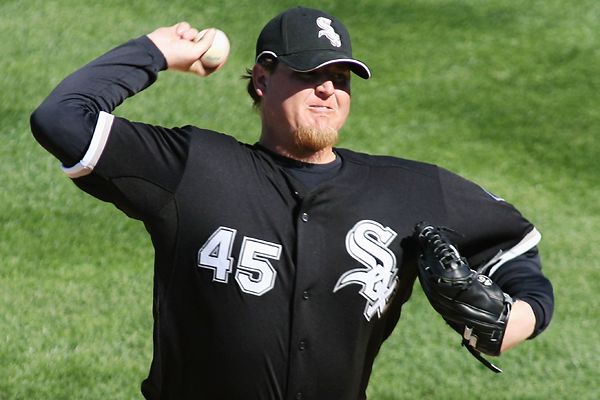
Bobby Jenks, Chicago White Sox
Jenks might scare some owners away this year after having back issues last year. But if he earned 30 saves at less than ideal health and after losing some zip on his fastball, then he’s capable of producing 35-plus saves this season now that he’s healthy again. If he ever matures, he could be one of the better closers in the league.

Kerry Wood, Cleveland Indians
Wood might be the most intriguing closer in fantasy this year after saving 34 games last season for the Cubs. He joins the Indians this year and if the Tribe bounces back, he has the potential to top the 40 mark in saves. He obviously has to stay healthy, however, and must avoid tiring like he did in the second half last season. (He went from having a 2.43 ERA and 0.86 WHIP to 4.57 and 1.45 in the second half.)

Jonathan Broxton, Los Angeles Dodgers
Don’t be scared – Broxton is a stud in the making. The 24-year old has 40-plus save potential and should once again sniff 90 strikeouts, all while keeping his ERA south of 2.80. He has trouble staying consistent at times, but Broxton’s 11.4 strikeouts per 9 innings is nothing to scoff at.

Brian Fuentes, Los Angeles Angels
If the Angels give Fuentes as many opportunities for saves as they did K-Rod last year, then the former Rockie could be one of the best bargains in your draft this season. He saved 30 games last year and managed to keep his ERA (2.73) and WHIP (1.10) low. You might be able to put Fuentes down for 35 saves this season, with comparable ERA and WHIP numbers from 2008.

Brian Wilson, San Francisco Giants
Wilson’s 4.62 ERA and 1.44 WHIP were nasty last year, but his 41 saves make him an awfully intriguing pick. Now that he has a full season under his belt, he should be able to lower his ERA dramatically, although he must be more consistent and cut down on the walks. Even though he pitches for a poor team, the Giants will give Wilson plenty of opportunities for saves as they have the penchant for playing in a ton of tight ballgames.

Below is our official ranking of relief pitchers.

1. Jonathan Papelbon, BOS
2. Joe Nathan, MIN
3. Mariano Rivera, NYY
4. Brad Lidge, PHI
5. Joakim Soria, KC
6. Jose Valverde, HOU
7. Francisco Rodriguez, NYM
8. B.J. Ryan, TOR
9. Carlos Marmol, CHC
10. Bobby Jenks, CWS
11. Jonathan Broxton, LAD
12. Kerry Wood, CLE
13. Francisco Codero, CIN
14. Brian Fuentes, LAA
15. Matt Capps, PIT
16. Brian Wilson, SF
17. Heath Bell, SD
18. Trevor Hoffman, MIL
19. Frank Francisco, TEX
20. Matt Lindstrom, FLA
21. Mike Gonzalez, ATL
22. George Sherrill, OAK
23. Chad Qualls, ARI
24. Huston Street, COL
25. Joey Devine, OAK
26. Troy Percival, TB
27. Joel Hanrahan, WAS
28. Justin Duchscherer, OAK
29. Brad Ziegler, OAK
30. Brandon Lyon, DET
31. Jose Arredondo, LAA
32. Brandon Morrow, SEA
33. Manny Corpas, COL
34. Chris Ray, BAL
35. Chris Perez, STL
36. J.J. Putz, NYM
37. Fernando Rodney, DET
38. Manny Parra, MIL
39. Dan Wheeler, TB
40. Miguel Batista, SEA
41. Kevin Gregg, CHC
42. Takashi Saito, BOS
43. Grant Balfour, TB
44. Hong-Chih Kuo, LAD
45. Rafael Betancourt, CLE

It’s all about the pitching

“Momentum is always as strong as your starting pitcher is the next day.”
– Joe Maddon

Leave it to the well-read Rays manger to come up with such a profound statement. Chances are this saying is nailed up in his teams’ clubhouse alongside others from the likes of Albert Camus and Jean-Paul Sartre. Maddon’s right, and he’s used this pitching-first philosophy to propel his team into the ALCS.

If there’s one quality that ties each of the remaining four teams together, it’s that each of them can hit. They each have at least two big bats, lead-off men that can hit for average, and a bottom of the order that can consistently do some damage. When teams are this evenly matched at the plate, it’s often a single blunder on the part of a pitcher that can decide a game. As we’ve seen in the Division Series between the Angels and Red Sox, it comes down to the pitching. Both teams boasted fabulous rotations and excellent hitting, but it was the Red Sox middle relief and closer that really won the games.

The same will go for both matchups in the Championship Series. The Phillies, Dodgers, Rays, and Red Sox all have three starters who can win games at home and on the road. However, these series are best out of seven games, which creates a dilemma for each of these ball clubs as there isn’t a strong fourth starter to be found. Subsequently, these teams might start their aces after three days rest, or even force them to pitch for a third time if the series extend to seven games. This will be a test of player’s stamina and sound decision-making on management’s part. While managers struggle with whether to start a tired arm or an unpredictable one, a bullpen becomes even more valuable. They can come to the rescue (Matsuzaka in the ALDS), consistently put the lid on a victory (Papelbon and Lidge all year), or sometimes pitch the majority of the game after a starter bombs (Wade, Park, Kuo, and Saito of the Dodgers).

These games are going to be decided in the late innings, and this factor alone will make watching them gratifying. Here’s the breakdown:

Los Angeles Dodgers vs. Philadelphia Phillies

At their healthiest, the Dodgers have a better pitching staff than the Phillies. If set-up man Hong-Chi Kuo and closer Takashi Saito hadn’t injured themselves at the end of the season, this series would undoubtedly favor the Dodgers. As a result, they need their starters to go as long as possible. If Derek Lowe, Chad Billingsley, and Hiroki Kuroda can each go seven innings in all of their starts, I think the Dodgers can rely on their bullpen to pull through. Chan Ho Park and Cory Wade are both capable of maintaining a lead. The problem lies in the intimidating left-handed Phillies hitting. The Dodgers only have three southpaws on their roster: starter Clayton Kershaw, reliever Joe Beimel, and the aforementioned Kuo. Word is that the left-handed Kuo has been comfortable in recent simulated sessions. The Dodgers have said that Kuo might pitch an inning per game. A successful eighth inning with Kuo in relief opens the door with recent go-to closer Jonathan Broxton. Of course, this is idealistic. Yet, the fact remains that the Phillies cannot match this formula. It’s true that Brad Lidge outshines any of the Dodgers relief, but he’s only as good as the lead he’s protecting. The Dodgers dominated the opposition’s starting pitching better than any other team in the Division Series. They pounded Ryan Dempster, Carlos Zambrano, and Rich Harden of the Cubs, a rotation far more intimidating than the Phillies’. During the regular season, the clubs were evenly matched, with each sweeping the other at home and splitting their decisions. What’s important now is how late into the game their starters can pitch before handing it off to their relief.

The Dodgers have a couple advantages over the Phillies. The first lies in Derek Lowe. He’s thrown “Cy Young” quality pitching for the past two months and has more playoff experience than the Phillies starters combined. The Dodgers can pressure Lowe into pitching Games 1, 4, and if need be, 7. With a two or three run cushion, Lowe can hold steady into the eighth inning, even on three days rest. Given the Dodgers recent activity at the plate, they should be able to support their ace. If Lowe isn’t given the reins in Game 4, the Dodgers could either go with Clayton Kershaw or Greg Maddux. Both can outduel Joe Blanton of the Phillies. Kershaw, the likely choice, has pitched capably against Jimmy Rollins, Chase Utley, and Ryan Howard who have struggled against left-handed pitching.

Boston Red Sox vs. Tampa Bay Rays

The two best teams in the American League advanced. This statement is obvious as both the Red Sox and the Rays made due with critical injuries that severely altered their team’s chemistry. Josh Beckett’s recent injury was visibly apparent in Game 3 against the Angels, as he gave up three runs on eight hits in five innings. Still, Jon Lester, the strongest pitcher in the postseason, led the Red Sox to a Game 4 clincher. The Rays will likely be without veteran closer Troy Percival, who had a magnificent first half. With Percival gone, they’ve moved Dan Wheeler into his spot. Wheeler blew five out of 18 chances during the regular season. Even without a strong closer, the Rays offense produced a large enough lead for their starters to secure wins against the White Sox.

Tampa Bay enters this series with the third best team ERA in baseball. Though they finished 10-8 against the Red Sox, both teams were swept twice at home. James Shields, Scott Kazmir, Andy Sonnanstine, and Matt Garza are a very good rotation, and they’ve proven they can hold a lead when given it. Nevertheless, Jon Lester, Josh Beckett, Daisuke Matsuzaka, and Tim Wakefield stack up better pound for pound—when they’re injury-free. And they’re not. The Rays need to win all their games against an ailing Josh Beckett and a struggling Tim Wakefield. Also, it’s essential to build a lead substantial enough to render Papelbon useless. If Shields, Kazmir, or Garza can outpitch either Lester or Matsuzaka in at least one decision, the Rays have a very good chance.

For Boston, Papelbon is just as key now as he’s ever been. Of the teams that remain, no other closer is as valuable. While the Rays have a fairly talented set-up in Grant Balfour, J.P. Howell, and David Price, Dan Wheeler doesn’t bring the sense of security that comes with Papelbon. If he’s on the mound, the Red Sox are going to win—there’s just no way around it. To advance to the World Series, the Rays need to get to Lester or Matsuzaka in one of their starts. It’s difficult, but not impossible.

Any way you slice it, this year’s World Series is going to be entertaining. Each of these teams carry their own unique story. Whether it’s Manny and Torre in L.A., Charlie and the Phillies, the Red Sox domination, or the endearing Rays, whoever wins will be a deserving champion.

« Older posts