Tag: Top 10 lists (Page 3 of 3)

Top 10 Worst Super Bowl MVPs

RealClearSports.com ranked the top 10 worst Super Bowl MVPs of all-time:

Tom Brady10. Tom Brady – Super Bowl XXXVI
The game itself – one of the biggest upsets in Super Bowl history – featured many heroes: Ty Law and his 47-yard interception returned for touchdown, Adam Vinatieri’s two field goals, including the game-winner as time expired, and Troy Brown’s game-high six receptions, but the real MVP was head coach Bill Belichick, who designed a game plan that slowed the “Greatest Show on Turf” to just 17 points.

While it can be considered near blasphemous to include Tom Brady on any list with “worst” in the title, his performance in Super Bowl XXXVI was hardly MVP-worthy. The NFL’s Golden Boy was a paltry 16-for-27 for 145 yards and one score; even on the now famous last-minute drive, he completed three of the five passes to running back J. R. Redmond.

9. Ray Lewis – Super Bowl XXXV
The Ravens defense dominated the Giants in Super Bowl XXXV, allowing just 152 total yards as they rolled to a 34-7 victory. Ray Lewis, the emotional and vocal leader, played a large role in the game, but his stats, three solo tackles and four blocked passes, are far from stellar. Of the Giants’ five turnovers, Lewis was only partially responsible for one of them, a tipped-pass that was then picked-off by Jamie Sharper. While leadership is important in naming the MVP, stats count too, and Lewis just didn’t have them.

1. Dexter Jackson – Super Bowl XXXVII
The Raiders had the most potent passing attack in the league in 2002. Quarterback Rich Gannon led the league in passing yards, had the best touchdown-to-interception ratio and was the league’s regular season MVP. But it was the Bucs defense that shined, forcing Gannon into throwing a Super Bowl record five interceptions (after recording just 10 during the regular season).

Two of those interceptions were returned for touchdowns of 44 and 50 yards – both by the same cornerback, Dwight Smith – but he was surprisingly not named MVP. Instead, Dexter Jackson, who also had two picks, was named MVP. Two interceptions in a Super Bowl are impressive, but it’s far from an anomaly: 10 other players have intercepted at least two passes in the big game. And what did the Bucs get out of those two interceptions? Just one field goal.

To be fair to Jackson, both of his interceptions came in the first half when the game was still close. In fact, one could say that both of his picks set the tone for Tampa’s blowout. Where as Smith’s two interceptions came when the game was largely in hand for the Bucs, his second one coming with under 30 seconds left to play and Tampa up 41-21. This is an example where stats don’t paint the entire picture.
Top 10 Sports Fight Songs

The Love of Sports ranked the top 10 sports fight songs:

3. “Brass Bonanza” – Hartford Whalers
This amazing tune was the fight song of the Hartford Whalers hockey team, now known as the Carolina Hurricanes, of course. It’s part elevator music, part cheesy sports movie soundtrack, part magic. Hard to imagine why anybody in Hartford would ever let the team leave Connecticut.

2. Miami Dolphins Fight Song
It’s surprising that anybody talks about the Miami Dolphins’ fight song anymore, because the banjo-laden and grammatically incorrect tune certainly takes listeners back to an earlier era. However, the upbeat tempo and positivity that oozes from the fight song makes it hard to resist.

1. “When The Saints Come Marching In” – New Orleans Saints
Though the song isn’t used exclusively by the Saints, it’s often associated with the team (like in that MasterCard commercial last year!). In actuality, the team was named after the song. Once covered by Louis Armstrong, the song isn’t just a part of football culture, but of American culture as well. Much like Peyton Manning, who’s transformed himself from an NFL quarterback to a television commercial superstar. But I digress.

The Whalers’ jam sounds like an 80s sitcom theme song or something. It makes you want to bounce your head.

Could you imagine some of the theme songs for teams now? All of the songs on TLOS’s top 10 list are all light and fun. If teams had their own theme songs nowadays it would probably be about ho’s, intravenous drug use and detailed ways to literally kill the other team.

Top 10 MLB Free Agent Signings

On Tuesday, RealClearSports.com tackled the top 10 worst MLB free agent signings of all-time.

On Thursday they pay tribute to the best:

1. Barry Bonds – Signed by San Francisco in 1992, six years, $43 million.
A six-time all-star, five gold gloves, one MVP award; his numbers were not as gaudy as they would be in the six years that followed, but he still lived up to the contract, and then some. And never, ever caused off-the-field concerns or troubles.

2. Greg Maddux – Signed by Atlanta in 1992, five years, $28 million.
It seemed almost unfair when the Braves, who already had Tom Glavine, John Smoltz, and Steve Avery, added Cy Young winner Maddux to the rotation. In the five years of his contract, he won three more Cy Youngs in the first three years, two of them unanimous; he was first or second in the league in ERA all five years; and posted an 89-33 record for the perpetual division champs.

3. Manny Ramirez (Boston, Dec. 2000, eight years, $160 million) and Alex Rodriguez (Texas, Jan. 2001, ten years, $252 million).
Both contracts were gargantuan, for amounts of money that seemed obscene at the time – and still do. Yet both, under the representation of Scott Boras, opted out of the last few years of the deals, expecting to make even more. The two were nearly traded for each other in 2003 before the Players Association rejected an agreement with Boston that would have reduced A-Rod’s compensation by $4 million per year. Both players are sure Hall of Famers, two of the greatest right-handed hitters who ever lived.

A-Rod’s opt-out brought him more years and more money; Manny does not yet know how it will work and where he’ll end up “being Manny.” Would A-Rod trade his three MVPs for just one of Manny’s two World Series titles — or even a single World Series at-bat? We’d like to think so, but honestly, we don’t know.

It’s kind of interesting to think that Bonds was very close to becoming an Atlanta Brave in 1992. I don’t think there has ever been a free agent signing in baseball that made a bigger impact than when Bonds went to San Fran. Makes you wonder if things would have been different in Atlanta and if he would have stayed in a city/state dominated by college football and NASCAR for as long as he wound up staying in Frisco.

Top 10 Worst MLB Free Agent Signings

RealClearSports.com recently ranked the top 10 worst MLB free agent signings of all-time.

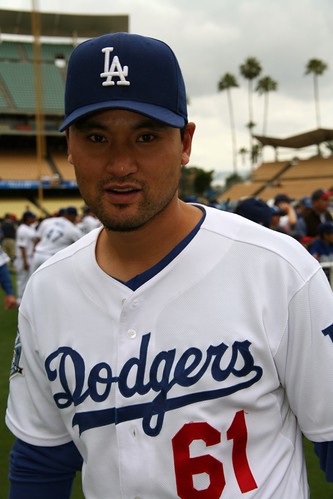
Chan Ho Park#1 Chan Ho Park Signed by Texas in 2002, five years, $65 million.
Coming off 18-10 and 15-11 seasons in the pitchers’ heaven that is Dodger Stadium, Texas gave Park one of the most lucrative contracts ever given to a pitcher at that time. Injuries limited his workload, which wasn’t a bad thing considering his ERAs with the Rangers: 5.75, 7.58, 5.74, 5.66, before he was finally unloaded to San Diego in 2005.

#2 Juan Pierre (signed by Los Angeles in 2006, five years, $44 million) and Andruw Jones (signed by Los Angeles in 2007, two years, $36.2 million).
You know it’s a really bad signing when the team inks someone a year later to play the same position, and he does even worse. Pierre took his below-league-average on-base ability and minuscule power into the offensive void of Dodger Stadium with predictable results: .664 and .655 OPS in his two seasons so far. Andruw Jones received a raise off his worst season in 2007, and demonstrated that bad year in Atlanta was no fluke, batting .158 with three home runs in 209 at bats in 2008. The Jones signing also shifted Pierre to left field, where his wretched bat for a centerfielder would be an even greater liability. By the end of the season, the Dodgers recognized their CF answer had been there all along, in the person of Matt Kemp.

#3 Mike Hampton and Denny Neagle – Signed by Colorado in 2000; Hampton for eight years, $121 million, Neagle for five years, $51 million.
The vertiginous problem of pitching in Colorado led to some terrible decisions. Even though importing a free agent had failed in the case of Darryl Kile (ERAs of 5.20 and 6.61 in his two seasons before he was traded to St. Louis), the Rockies tried again in the 2000-01 offseason, giving $172 million to two lefthanders. Hampton was hampered by injuries and ineffectiveness in his two seasons in Colorado, going 21-28 with ERAs of 5.41 and 6.15 before being shipped off to Florida (and then on to Atlanta); his free-agent contract finally expired last year. Neagle was a decent 31-year-old pitcher with a 105-69 record and 3.92 career ERA when the Rockies elevated him to the front of their rotation; he gave them three seasons of 19-23, 5.56, before earning his release with two years left on his contract.

I’m a little surprised Barry Zito didn’t make the list, but I guess people are willing to give him one more year of brutal pitching before really laying the hammer on the massive free agent bust.

Top 10 Miami Hurricanes in the NFL

The Love of Sports ranked the top 10 Miami Hurricane players currently in the NFL (with YouTube highlight clips, by the way).

2. Reggie Wayne, Wide Receiver
Wayne was a rare four-year starter at Miami and set a school record with 173 career receptions. This wide receiver’s been an integral part of the Colts’ vaunted aerial attack since the team drafted him in 2001, and his receptions have increased in each of his seven seasons in the league. He was named to his first Pro Bowl in 2006 and followed it up with 104 receptions for a league-leading 1,510 yards last season. He’s recently supplanted Marvin Harrison as Peyton Manning’s favorite target and hasn’t missed a game since 2002.

1. Ed Reed, Safety
Reed set Miami’s all-time interception record while leading the Canes to a national championship in 2001. He’s now the best defensive player on a Ravens unit that’s surrendered the second-fewest yards per game this season. He reads quarterbacks as well as any safety in the league and is regularly among the league leaders in interceptions. He’s made four consecutive Pro Bowls and was the NFL Defensive Player of the Year in 2004. Good ole #20’s also a menace on special teams, where he’s blocked four punts in his career and returned one for a touchdown last season as well.

It’s amazing how many good NFL players the Canes have produced over the years.

Newer posts »