Tag: Tony Parker (Page 3 of 6)

Spurs dangled Tony Parker for Chris Paul?

The NBA rumor mill is in full effect and one of the more interesting tidbits I saw this fine Monday morning was that, via Hoopsworld, “league sources” are saying that the Spurs offered up Tony Parker in a bid to get Chris Paul.

The offer was immediately turned away by the Hornets.

However it is interesting to hear San Antonio would consider parting with Parker, but if it returned Chris Paul the move is easy to justify. Parker has one more season remaining on his deal worth $13.6 million and could be one of the top free agent guards in the summer of 2011.

First of all, any rumors that come from “league sources” need to be taken with a grain of salt. If true, it is interesting that the Spurs would be willing to part ways with Parker, but I think even he would understand the upside of the Spurs landing Chris Paul.

The deal wouldn’t make any sense for the Hornets as the two players’ salaries are about the same. Paul is signed through the 2011-12 season, one year longer than Parker. The downgrade wouldn’t be worth it for New Orleans.

The Hornets need to weather the storm and try to hold onto Paul. If they were ever to trade him, it should be during (or just before) the 2011-12 season. The Hornets are in a tough financial situation, but it’s of their own doing. The moves for Peja Stojakovic, Morris Peterson and James Posey simply haven’t resulted in the kind of winning the franchise was expecting. Then they traded away Tyson Chandler (whose deal expires in 2011) for Emeka Okafor (whose deal runs through 2014). This is a curious move for a team that is supposedly cash-strapped. I don’t mind the trade from a pure basketball standpoint, but fiscally it doesn’t make a lot of long term sense.
Decade Debate: 6 Greatest Sports Rivalries

The word rivalry is defined as “competition for the same objective or superiority in the same field.” Rivalries exist in all facets of life, but they are no more apparent than in the world of sport. With the end of the decade looming, here are the six most intense rivalries of the last ten years.

6. Tiger Woods vs. Phil Mickelson

Competition between Tiger Woods and Phil Mickelson may not produce the mystique that Arnold Palmer and Jack Nicklaus once did, but their rivalry has been exciting nonetheless. Without Tiger Woods, professional golf’s popularity would be a mere morsel of what it is today. The man has won 14 majors, holds his own tournament (the AT&T National), designed two beautiful courses, is the only golfer with his own video game, and garners public intrigue on the same level as world leaders. Still, his status as figurehead of professional golf wouldn’t have any merit without some stiff competition. Enter Phil Mickelson, Tiger’s only adversary with any staying power. When Mickelson won the 2000 Buick Invitational, he also officially ended Tiger’s streak of consecutive tournament wins at six. Over the years, Mickelson would hire Butch Harmon, Tiger’s former coach, and joke about Tiger’s use of “inferior equipment.” Still, their rivalry always remained amicable, even as Phil won his first major in ’04 (The Masters), the PGA Championship in ’05 another Green Jacket in ’06. During this year’s Masters, Tiger and Mickelson were finally paired together in a major event. Trudging down the final back nine at Augusta, the two golfers put on a show that thankfully lived up to the hype. –- Christopher Glotfelty

Continue reading »

The top 10 first round steals of the last 10 years

Everyone loves to focus on the lottery, but there are good players to be had in the late first round as well. A while back, I put together a list of the top second round picks of the modern era, so now I’m going to focus on those players that were drafted between pick #21 and pick #30 in the first round. (Note: If a player was drafted in the second round, even if they were taken with the #29 or #30 pick overall, they are ineligible to make the list. Sorry, Gilbert.) Since there are more star-quality players available in the 20’s, I’m limiting this list to the last ten drafts (i.e. 1999 through 2008).

It is sometimes tough to rank older players with newer players, but even if a younger player holds more trade value right now, I am going to take into account each player’s entire career. For the young guys, I have to project a little bit, so keep that in mind as you read and react. I feel great about the top eight guys, but there are a few players that missed the list that are pretty interchangeable with #9 and #10.

On with the list…

10. Aaron Brooks, Rockets
26th pick in 2007
I had to decide between Brooks and Nate Robinson here and went with Brooks given his fine performance in the playoffs this season (16.8 ppg, 3.4 apg, 42% from 3PT) and how Robinson’s numbers are a little inflated playing for Mike D’Antoni. Brooks is not a natural point guard, but his sharpshooting is a good fit given Houston’s inside-out attack. He’s small, but he’s quick and is able to score at the rim when given some daylight. The Rockets feel good enough about Brooks to trade Rafer Alston away midseason, so you have to like his upside.

9. Kendrick Perkins, Celtics
27th pick in 2003 (drafted by the Grizzlies)
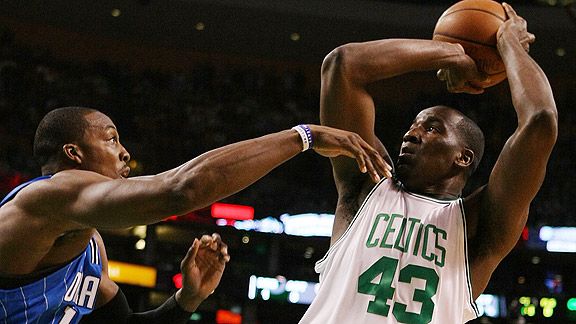
In the world of “big” guys, I also considered Boris Diaw here, but it’s tough to pass on a 6’10” 24-year-old who averaged 8.5 points, 8.1 rebounds and 2.0 blocks per game on a team loaded with vets. Without Kevin Garnett in the playoffs, the C’s needed Perkins to step up his game and he responded with 11.9 points, 11.6 boards and 2.6 blocks per contest. He also did a pretty good job on Dwight Howard, who had his worst numbers of the playoffs against the Celtics.

8. David Lee, Knicks
30th pick in 2005
Isiah Thomas couldn’t make a good trade to save his life, but he could spot talent in the draft. Lee has turned out to be a steal with the last pick in the 2005 draft. He’s an athletic lefty whose best traits are his hustle and smarts. In just his fourth season, Lee averaged 16.0 points and 11.7 rebounds per game, which made him one of the most consistent double-double guys in the league. His stock is so high right now that the Knicks might be able to use him as trade bait in order to land Chris Bosh or Amare Stoudemire. Maybe they’d be better off sticking with Lee…

Continue reading »

What kind of point guard is he?

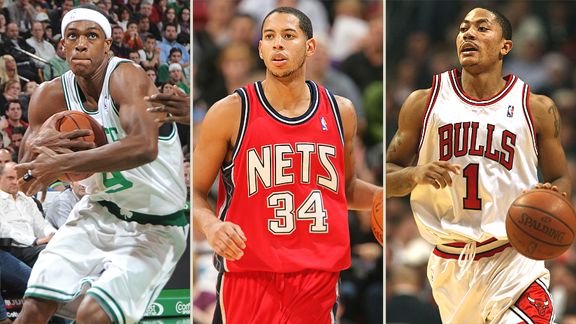
We hear it all the time. NBA analysts call one point guard “pass-first” and another “shoot-first.” Or they say one guy is “turnover-prone” while another “takes care of the ball.” But really, what makes a player a “pass-first” point guard? How carefree must he be with the ball to be considered “turnover-prone”?

Taking an analytical approach to these questions, I decided to bust out an Excel spreadsheet and try to come up with some answers. Below you’ll see a graph that attempts to classify the top point guards in the league. But first, a little background…

I chose to categorize each player based on two stats. First, to determine if he’s “shoot-first” or “pass-first,” I calculated the shot-to-assist ratio for each player. The bigger the number, the more of a “shoot-first” mentality the player has. Second, to determine whether or not a player is “turnover-prone,” I calculated each player’s assist-to-turnover ratio. I thought about using turnovers per 48 minutes, but I like the idea of including assists so that playmakers are rewarded for the positive as well as the negative. Next, I calculated each player’s Efficiency Per Minute (EPM) to see if there is any correlation between these other statistics and the overall efficiency of the player in question.

Continue reading »

What happened to the Spurs?

With the Mavericks’ 106-93 Game 5 win in San Antonio, it is the first time that Tim Duncan has lost a first round series. Tony Parker shot 55% from the field, and averaged 28.6 points, 6.8 assists and 4.2 rebounds per game. Battling sore knees, Duncan still shot 53% from the field, averaging 19.8 points and 8.0 rebounds. Normally, those kinds of numbers from the Spurs’ top two players would result in a series win. What happened?

1. No supporting cast.
Manu Ginobili was out. Duh. But the rest of the Spurs failed to step up in his absence. Parker and Duncan combined to shoot 100 of 185 (54%) in the series, which means everyone not named Tim or Tony combined to make just 75 of their 198 attempts (38%). Roger Mason shot 42% from long range during the season, but made just 37% in the series. The midseason addition of Drew Gooden was a bust; he averaged just 7.3 points and 3.8 rebounds, and shot 33% from the field. Without Ginobili, there wasn’t a third scorer to take the pressure off of Parker and Duncan.

2. Mediocre defense.
The Mavs averaged 96.4 points per game, shot better than 46% from the field and better than 38% from long range during the series. Now those numbers are by no means eye-popping, but they are very un-Spurs-like. San Antonio just couldn’t get the consistent stops it needed to make up for its overall lack of scoring. Josh Howard and Dirk Nowitzki were both stellar, while J.J. Barea and Brandon Bass played great off the bench when Dallas needed it.

The Spurs head into the summer with zero cap space, but with the fiscal state of the league, they’ll have a good opportunity to add a quality player at the mid-level exception, assuming they want to spend the money. My guess is that they will, given that Tim Duncan’s championship window continues to get smaller and smaller. The team is fine in the backcourt, with Parker, Ginobili, Mason and George Hill. They need help on the wing and in the frontcourt, so the priority will likely be a big man. Rasheed Wallace’s name has been floated, but Zaza Pachulia, Anderson Varejao, Brandon Bass, Chris Andersen and Antonio McDyess are cheaper options.

« Older posts Newer posts »