Tag: statistical studies (Page 3 of 4)

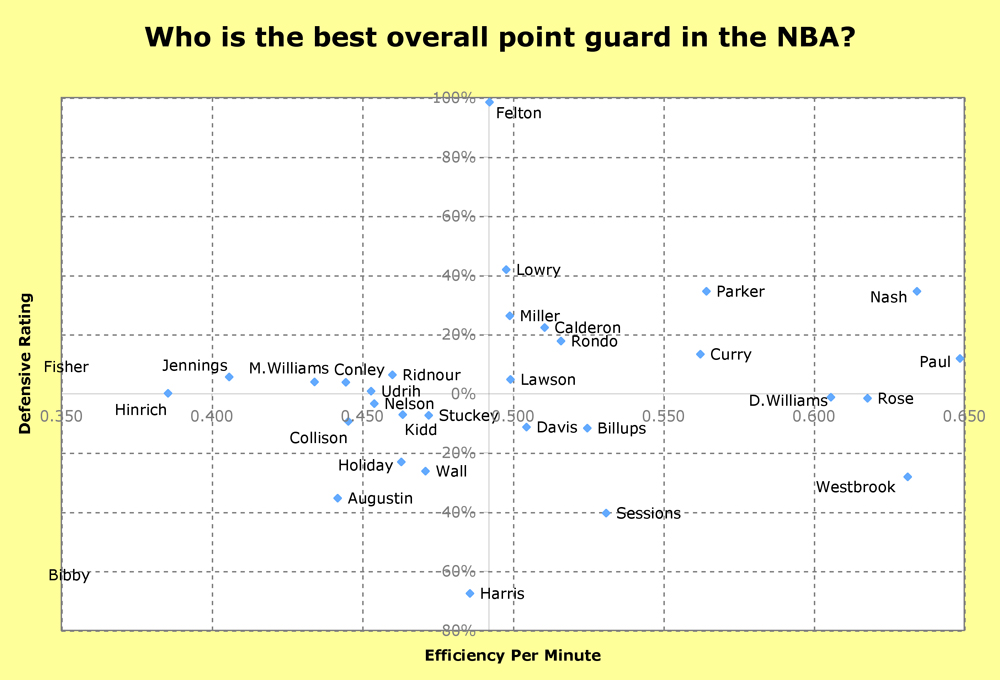
Who is the best overall point guard in the NBA?

Phoenix Suns guard Steve Nash celebrates after his teammate Hakim Warrick scored to put the New York Knicks down nine points very late in the fourth quarter of their NBA basketball game at Madison Square Garden in New York January 17, 2011. REUTERS/Ray Stubblebine (UNITED STATES)

Follow John on Twitter.

Who is the best overall point guard in the NBA? The answer to this question depends on your criteria. Are you using the eye test or are you more interested in basic stats like points, assists and turnovers. Or do you want to use advanced statistics like Player Efficiency Rating (PER) or plus/minus numbers?

I am a stathead, but numbers only go so far. A point guard’s leadership, presence, poise, vision and defense is just as important as his shooting percentage or his assist to turnover ratio. As a former college player I think I know the game pretty well and I understand that numbers only go so far.

That said, let’s look at some numbers!

I like to use Efficiency Per Minute as a good overall gauge of a player’s production when he’s on the court. For this study, I took the top 30 players in Efficiency Per Game and then added a few players so that every team would be represented at least once.

EPM doesn’t take into account defense (except for steals, blocks and defensive rebounds), so for that side of things, I am putting together a custom statistic that uses both Opponent PER and on/off defensive stats from 82games.com. So, for Tony Parker, I’ll use his 48-minute opponent PER (15.1) and his Net Defense per 100 Possessions (-3.8). Both of these stats are flawed. Opponent PER doesn’t take into account what kind of team defender Parker is while his net defense could be impacted positively (or negatively) if his backup is really poor (or really great) defensively. There may also be bias of strength of schedule (i.e. there are better point guards in the West). But this is what we have to work with.

Using both Opponent PER and Net Defense, I came up with a Defensive Rating that weights each number equally versus others in this study. If the Defensive Rating is positive, he’s a better than average defender. If it’s negative, he’s below average.

Keep in mind that the EPM numbers are for an entire season while the 82games stats are only for a player’s current team, so the defensive rating for players who were traded midseason — Ray Felton, Chauncey Billups, Mike Bibby, Deron Williams, Mo Williams, Baron Davis, Devin Harris and Kirk Hinrich — will only factor in games after they were traded.

Here’s a look at the resulting chart. As always, click on the chart for a bigger version.

Continue reading »

Who is the best rebounder in the NBA?

Minnesota Timberwolves forward Kevin Love (42) holds back Dallas Mavericks forward Brian Cardinal (C) in front of Timberwolves’ Michael Beasley (R) during the first half of their NBA basketball game in the Target Center in Minneapolis, March 7, 2011. REUTERS/Eric Miller (UNITED STATES – Tags: SPORT BASKETBALL)

Over the past few weeks, I’ve tackled the MVP race, triple-dozens, point guard characteristics and three-point shooters, and now it’s time to take a look at rebounding.

To be eligible, a player has to meet the following criteria:

1. He must appear in at least 50 games.
2. He must play in at least 24.0 minutes a game.

I took the top 30 players in terms of Total Rebounding Rate (the number of rebounds a player gets as a percentage of total available rebounds available while he’s on the floor) and plotted Offensive Rebounding Rate (ORR%) against Defensive Rebounding Rate (DRR%).

Here is the list of eligible players (in alphabetical order): Andrew Bogut, Carlos Boozer, Kwame Brown (yes, Kwame Brown), Marcus Camby, Tyson Chandler, DeMarcus Cousins, Tim Duncan, Kevin Garnett, Pau Gasol, Marcin Gortat, Blake Griffin, Chuck Hayes, Roy Hibbert, J.J. Hickson, Nene Hilario, Al Horford, Dwight Howard, Kris Humphries, Serge Ibaka, Josh Smith, Al Jefferson, Amir Johnson, DeAndre Jordan, David Lee, Kevin Love, JaVale McGee, Greg Monroe, Lamar Odom, Emeka Okafor and Zach Randolph.

Below is the chart. As always, click on it to see a bigger version.

Continue reading »

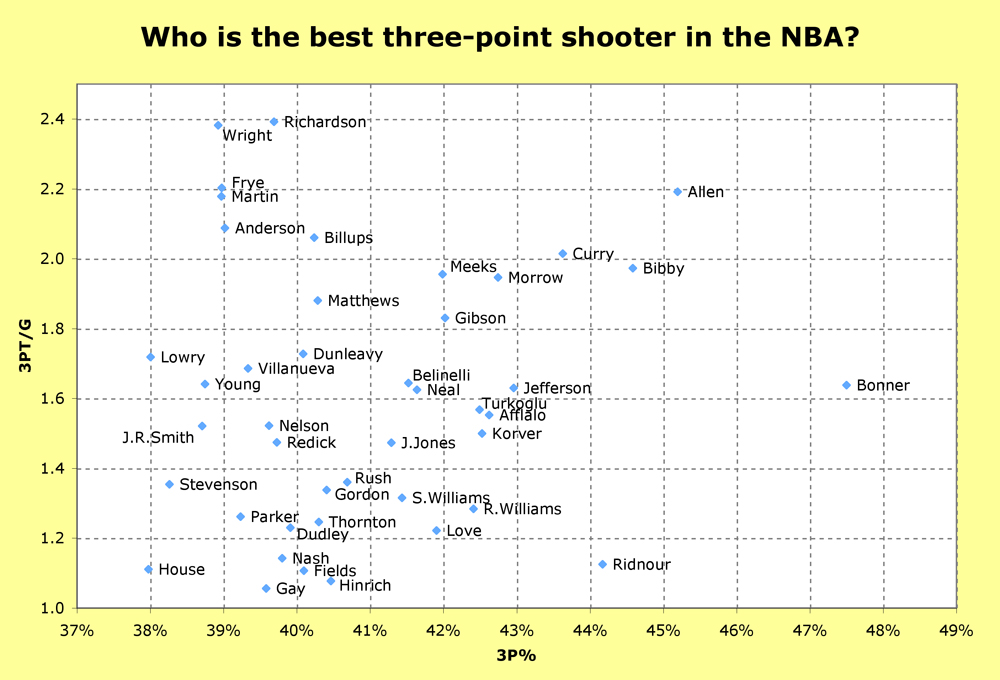
Who is the best three-point shooter in the NBA?

Boston Celtics’ Ray Allen competes in the three-point contest during the NBA basketball All-Star weekend in Los Angeles, February 19, 2011. REUTERS/Gary Hershorn (UNITED STATES – Tags: SPORT BASKETBALL)

As the season winds down, I try to answer questions like these. Here’s my criteria:

1. The player has to shoot at least 38% from long range.
2. He must make at least 1.0 three-pointer per game played.
3. He has played in at least 50 games.

Here’s the alphabetical list of players that qualify: Arron Afflalo, Ray Allen, Ryan Anderson, Marco Belinelli, Mike Bibby, Chauncey Billups, Matt Bonner, Stephen Curry, Jared Dudley, Mike Dunleavy, Landry Fields, Channing Frye, Rudy Gay, Daniel Gibson, Ben Gordon, Kirk Hinrich, Eddie House, Richard Jefferson, James Jones, Kyle Korver, Kevin Love, Kyle Lowry, Kevin Martin, Wes Mathews, Jodie Meeks, Anthony Morrow, Steve Nash, Gary Neal, Jameer Nelson, Anthony Parker, J.J. Redick, Jason Richardson, Luke Ridnour, Brandon Rush, J.R. Smith, Deshawn Stevenson, Marcus Thornton, Hedo Turkoglu, Charlie Villanueva, Reggie Williams, Shawne Williams, Dorell Right and Nick Young.

Three-point accuracy is important, but so are makes. To me, it’s more impressive when a guy is hitting 2.0 threes per game at 39% than if he’s hitting 1.2 per game at a 41% clip. The more makes, the more the defense is keying on stopping that player from getting open looks, so that makes the makes (yep, makes the makes) that much more impressive.

Here’s a look at the chart. As always, click it to see a bigger version.

A few takeaways:

— What a year Ray Allen (45.2%, 2.2) is having. Not only did he break the three-point record, but he’s having his best year accuracy-wise if his career, all at the age of 35 years. As a Bucks fan, I was sad to see the team trade him away for Gary Payton, but I understood the reasoning behind it. They had the younger Michael Redd waiting in the wings. Now look at the two of them.

— Stephen Curry is proving that last year’s accuracy was no fluke. Whenever Ray Allen decides to retire, Curry is the odds on favorite to take the mantle of the best three-point shooter in the league.

— Best big man shooter? I guess we’d have to go with Matt Bonner, who is listed at 6’10” and is hitting 47.5% of his threes. Kevin Love, Channing Frye and Ryan Anderson are also impressive.

— Thirty-two of the 43 players are black. Eight are white Americans. Three are foreign-born (Turkoglu, Belinelli and Nash). I’m surprised there aren’t more foreign-born players on the list, though a few (Carlos Delfino, Omri Casspi, Sasha Vujacic) just missed the list.

— Of the 43 players, there are five power forwards, nine small forwards, 12 point guards and 17 shooting guards. Best shooter by position…PG: Curry, SG: Allen, SF: Jefferson and PF: Bonner. There are two Spurs on that list.

Like this post? Here are more statistical studies.

What kind of point guard WAS he?

My post from a few days ago was relatively well-received at reddit, and one of the readers there said that he’d like to see the same graph for some of the all-time great point guards.

So with a little help from Basketball-Reference.com, I compiled a list of (all?) the Hall of Fame point guards: Oscar Robertson, Lenny Wilkens, Bob Cousy, Jerry West, John Stockton, Isiah Thomas, Magic Johnson, Dennis Johnson, Tiny Archibald, Calvin Murphy, Pete Maravich and Walt Frazier. Unfortunately, the NBA didn’t start keeping track of turnovers until the 1977-78 season, so there’s no assist-to-turnover data for the first four (Robertson, Wilkens, Cousy, West) and the data for Archibald, Murphy, Maravich and Frazier is incomplete, so I could only use their post-1977 numbers.

I also compiled a list of the top non-HOF point guards who are both retired and still active: Jason Kidd, Mark Jackson, Steve Nash, Gary Payton, Rod Strickland, Maurice Cheeks, Terry Porter, Tim Hardaway, Andre Miller, Muggsy Bogues, Kevin Johnson, Derek Harper, Stephon Marbury (yes, Stephon Marbury), John Lucas, Norm Nixon, Mookie Blaylock, Sam Cassell, Avery Johnson, Baron Davis, Nick Van Exel, Allen Iverson, Chauncey Billups and Mike Bibby. All of these players have at least 5,400 career assists, which seemed to be the cutoff for players I was interested in using for this study.

Lastly, I added seven of the top current point guards who have yet to break the 5,400-assist barrier: Tony Parker, Stephen Curry, Russell Westbrook, Rajon Rondo, Derrick Rose, Deron Williams and of course, Chris Paul.

I first tackled this subject two years ago, and settled on the shot-to-assist ratio to determine whether a player is “pass-first” or “shoot-first.” The higher the number, the more of a “shoot-first” player he is. To determine whether or not a player is “turnover-prone,” I calculated each player’s assist-to-turnover ratio. The higher the number, the better the player is at taking care of the ball, relative to what he’s asked to do as a playmaker for his team. The graph takes a gentle downward slope because assists are part of both calculations. (Note: While I do like FGA/A as the criteria for shoot-first/pass-first, I am not completely sold on A/TO as the criteria for turnover-prone. Perhaps (A+FGA)/TO would show shoot-first guards in a better light? Maybe I’ll try that next year.)

Continue reading »

What kind of point guard is he?

The Chicago Bulls’ Derrick Rose shoots a free throw while playing the San Antonio Spurs during the fourth quarter of their NBA game in Chicago February 17, 2011. REUTERS/John Gress (UNITED STATES – Tags: SPORT BASKETBALL)

We hear it all the time. NBA analysts call one point guard “pass-first” and another “shoot-first.” Or they say one guy is “turnover-prone” while another “takes care of the ball.” But really, what makes a player a “pass-first” point guard? How carefree must he be with the ball to be considered “turnover-prone”?

I first tackled this subject two years ago, and settled on the shot-to-assist ratio to determine whether a player is “pass-first” or “shoot-first.” The higher the number, the more of a “shoot-first” player he is. To determine whether or not a player is “turnover-prone,” I calculated each player’s assist-to-turnover ratio. The higher the number, the better the player is at taking care of the ball.

I narrowed the list of players to 33, one for each team plus a few extra for teams like Cleveland, Sacramento and Denver, who have a couple of players manning the position. I also added eight prospects (indicated in green) just to see where a few of the younger guys land. Here’s the graph — it’s small, but if you click it, you’ll get to a bigger version:

So the pass-first/shoot-first aspect goes left to right, and the turnover-prone players will be towards the bottom, while the guys that take really good care of the ball will be up top. Players indicated with a blue diamond are in the Top 10 in this group in Efficiency Per Minute. I set the axis for each category at the average of the 33 players in question, so 1.97 for FGA-to-assist and 2.70 assist-to-turnover.

Two years ago when I conducted this study, seven of the top 10 EPM performers were in the top left quadrant (pass-first, takes care of the ball). This year, only five of the top 11 (I included both Rondo and Calderon, since they tied for #11) are in that quadrant. This is due to the emergence of three shoot-first, (fairly) turnover-prone guards who are emerging as stars: Derrick Rose, Russell Westbrook and Stephen Curry.

A few takeaways:

Continue reading »

« Older posts Newer posts »