Tag: NBA free agency (Page 18 of 22)

A look ahead at the free agent class of 2009

With the trade deadline in the rear view mirror and players tied to their current teams at least until the summer, it’s a good time to take a look ahead at the free agent class of 2009. Given the state of the economy and how so many teams are saving up for the class of 2010, some are suggesting that this summer’s free agency could be a “nuclear winter” of sorts, no pun intended. The salary cap and luxury tax thresholds are likely to decline for the first time in years and that has GMs and owners around the league scrambling to cut salary where they can.

There are three types of free agents: players with early termination options (ETO) or player options (PO), restricted free agents and unrestricted free agents.

Players with ETOs or POs

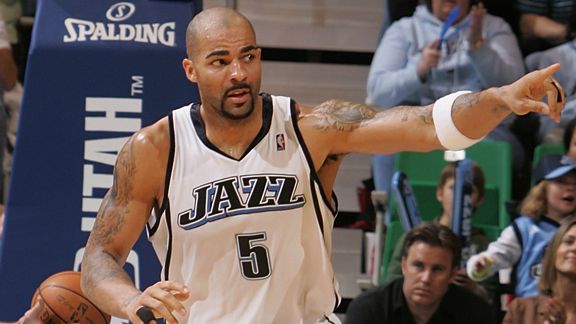
This group includes Kobe Bryant, Jermaine O’Neal, Al Harrington, Jamal Crawford and Mehmet Okur, but it’s highly unlikely that any of these guys will hit the open market given the kind of money they’ll be making by extending their respective contracts. Of this group, Hedo Turkoglu, Anderson Varejao and maybe Carlos Boozer are the only big names that are likely to hit free agency. Boozer has already stated that he’s going to opt out, but he may decide against it if he doesn’t come back strong from his injuries. Turkoglu — the reigning Most Improved Player — is having another nice season, but he’s not playing quite as well as last year. Still, he can command more than the $7.3 million he’s due to make next season. Varejao could stay with the Cavs and make $6.2 million next season, but he and his agent (Dan Fegan) have been looking for more. Varejao wants a long term deal but it seems he and the Cavs disagree on how much he’s actually worth.

For the most part, guys in this group are going to be conservative and play out their contracts.
Restricted Free Agents

RFAs hardly ever change uniforms, but in this economic climate there are teams that are unlikely to match substantial offers for their restricted free agents. The other issue is that once a team signs a RFA to an offer sheet, the player’s team has a full week to match the offer. Most teams know instantly whether or not they’re going to match, but they take the full week so that the other team can’t make any other offers because its money is tied up in the offer sheet. The NBA should reduce this period to three or four days so that teams are more willing to make offers to RFAs. Or better yet, it should eliminate restricted free agency completely to avoid Josh Childress-type cases in the future.

(Stepping down from my soapbox…)

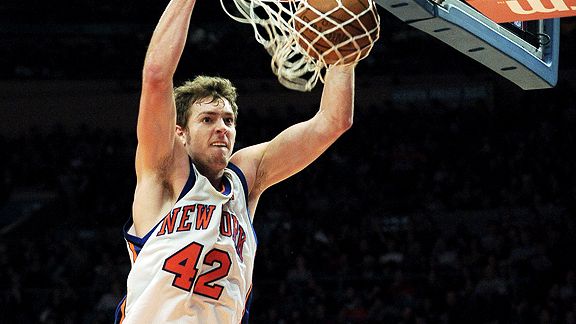
Anyway, the list of restricted free agents includes Childress, David Lee, Paul Millsap, Nate Robinson, Charlie Villanueva, Ramon Sessions (ESPN says he’s restricted though HoopsHype and ShamSports show Sessions as an UFA), Marvin Williams, Raymond Felton, Leon Powe and Linas Kleiza.

The Knicks can’t afford to keep both Lee and Robinson and sign LeBron or some other max-type free agent next summer, so if someone comes along and offers either player a substantial contract, it is unlikely that the Knicks will be able to match. Millsap played great in Boozer’s absence, and they are very similar players so it is unlikely that Utah can afford to keep both. Millsap looks like a potential All-Star and would be a cheaper option, but only time will tell if the Jazz have the balls to let Boozer walk.

Childress will probably return to the U.S. after a year playing in Greece. I suspect he’ll be a mid-level type guy, which increases the number of potential suitors as teams that are over the cap can still sign a player at the mid-level. The Bucks are in financial trouble and they need to get rid of Michael Redd or Richard Jefferson if they hope to keep both Sessions and Villanueva. Both players are having career years under Scott Skiles, but it’s unclear if the Bucks will be able to keep them. I’d expect Sessions to be a mid-level guy (and should be a solid starter for that price), while Charlie V might command a bit more. There are still questions about his heart, but if he’s thriving under Skiles, could he really be lacking toughness and drive? The Bucks have been hit by injuries to Redd and Andrew Bogut but are still holding onto the #8 playoff spot in the East, so they’d be wise to keep this core together if they can.

The Bobcats’ decision to draft D.J. Augustin made Raymond Felton expendable, so he could probably be had for the right price. I’m guessing that he’s a mid-level guy as well, though he and his agent will probably want more. Leon Powe and Linas Kleiza are both productive bench players and if the offer sheet is big enough, the Celtics and Nuggets (respectively) may decide not to match.
Unrestricted Free Agents

This group includes Ben Gordon, Lamar Odom, Shawn Marion, Allen Iverson, Ron Artest, Mike Bibby, Andre Miller, Jason Kidd, Rasheed Wallace, Trevor Ariza and Brandon Bass. Most of these players are older and on the decline, but they can still play. Veteran players in this group might be shocked by the kind of pay cut that they’re going to have to take in today’s climate. The days of 30+ year-old stars (not superstars) signing max or near-max deals are over, at least for a while. I bet all of these guys sign for less than $10 million per season. (I know…that’s peanuts, right?)

Gordon, Ariza and Bass are younger and could still be on the rise if they find the right team. Gordon seems to think he’s a starter and should be paid as such, but he’s small and doesn’t have a reputation for being a very good defender. He can really score though. If some team wants to pay him starter’s money, he’d be a good match to play alongside a bigger point guard who could cover the opponent’s off guard (Utah, Denver, Detroit?) or he needs to go to a team that doesn’t emphasize the defensive end.

Ariza continues to play well for the Lakers, but since he’s a much cheaper option than Odom, he’s probably going to be staying put. Bass had a terrific season two years ago, and is really coming on after a slow start this season. He’s just 23 and has some upside. I’d expect some team will sign him to a deal averaging in the $3-$4 million range, which would make him one of the best bargains of the summer.

So where will these players end up? Your guess is as good as mine. There are only a handful of teams — Atlanta, Detroit, Memphis (of course), Minnesota, Oklahoma City, Portland, Sacramento and Toronto — with the cap space (~$7 million or more) to sign a good player for another team, so I think there may be quite a few starter-level players/borderline stars signing mid-level deals this season. Playoff contenders that are over the cap won’t be able to pass up a good player for $5 million per season and there should be a number of guys that fit the bill this summer.
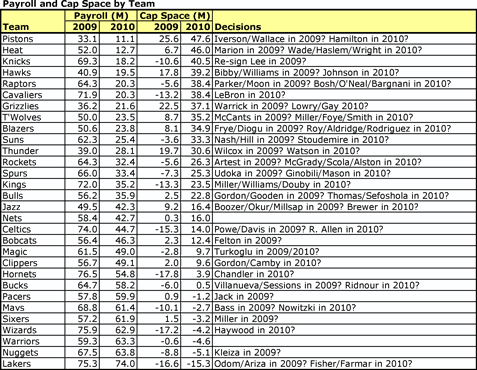
Which NBA teams project to have the most cap space over the next two years?

In previous columns, I ranked the top 10 free agents of 2010 and identified several players with expiring contracts that might be moved before the Feb. 19 trade deadline. Now it’s time to talk about cap space.

We’ve been hearing a lot lately about how teams are “clearing cap space” so that they can sign a big-name free agent in the summer of 2010 (or in some cases, 2009). But what exactly does this mean?

The NBA has a “soft cap” which is currently set at $58.7 million. Teams that are over the cap can’t sign a free agent from another team for more than the mid-level exception, which usually starts at around $5 million per season. Teams that are under the cap can offer free agents whatever cap space they have up to the level of a max contract, which starts at about $14 million per season under current conditions.

HoopsHype has all the salary data for each team, but I thought it would be useful to compile it all into one table so we can easily see who will have money to spend over the next two summers.

First, my assumptions:

– Given the current state of the economy, the salary cap is likely to stay at about $59 million over the next two seasons, so I used the current cap ($58.7 million) to calculate each team’s cap space.

– Certain players have already indicated that they’re planning to “opt out” of the final year of their contracts so that they can enter free agency. For those that have not announced, I used my best judgment to determine whether or not a player is likely to opt out. For example, LeBron James is very likely to opt out of his contract in the summer of 2010, but Michael Redd, who stands to make more than $18 million that same season, is likely to play out the final year of his deal because he’s not going to get anything close to that kind of money on the open market.

– I’ll also list the major (and some minor) decisions that each franchise will have to make over the next two seasons. These are typically decisions about whether or not to re-sign a player whose contract is up (or is entering restricted free agency). For example, if the Knicks decide to sign David Lee to a long-term deal, it’s going to have an impact on the team’s available cap space.

Without further ado, here’s the table, sorted by total projected cap space in the summer of 2010.

The data is interesting. If teams didn’t spend another dime until the summer of 2010, there would be seven teams capable of signing one player to a max-type contract and 11 teams capable of signing two players to max deals. This isn’t realistic, however, as most teams are going to re-sign their current players when they enter restricted or unrestricted free agency, and that’s going to take a bite out of their cap space. Plus, there are a number of stars – Carlos Boozer, Shawn Marion, Allen Iverson – and several starter-quality players that will sign free agent deals this summer. That’s going to gobble up cap space as well.

Of the four teams that have significant cap flexibility this summer – Detroit, Memphis, Atlanta and Oklahoma City – only two, the Pistons and the Hawks, have major decisions to make this summer. The Hawks have to decide whether or not the 30 year-old Mike Bibby is worth a significant long-term deal. If they do sign him to a contract averaging, let’s say, $10 million per season, it is going to reduce their cap space for the summer of 2010 by that amount. They can always re-sign Joe Johnson (because he is “their” free agent), but they may not have enough space to sign another top tier player. That space would be reduced further if they elect to sign Marvin Williams to a long-term deal.

The Pistons have to make a decision about Allen Iverson and Rasheed Wallace. Both players are getting on in age, so I wouldn’t be surprised if the Pistons allow both contracts to expire and use the new cap space this summer or next, building around Rodney Stuckey and Tayshaun Prince.

The Grizzlies have a ton of projected cap space over the next two years, but their challenge is not the money – it’s attracting a top-tier free agent to a small city and a bad team. No one really thinks that Memphis has a shot at any of the top five free agents of 2010 – LeBron, Dwyane Wade, Amare Stoudemire, Chris Bosh and Joe Johnson – though there’s a slim chance that Amare or Bosh might want to play with O.J. Mayo and Rudy Gay. Small market teams like Memphis that are struggling to win are going to have to overpay for second-tier free agents. The Thunder, Timberwolves, Raptors and Kings are four other teams that will have significant cap space over the next two seasons but are unlikely to attract a top-tier free agent.

These numbers will obviously change over the next two seasons as teams make trades and sign free agents (and draft picks). However, I can’t remember a time when this many teams had this much cap space. Under normal circumstances, it would lead to a frenzy of spending in the short term, but with the current state of the economy, teams may be quite a bit more cautious as they open those checkbooks.

Luke Ridnour finding a home in Milwaukee

By far the most surprising score from Tuesday’s NBA action is the Bucks 100-98 win over the Spurs in San Antonio. Michael Redd led the Bucks with 25 points and 10 boards, while Andrew Bogut held down the middle with 20 points, 14 rebounds, four assists and three blocked shots. More importantly, he limited Tim Duncan to 7 of 20 shooting from the field, which helped the Bucks spring the upset.

But point guard Luke Ridnour might have been the difference in the game. He posted 21 points (on 9 of 15 shooting), six assists, five rebounds, two blocked shots and a steal, and if he didn’t outplay Tony Parker (19 points, 10 assists), then he sure negated him.

Ridnour joined the Bucks as part of the three-team trade that sent Mo Williams to the Cavs in the offseason. He’s 27, and prior to joining the Bucks, he had spent his entire career in Seattle. At the beginning of the season, new head coach Scott Skiles immediately inserted him into the starting lineup and he has responded with solid play, especially recently.

Take a look at Ridnour’s numbers from November and December:

Nov: 10.6 ppg, 4.9 apg, 38.8% FG%, 0.93 spg
Dec: 11.7 ppg, 6.2 apg, 47.7% FG%, 2.08 spg

That jump in field goal percentage is key. He cut back on the number of three pointers he’s taking (from 2.9 to 1.7) and is taking more open mid-range jumpers created off of pick-and-rolls with Bogut.

For much of November, I thought that Ramon Sessions (who is having a great year in his own right) would soon take over as the starter, but with Ridnour’s December play, I’m not so sure. Skiles is a former point guard, and he has two good, underrated options at the position. The key for Ridnour is to keep up that FG%; everyone knows that he can pass the ball.

Sessions is a free agent after the season, and on a per-minute basis he’s still way ahead of Ridnour in terms of production (PER: 16.48 vs. 13.75). Ridnour has another year on his contract. It will be interesting to see how the team handles these two players. I wouldn’t be surprised if Skiles continues to play Ridnour heavy minutes so that he can keep a lid on Sessions’ league-wide profile until the Bucks can lock him up in a long-term deal at a discount. If that’s the case, he has to be careful not to alienate Sessions so much that a rift is created between the player and the head coach. It’s a bad, bad thing when a point guard and his coach aren’t on the same page.

Carlos Boozer confirms that he intends to opt out

Carlos Boozer raised a few eyebrows recently when he told ESPN’s Chris Sheridan that he did intend to opt out after this season. He confirmed this to The Salt Lake Tribune via a conference call.

Since I wasn’t there for the conversation between Carlos Boozer and ESPN.com’s Chris Sheridan on Wednesday night, I can’t say what was and wasn’t said. What I can report is that there are some in the Jazz organization who believe Boozer was, to borrow the description of one, “sideswiped” by the whole report.

That’s not excusing anything Boozer said. But Boozer thought he was chatting with Sheridan, who covered the U.S. Olympic team in Beijing, and might have been talking through the various scenarios associated with opting out more than making any definitive statements about his future.

As the Jazz note, Boozer gains nothing by announcing he’s opting out right now. Maybe it would have made sense to do so before the season. But right now, all Boozer’s achieving is calling attention to himself when he’s not playing and undergoing second MRI exams. In other words, he’s hurting his value.

The Jazz also continue to believe the Boozer-to-Miami rumors are more media driven than grounded in fact. There are questions, first of all, about whether the Heat will even have $10 million of cap space to sign a free agent this summer. The Heat also have forwards Udonis Haslem and Michael Beasley, both similar to Boozer.

Boozer took part in a conference call this afternoon with the Deseret News’ Tim Buckley and me. Here’s the transcript of what he had to say:

“First of all, I just want to say when I was talking to Chris yesterday, obviously I was thinking it was more of a casual conversation, but he was asking about the future, for myself and also for Paul and for our team. Obviously, the thing that came out in the papers, or the Internet, whatever, what I was trying to say to him was obviously in my business, like in most people’s businesses, you get a chance every now and then to sign a long-term contract and have stability.

“So the smart thing for me as an individual obviously would be to opt out and have a chance to have stability. Obviously, I wanted to stay here with the team. I wasn’t trying to say I was going to leave or anything like that. Obviously, I’ll look at my options, but the smart thing for me is to opt out and instead of having a one-year deal, the possibility of having a six-year deal. That makes sense for my business. That’s what I was trying to tell him yesterday. I didn’t know it was going to turn into this big rainfall type of thing.”

I don’t know why Jazz owner Larry Miller is upset.

Jazz owner Larry Miller slammed Boozer in his weekly radio appearance on KFAN 1320, saying, “It’s one of the top 10 stupidest things I’ve heard an NBA player do in 20 years.”

Miller said Boozer’s timing detracted from the Jazz’s victory over New Jersey and came not only as he has missed 15 games with a strained left quadriceps tendon but after he missed 80 games early on after coming to the Jazz.

Those memories are hard to shake, with Miller saying, “a lot of people are still suspicious about that, a lot of fans and stuff, and we’ve covered for him and protected him, justifiably.”

Of course he’s going to opt out. He’s due to make $12.7 million next season which is well below the market value of a player with his skill set. Assuming he’s healthy — and he has battled injuries in the past — he’s going to be able to sign a max or near-max contract next summer. Why would anyone play out the final year of a deal when they could sign a five- or six-year guaranteed contract and start at a higher salary?

The timing is odd, considering that Boozer has missed the last 15 games with a quad injury. It doesn’t sound like he planned to share this information with the world, but I don’t know why anyone is really surprised.

Paul Millsap has averaged 17.8 points and 11.1 rebounds in 13 games as a starter filling in for Boozer. He too is a free agent after the season, so it will be interesting to see how the Jazz handle these two players as they bring similar things to the table. In my latest column, I suggested that Utah trade Boozer to Dallas for Dirk Nowitzki. To me, it’s likely that he’s going to leave and sign with Miami, but he continues to state that he intends to stay in Salt Lake City.

Four NBA trades that need to happen

About this time every season, the contenders are starting to separate themselves from the pretenders and teams that are struggling to stay in the playoff hunt are starting to look forward to next year. With that in mind, here are four trades that I’d love to see pop up amongst the NBA headlines in the coming weeks. I’ve done my best to make these trades equitable and realistic, but if you’re a fan of one of these teams, or just a fan of the NBA in general, I’d love to hear your thoughts.

1. Shawn Marion for Lamar Odom and Sun Yue
Yes, I know that the Lakers have the best record in the West, but let’s get real – they’re starting Luke Walton at small forward. No matter what the Laker faithful believes, they have a hole in their lineup. Lamar Odom can’t play alongside Andrew Bynum and Pau Gasol because he can’t shoot. He proved in the Finals against the Celtics that he wasn’t tough enough to battle Kevin Garnett. Trevor Ariza is a slightly better option, but after a quick start, he’s shooting 29% from long range. Vladimir Radmanvoic? Sasha Vujacic? Come on.

Is Marion the perfect fit? Not really. His three-point accuracy (34%) could be better, but he’s still more of a threat than Odom (32%), especially from the corners. Are there any other holes in his game? He thrived in the Suns’ up-tempo system and the Lakers boast the third-fastest pace in the league. He’s a much better defender than Odom and is far more versatile on that end of the court. Marion could even give Kobe a break defensively by covering the other team’s best perimeter player. That would keep Kobe’s legs fresh for crunch time. (Sun Yue is a throw-in to make the numbers work.)

What’s the upside for the Heat? Well, they can still make a run at Carlos Boozer if they choose, and if that doesn’t pan out, they can re-sign Odom, a versatile forward that can play alongside Dwyane Wade and Michael Beasley. He’s a better passer than Marion (so he can better set up Wade and Beasley) and is every bit the rebounder. Odom had one of his best years when he was in Miami and would be a solid backup plan if Operation Boozer doesn’t succeed. It doesn’t look like the Marion experiment is working, so they should acquire a player they at least might want to re-sign next summer.

See this deal in the ESPN Trade Machine.

2. Michael Redd for Wally Szczerbiak, Delonte West and J.J. Hickson
Redd still has two more seasons on his deal at the tune of $35 million, but that shouldn’t matter to the Cavs. Right now, it’s all about surrounding LeBron with enough talent to get to the Finals. Redd’s numbers have taken a dip this season, but that probably has more to do with fewer attempts (-2.1) than anything else. His shooting percentage is down (-2.3%), but he’s a career 45% shooter, so there’s no reason to believe that he wouldn’t get back to that level of accuracy playing alongside LeBron and Mo Williams.

Barring a mid-season surge by the Bucks, they are once again looking at finishing in the lottery. They’ve struggled with injuries and may yet make a push, but right now it looks like another year of rebuilding. This trade would get the team out from under Redd’s monster contract (because Wally’s deal is expiring) while also giving the team a starter-quality shooting guard (West) and a nice power forward prospect (Hickson) who isn’t getting any minutes in Cleveland. With Redd’s contract jettisoned, the Bucks would have a significant amount of cap space (~ $14 million) to throw at a guy like Joe Johnson.

See this deal in the ESPN Trade Machine.

3. Dirk Nowitzki for Carlos Boozer, Ronnie Price and Jarron Collins
Right now, Carlos is saying all the right things, but if he has the option of a max contract in Utah and a max contract in Miami (where he lives in the offseason), which do you think he’ll choose? Sure, he and Deron Williams make a nice combo, but with Dwyane Wade and Michael Beasley, Miami is just as attractive. So if you’re the Jazz and you see the writing on the wall, don’t you want to get something in return? Nowitzki would replace Boozer’s scoring and rebounding and keep Utah’s winning ways going. Dirk really needs a change of scenery (to put the memory of the 2006 Finals behind him) and the Jazz would be one step closer to putting together an all-international roster.

For Dallas, it’s about changing things up. They’d get younger – Boozer is 27 while Dirk is 30 – and he’d give the team someone to build around for the next few years. This move would make a lot more sense for the Mavs if they hadn’t traded away Devin Harris (because re-signing with Dallas would make a lot more sense for Boozer), but if they could get a commitment from Boozer that he would re-sign, the deal makes sense. (Of course, as Cleveland fans know, trusting Boozer’s word is awfully dicey.)

See this deal in the ESPN Trade Machine.

4. Mike Miller for Bruce Bowen, Roger Mason and a first round draft pick
At 28, Mike Miller is one of the best shooters in the league and is languishing on a team that is going nowhere. Spurs fans may not want to give up Mason, but Miller is the better shooter, passer and rebounder. Plus, he’s a natural small forward, which would make him a better fit alongside Manu Ginobili on the wing. He would be deadly spacing the court for Tim Duncan’s post play and Tony Parker’s penetration.

What’s the upside for the T-Wolves? Well, they’d get a solid player in Mason and another first round pick, which would give them five for next summer’s draft. They should be able to turn five picks into two (or three) star- or starter-quality players.

See this deal in the ESPN Trade Machine.

« Older posts Newer posts »