Tag: Michael Young (Page 2 of 2)

Five Deep Sleeper Teams for the ’09 MLB Season

I know this guy (I’ll stop short of calling him a friend but wouldn’t hesitate to pick up the phone if he called) that at the start of all the major sporting seasons will throw out his list of “sleeper teams” to watch out for.

What’s funny about this guy is that he knows if he’s wrong he’ll never be called out because hey, they were just sleeper teams anyways right? But if he’s right, well hell, he’ll look like some kind of sports sleeper team Nostradamus.

This is the same guy that’ll pick a No. 16 seed to beat a No. 1 every year in the March Madness Tournament, so on the rare chance it happens he’ll have the opportunity to say that he called the upset of a lifetime. The funny thing is that he would have been wrong the previous 34 years of predicting 16’s over 1’s, but that would be beside the point.

Anyway, this piece is dedicated to him – the “Sleeper Team Guy.” For fans, there’s nothing like predicting a perennial loser (i.e. the 2008 Tampa Bay Rays) to rise from the ashes and make a postseason run no matter what sport it is. And with Opening Day right around the corner, I think it’s a perfect time to hand out some potential sleeper candidates of my own.

Below are five deep sleepers to make a postseason run this year in baseball. Most pundits assume that none of the five will finish better than third in their respective divisions, which is why I can get away with calling these teams “deep sleepers.” If any of them make the playoffs, I’ll wax poetically about it in my sleeper teams piece next year. If none even sniff a postseason berth, then in honor of “Sleeper Team Guy” don’t expect me to admit I was wrong. Yeah, that’s right – accountability is for losers.

Continue reading »

2009 Fantasy Baseball Preview: Shortstops

All 2009 Fantasy Articles | 2009 Position Rankings

Before your 2009 fantasy baseball draft kicks off this year, do yourself a favor and repeat this three or four times to yourself: I will draft a shortstop in the first nine rounds.

Not unlike third basemen, the shortstop position is weak this season. After Hanley Ramirez, Jose Reyes and Jimmy Rollins come off the board in the first two rounds, you’re left with roughly eight shortstops that will give you adequate to good production this season. We project those eight shortstops to be selected anywhere between the fifth and ninth round in standard mixed leagues, which is why we suggest nabbing one before the conclusion of the ninth.

The good news is that in a 12-team league, you’ll definitely have the opportunity to land one of the big three (Ramirez, Reyes, Rollins) or scoop up one of the eight adequate-to-good shortstops that we’re referring to. The bad news is that shortstops can start flying off the board quickly and if you’re selecting in a snake draft, you could wind up on the wrong end of the spectrum when the run starts.

That’s why to be safe, you will draft a shortstop in one of the first nine rounds because you don’t want to be the guy that’s trying to figure out whether or not Edgar Renteria will bounce back now that he’s in the NL again, or having to choose between Orlando Cabrera’s consistent .280 batting average and Khalili Greene’s 25-plus home run potential. (Side note: If you do wind up being that guy come draft day, it might be wise to select two shortstops back to back and hope you catch lightning in a bottle with one of them.)

Obviously you still want to be smart on draft day; we’re not advising you to take Derek Jeter in the third because you’re spooked about failing to grab a shortstop before the ninth round. But taking one of the top 11 shortstops a round early might not be a bad idea considering what you’ll be left with later on.

After Ramirez, Reyes and Rollins come off the board, here are the eight shortstops we’d suggest taking before the ninth round ends:

Stephen DrewStephen Drew, Arizona Diamondbacks
In his third season with the D-Backs last year, Drew was only the third shortstop in major league history to finish with 40 doubles, 20 home runs and 10 triples in 2008. At 26 years old, his ceiling is sky high right now as he enters the prime of his career and there is no doubt that he’s one of the bright young stars in baseball. If he builds off the success he had last year, Drew could easily hit 25 home runs, knock in 75 RBI, score 100 runs and chip in five stolen bases. He probably won’t sniff the .300-mark in terms of batting average, but he should be right around .290.

Troy Tulowitzki, Colorado Rockies
Tulowitzki exploded onto the scene in 2007, helping the Rockies make a World Series appearance and setting a record for most home runs (20) in a season by an NL rookie shortstop. But injuries destroyed what was supposed to be a promising second season in 2008 and he obviously fell short of expectations. Still, he hit .300 over the second half of the season last year and he should once again build on his promising young career. He has the potential to hit 20-plus home runs, knock in 80 RBI, score 90 runs and add 10 stolen bases along with his .290 average. Tulowitzki is a star in the making and definitely one of the better young shortstops in the game.

Alexei Ramirez, Chicago White Sox
Potential could be the one word to describe the Sox’s young shortstop. Ramirez has 20-home run and 20-stolen base potential and he could easily average .290 and score 100 runs. The one thing to keep in mind about him, however, is that last year was his breakout campaign and he could regress in ’09. Still, with Orlando Cabrera moving on in free agency, Ramirez will get every opportunity to build on his rookie performance and should have plenty of fantasy potential hitting in front of Carlos Quentin in the two-hole.

Jhonny Peralta, Cleveland Indians
With most of the Tribe hitters taking a step back in ’08, Peralta came through with a fine season. If Travis Hafner is healthy again this year, Peralta will move back to the third or fifth spot in the order (he was hitting cleanup in Hafner’s absence last season) and should hit 25-plus home runs. He does strike out a lot and his average will probably teeter around .275, but he’ll also give you 80-plus RBI and score 100-plus runs. There’s talk of him moving to third base this year so keep an eye on that, but he’ll still qualify as a shortstop in all leagues.

Derek Jeter, New York Yankees
Tried and true – Jeter is more than capable of giving you quality production day in and day out. At 35 years old, his numbers are definitely on the decline but that doesn’t mean the veteran will crash and burn in 2009. He might not hit 20 home runs or steal 20 bases this year, but you can probably bank on 15 dingers and 15 swiped bags. Just don’t overvalue him, because there’s no doubt someone will based on name recognition alone.

Rafael FurcalRafael Furcal, Los Angeles Dodgers
Obviously he’s a major injury risk, but if he’s healthy there’s no reason to believe Furcal can’t pick up where he left off in April of last year when he hit .367. He also returns to familiar stomping grounds after re-signing with the Dodgers, and he should have every opportunity to top 15 home runs and swipe 35-plus bases. Some owners will look at his name and take a pass given his age and injury concerns, but Furcal could be worth the risk come draft day, especially depending on how far he falls.

J.J. Hardy, Milwaukee Brewers
If you can put up with Hardy’s streaky production, he’s liable to blast 25 home runs, drive in 75 RBI and bat around .280. Depending on how your first five or six rounds turn out, the addition of Hardy could give you a boost in the power department without killing your team’s overall batting average. Not a lot of owners will jump at the opportunity to select him, but Hardy is an underrated player and after hitting 20-plus home runs the last two seasons, he looks like a reliable option.

Michael Young, Texas Rangers
Some owners might choose to go with a young sleeper like KC’s Mike Aviles over an aging vet like Young, but keep in mind how good the Rangers’ offense was last year. Young has the potential to hit .300 with12 dingers, knocking in 82 RBI and scoring 102 runs at the top of Texas’s lineup. Aviles might hit .300 again with 10-plus home runs, but it’s doubtful he brings what Young does to the table in terms of RBI and run production.

Here is our official ranking of shortstops. Remember that all of these players qualify for your middle infield position, so don’t fall asleep and miss out on taking a potential sleeper or consistent veteran shortstop in later rounds.

1. Hanley Ramirez, FLA
2. Jose Reyes, NYM
3. Jimmy Rollins, PHI
4. Stephen Drew, ARI
5. Troy Tulowitzki, COL
6. Alexei Ramirez, CHW
7. Jhonny Peralta, CLE
8. Derek Jeter, NYY
9. Rafael Furcal, LAD
10. J.J. Hardy, MIL
11. Michael Young, TEX
12. Mike Aviles, KC
13. Miguel Tejada, HOU
14. Yunel Escobar, ATL
15. Orlando Cabrera, OAK
16. Elvis Andrus, TEX
17. Edgar Renteria, SF
18. Jason Bartlett, TB
19. Ryan Theriot, CHC
20. Khalil Greene, STL
21. Jed Lowrie, BOS
Fantasy baseball draft tips: Tier it up!

All 2009 Fantasy Articles | 2009 Position Rankings

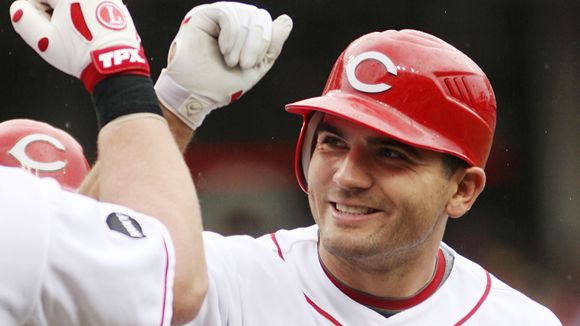
You’re hunched over your desk, boring a hole into your cheat sheet. “Michael Young or Joey Votto?” You’re up in two picks. Make that one pick. Panic sets in. “Michael Young or Joey Votto?” You’re running out of time. Your eyes dart right to left between the two names. “Michael Young or Joey Votto?!” Time’s up; you need to make a choice. “MICHAEL YOUNG OR JOEY VOTTO?!” You burst into tears.

Okay, maybe you don’t actually cry…or maybe you do, I don’t know. Either way, you can potentially avoid this kind of draft day drama entirely if you spend a little more time preparing beforehand. Sure, you probably at least have one or two cheat sheets from your fantasy magazines or websites in front of you. Maybe you even took the time to put together your own cheat sheet. Unfortunately, that just means you’re looking at a jumbled mess of names organized by position. What does it all really mean?

To get a clearer picture of what kind of talent is still available during my drafts, I break each of my position rankings up into tiers. Typically the elite players at each position get their own tiers, followed by the guys I view as starter-quality, the fallback options and the leftovers. Depending on the depth at a particular position, there may also be a “star” tier in between the elites and starters, and maybe another serviceable tier between the starters and fallbacks, but you get the idea.

Michael YoungSo what’s the point? If the poor fictional sap in my example above had a tiered cheat sheet in front of him, he may have noticed that Young was the last guy in his starters tier at shortstop, whereas there were three quality first basemen still available after Votto. So he takes Young to fill his hole at short and then targets Votto or one of the other three first basemen with his next pick. Problem solved, decision made, embarrassing emotional breakdown avoided.

My goal each draft is to fill my roster with as many starter-quality (and above) players as possible, and having my rankings broken up into tiers makes it much easier to gauge what kind of depth I’m dealing with. You may be surprised by the amount stress this kind of information can eliminate from your draft. Should you take a third outfielder or your starting middle infielder? What do your tiers say? You’d like to get one more closer but can you afford to wait another round or two? A catcher or another starting pitcher? Michael Young or Joey Votto?! The answer is in the tiers.

This isn’t a revolutionary way to approach your draft – all sorts of owners use some kind of tiered system – but it is an extremely useful tool that can help you build a deep and productive roster heading into the season. What owner wouldn’t want that?

Hot Stove League: Lots of little movement

You know it’s a slow week in MLB again when the big news is that Jeff Kent has announced his retirement. And just like Kent does with ease himself, the news stirred up controversy. This volatile player has never quite been a media darling, and has often gotten into it with teammates. But there is now debate about the guy’s Hall of Fame credentials. Okay, he may have the most homers for a second baseman in history, but you can’t tell me this guy is in the same class as a guy like Joe Morgan. He’s just not. And while a .290 career batting average is nothing to sneeze at, 377 homers over 20 years is not exactly Babe Ruth-esque.

Anyway, as Manny Ramirez remains unemployed, there were a few other smaller signings and moves this past week….

Okay, this isn’t small but just announced on Friday, Prince Fielder has agreed to a 2-year, $18 million deal with the Brewers that will keep him firmly entrenched (and who could move the guy?) on first base in Milwaukee through 2010. I’m glad for the Brew Crew since they lost out to the mighty Yankees in the CC sweepstakes.

Catcher Gregg Zaun re-signed with the Orioles, the team that drafted him back in 1989. The journeyman player signed a deal worth $1.5 million with a $2 million option for 2010.

The Phillies signed outfielder Jayson Werth to a two-year, $10 million contract and also inked reliever Chad Durbin to a one-year deal worth $1.635 million.

Young right fielder Nick Markakis of the Orioles came to terms on a six-year, $66.1 million deal, covering his first three arbitration-eligible years as well as his first three free agency eligible seasons. Clearly the O’s believe in this kid and want to keep him away from the Yankees and Red Sox.

Two other catchers signed this week—Brad Ausmus reached agreement with the Dodgers on a 1-year, $1 million deal; and Henry Blanco signed a $750,000 deal for one year to back up Padres’ catcher Nick Hundley.

Shortstop Omar Vizquel, who at 41 still looks like he’s 25, has been invited to spring training by the Texas Rangers. Vizquel signed a minor league deal that will allow him to mentor 20-year old Elvis Andrus, and to possibly become the team’s utility infielder. In order to make room for Andrus on the field, the Rangers are planning to move all-star shortstop Michael Young to third base. In addition, the Rangers are said to be casually wooing free agent pitcher Ben Sheets, who lives in Dallas.

Meanwhile, Tom Covill of Yahoo Sports posted this great summary of the remaining big name free agents still looking for work. It’s really kind of mind-boggling, but looking at these tiny deals being signed this past week, it’s clearly about economics and nothing more.

Newer posts »