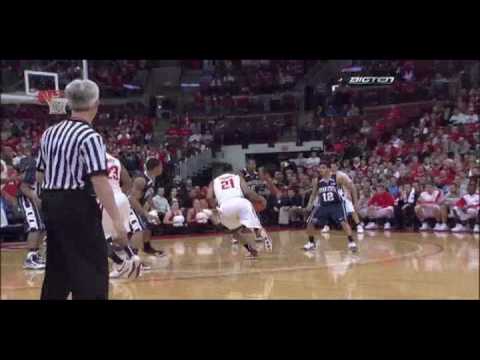
You don’t hear this often from anyone not named David Stern, but Brandon LaChance of BullsHome.com says that the NBA should keep its age-limit rule because it allows the NBA to get a better look at prospects. Let’s go point-by-point:
The draft entrance law does hurt the college game. There is no doubt about it. Players leaving after one year hurts a team’s roster and team chemistry. The star player gets all the shine while the rest of the players and the school itself are forgotten. I know who John Wall is but couldn’t list one of his Kentucky teammates.
No offense, but if LaChance can’t name DeMarcus Cousins, Patrick Patterson or Eric Bledsoe, maybe he shouldn’t be commenting about how a rule affects the college game.
If a school has a problem with a player leaving after one year, then don’t recruit the athlete. Instead of Derrick Rose, OJ Mayo or Kevin Durant, go after Tyler Hansbrough.
That’s fine, but there are only so many Tyler Hansbroughs in the world. When you force a kid to go to college for a year, he doesn’t want to be there and he doesn’t want to go to class. It makes a mockery of the so-called “student-athlete.” Basketball programs are going to do what is in their best interests in terms of winning, and under this flawed system that means some will recruit clear one-and-done players like John Wall. You can’t force a flawed system on the NCAA and expect everyone to forgo the best available talent. One-and-done players only have to pass a few credits in their first semester to become eligible to play in the NCAA tournament. They don’t even have to go to a single class in in their second semester. This is ridculous.
One and done gives the NBA and the players a showcase, practice and a scale to place talent. There are millions of college hoops fans turning on their television sets to watch a big game or Sports Center for highlights.
The stud player is showcased to the world. The fans hearing how good he is at the college level will more than likely pay attention to him at the next level. Carmelo Anthony helped Syracuse win a championship in his one year. Anthony did his one year before the rule was a rule. Denver drafted him and their ticket sales went up along with media coverage of the Nuggets. The NCAA showcased his talent for the world to see and the NBA cashed in on it.
Yes, the one-and-done rule gives NBA teams a better look at a prospect, but that’s not the point. It’s wreaking havoc on the college game. High schooler LeBron James went ahead of Anthony in that draft and he’s doing just fine.
Remember a guy named Kwame Brown. Brown was drafted straight out of high school by the Washington Wizards in 2001 with the number one overall pick. He is one of the biggest busts in NBA history. In 2003, his best statistical year, he only averaged 10 points and 8 rebounds. This may not be completely accurate, but if he would have played a year in college, the Wizards may have noticed weaknesses. Brown may have needed the year to further develop. He might have decided to stay longer to develop skills if he couldn’t be a big time performer in the college level.
Ah, yes, the Kwame Brown argument. Yet there are plenty of examples of players that were busts coming out of college. What’s the NBA’s excuse there? On the whole, players drafted straight out of high school have a much higher success rate than those that played in college. In other words, why is the NBA forcing their rule on the NCAA to fix a non-existent problem?
The one and done deal may not be the best solution ever but it is the best now. University’s get one year of excitement and the NBA gets to cash in off of the marketing the NCAA does for the players. I think it is a great system and should stay in place. If the NCAA wants students to stay longer or participate, they have to do something.
What is the NCAA supposed to do? You can’t force a kid to stay in college — the only entity that could do that is the NBA (by requiring any players not drafted straight out of high school to play two years of collegiate ball before entering the draft again). That’s the system I support. Allow players that are good enough to go to the NBA straight out of high school to do so, but if they enroll in college they have to play for two years. That way, the NBA gets a good look at the fringe NBA talent, the NCAA gets some semblance of continuity, and those same kids get an opportunity to develop for two seasons at the college level.
Everyone wins.
Photo from fOTOGLIF