Tag: fantasy football strategy (Page 56 of 80)

2009 Fantasy Football Preview: WRs

All 2009 Fantasy Articles | 2009 Position Rankings

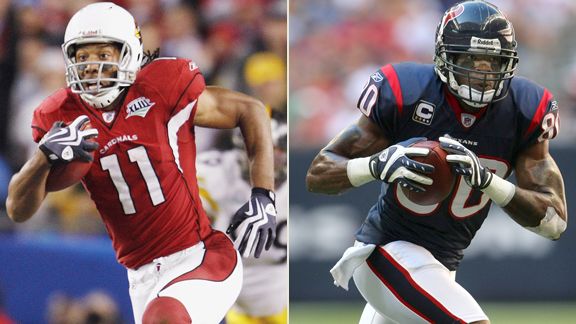
As more and more leagues have tweaked their rules to try to even out the importance of other positions with respect to running backs, wide receivers have become increasingly valuable in the last few years. In leagues that award one point per reception, it’s a completely legitimate strategy to draft a WR in the back half of the first round. In fact, after the top five or six PPR backs – Maurice Jones-Drew, Adrian Peterson, Steven Jackson, Matt Forte, LaDainian Tomlinson and Frank Gore – are off the board, we wouldn’t snicker at someone who decided to pull the trigger on Larry Fitzgerald or Andre Johnson instead of going choosing a player from the second tier of RBs. (If you’re wondering about Michael Turner, we love the guy, but he isn’t going to catch any passes and it doesn’t look like he’ll approach 376 carries again this season.)

Wide receivers are a little dicey because of the inconsistency that is intrinsic to the position. WRs have to depend on plays being called for them and on their QB to deliver the ball. There’s a better chance that a top RB will get his 20 touches (handoffs, dump offs) than there is that a top WR will get his 7-8 catches. As an example, last year’s top RB, Matt Forte, only had one game where he scored fewer than 14 fantasy points, and that was in Week 17, when it didn’t really matter. Conversely, the top WR, Andre Johnson, had four games where he scored fewer than 10 fantasy points (including Week 16, when it really mattered).

This year there appear to be a group of 12 stud fantasy wideouts: Fitzgerald, A. Johnson, Steve Smith, Calvin Johnson, Reggie Wayne, Randy Moss, Wes Welker, Anquan Boldin, Greg Jennings, Roddy White, Dwayne Bowe and Marques Colston. These are proven players that are in stable situations, or saw their situations improve over the summer (i.e. Matt Cassel in for Tyler Thigpen is an upgrade for Bowe). Anyone not on this list changed teams (T.J. Houshmandzadeh, Laveranues Coles), had a downgrade at QB (Brandon Marshall, Jerricho Cotchery), has an attitude problem (Braylon Edwards, Chad Ocho Cinco), or some combination of all three (Terrell Owens).

This, coupled with the relative depth at the RB position – there are a number of backs going in rounds 3-5 that are good bets to crack the top 20 or top 15 – makes this a year when drafting a WR or two in the first three rounds a pretty compelling strategy. Would it be better to have Steve Slaton, Brian Westbrook and Terrell Owens or Larry Fitzgerald, Reggie Wayne and Ronnie Brown? We’d feel better about that second group.

Regardless, it’s always good to have a few guys targeted in those middle rounds (5-9) so that you can build depth and maybe even find a guy that develops into a starter-caliber WR. There is a tendency now to always look young at wideout, and this is causing some proven veterans to slip further than they should.
Continue reading »

2009 Fantasy Football Preview: RBs

All 2009 Fantasy Articles | 2009 Position Rankings

Ah, the good ol’ running back…they’re the backbone of every good fantasy football squad…most of the time.

Over the past few years, many leagues have tried to diminish the importance of the running back position. If your league only requires one starting RB (and makes the other a flex position), then RBs aren’t quite as important as they are in leagues that require two starting backs. If your league awards a point per reception, the importance of wide receivers and tight ends is increased, while the talent pool at RB is expanded to include players that catch a lot of passes out of the backfield. For example, in a non-PPR league, Reggie Bush is just a mediocre starting back. In a PPR league, he is fantasy gold. (Assuming he’s healthy, of course.)

A typical first round will include 10 or 11 running backs with a quarterback or a wide receiver sneaking in late to break up the streak. With the trend of taking the onus away from the RB position, there has been a small, but growing movement towards drafting a WR late in the first round. The theory goes that the RBs available that late (and early in the second round) aren’t all that much better that those that are available in the late third or early fourth. So instead of following the herd, why not draft a WR like Larry Fitzgerald or Andre Johnson that will give you an advantage at another position? After all, in PPR leagues, Fitz and AJ might very well be expected to score more points than Adrian Peterson.

This year, for owners stuck with a late pick in the first round, this strategy looks solid, but it should (probably) only be utilized in those leagues that have a flex position instead of a RB2 or those leagues that award one point per reception. Instead of drafting Steve Slaton or Chris Johnson, go with Fitz or AJ. Guys like Ronnie Brown, Darren McFadden, Kevin Smith, Pierre Thomas, Ryan Grant, Derrick Ward, Knowshon Moreno and Marshawn Lynch may be available at the 3/4 turn – would anyone be shocked if one or more of these players outperformed Slaton or Johnson? And if you’re in a league that features both a flex position and one point per reception, don’t be afraid to go WR/WR with your first two picks. Yes, you’ll really be zagging when everyone else is zigging, but you really only need to find one good running back to start with your next several picks and you’ll already have a huge advantage at WR1 and WR2.

But if you’re in a non-PPR league with two starting RBs, then it’s usually wise to go RB/RB with your first two picks. Fitz or AJ would be tempting early in the second round, along with Reggie Wayne, Randy Moss, Steve Smith and Calvin Johnson a little later on, but by the time the 3/4 turn rolls around, there isn’t going to be much left at RB.

Still, with all of those aforementioned backs, a few are bound to be available. So let’s focus on a few players that should be available in rounds 3-7 and try to identify the best values of the early-middle rounds. We’ll also provide rankings for the entire RB position, broken into tiers.

Continue reading »

2009 Fantasy Football Preview: QBs

All 2009 Fantasy Articles | 2009 Position Rankings

Generally speaking, there are three schools of thought when drafting a quarterback. The first is to draft a stud in the first round or two and hope that he’s destined for a great year like the one Tom Brady had in 2007. The risk here is if this early pick doesn’t vastly outplay most of his peers, or if the owner isn’t able to unearth a good RB or WR in the middle rounds, the team is going to have trouble competing on a weekly basis.

The next theory is to go with running backs and/or wide receivers with the first two or three picks and then start looking for QB value in the next few rounds. This strategy could lead to an owner getting a player ranked in the top 5 in the third or fourth round, or a guy ranked 6-10 in the fifth or sixth round, or even later.

The final approach is to intentionally ignore the quarterback position in all of the early rounds, instead building up depth at running back and wide receiver (and maybe even tight end). Then in the eighth or ninth round, start to look at drafting a QB or three in the next few rounds with the hope of putting together a cohesive Quarterback By Committee (QBBC). (I recently posted a more detailed article that focuses solely on the QBBC.)

All of these strategies can work, but they each represent a different level of risk. For owners that always draft a QB early, they need that player to stay healthy and perform at a level commensurate with their draft position. The same goes for the owner who waits for value to emerge in rounds 3-6, though his QB has better odds of matching or outplaying his draft position. The owner that holds off until the middle rounds and then picks two or three guys that he expects to start throughout the season ultimately has quite a bit more room for error. If one player has a down year, the other (or other two) could very well pick up the slack.

Which strategy you choose may ultimately depend on your draft position. If there are five or six running backs you really like in the first round, but you have pick #12, you may elect to go with Drew Brees, Tom Brady or Peyton Manning instead of taking a RB leftover. Or if you have pick #4 and don’t deem any of those three worthy of your first rounder, but they’re all gone by 2.09, you’ll probably end up taking another RB or going with a WR.

The key is to look for value. That might mean waiting until Aaron Rodgers slips to you in the early 5th, or going with David Garrard and Jason Campbell in the late rounds as part of a QBBC, or even pulling the trigger on Peyton Manning in the early third, especially if there isn’t a RB or WR there that you like.

Below is a list of several guys that seem to represent good value at their current average draft positions (ADP). We’ll also provide rankings for the entire QB position, broken into tiers. Keep in mind that your scoring system will have a great impact on the value of the QB position.

Continue reading »

Fantasy Football: Quarterback By Committee (QBBC)

With the relative depth at the position, one approach to drafting a fantasy quarterback is to spend the first six or seven rounds drafting running backs, wide receivers and even a tight end. Then, in the eighth round or later, start to think about drafting a QB. Oftentimes, the players available in the 4th or 5th round won’t drastically outscore those QBs taken in the 8th or later.

Why is this? Well, one reason is that, once fantasy owners have a starting QB, they tend to draft for depth at running back and wide receiver instead of drafting a backup QB, whom they know probably won’t sniff their starting lineup, except as a bye week fill in.

Another reason is that most leagues require two starting running backs, which means 24 starting RBs in total (assuming a 12-team league). With more and more real NFL teams utilizing a RBBC, the position is much thinner than QB, which requires 12 fantasy starters of 32 real world starters.

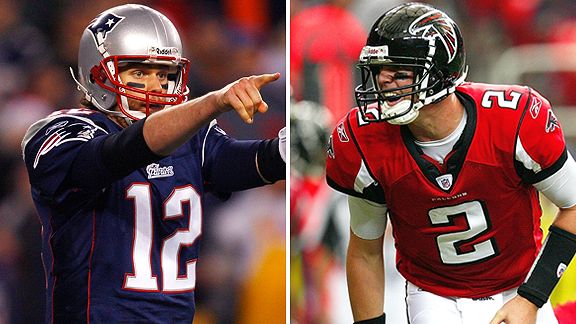
Typically, this results in good depth at the QB position, where the expected production from QB10 isn’t all that different than QB20. This year the QB10 off the board is Matt Ryan (7.01) while the QB20 is Joe Flacco (11.02). To illustrate my point, in a “high performance” scoring system (4 pts per pass TD, 1 pt per 20 yards passing), Footballguys projects Ryan to score 255 fantasy points and Flacco to score 235. Are those 20 fantasy points worth burning a 7th round pick instead of an 11th? Over a 17-game schedule, that works out to less than 1.2 fantasy points per week.

In other words, it’s probably not going to cost you too many wins to go with Flacco instead of Ryan. In fact, you’ll probably be better off because the WR or RB you draft in the 7th round (Santana Moss?) is likely to vastly outperform his 11th-round counterpart (Michael Jenkins?). Footballguys projects Moss to outscore Jenkins by 75 points, a 4.4-point per week advantage. So by going with a Moss/Flacco combo instead of a Ryan/Jenkins combo, you’re gaining a net of 3.2 points per week.

Going one step further: why not draft two middle- to late-round quarterbacks whose schedules mesh well together to create a Quarterback By Committee (QBBC)? That way, you can load up on RB, WR and TE talent in the first seven or eight rounds knowing that you’ll still be able to get good QB play from a couple of later picks by taking advantage of the ebbs and flows of each player’s schedule.

To that end, I took the QB strength of schedule data from Footballguys and calculated the per week projections (by using the aforementioned Footballguys projected stats) for every starting quarterback in the league.

Continue reading »

Ranking the top 5 fantasy RBs

We’ll be spending much of our fantasy football preview (coming soon!) highlighting the players who represent good value this year. But while finding a few diamonds in the rough can make or break a fantasy team, it is just as important to pick the right diamond in the first round. Fantasy championships aren’t won in the first round, but they can be lost.

To that end, I’m going to discuss the five RBs that I believe are head and shoulders above the rest. The first three players are as solid as the day is long, and while the last two aren’t quite as dependable, their upside trumps the question marks surrounding their short-term prospects.

Any ADP data you see is from Antsports, and it assumes a 12-team league with their high performance scoring system, which includes six points per rush TD and one point per reception.

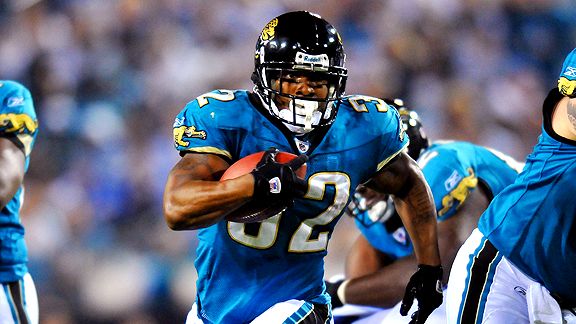
1. Maurice Jones-Drew, Jaguars (1.02)
Sharing time with Fred Taylor for much of his career, MJD has still averaged 1313 total yards, 49 receptions and 12.6 TD over his first three seasons. Even though Taylor seemed to step aside in 2008, he still had 143 carries, which ate into MJD’s touches. The Jacksonville offensive line is finally healthy, and along with new additions Eugene Monroe and Eben Britton, the Jags should get much better play up front. With Taylor gone and an easier schedule, all signs point to a career year for Maurice Jones-Drew.
Projected stats: 230 carries, 1035 rushing yards, 12 rush TD; 55 rec, 495 rec yards, 2 rec TD…291 fantasy points

2. Matt Forte, Bears (1.03)
As a rookie, Forte was the top fantasy back in 2008. Kevin Jones has been looking good, and the Bears seem to want to take some of the workload off of their young buck. So I’m predicting a drop in carries and receptions, but not a huge drop. He is one of the league’s best pass-catching backs and with limited options in the passing game, Jay Cutler will have to look Forte’s way early and often. Moreover, the Bears’ O-line looks to be improved with the addition of Orlando Pace, who needs to stay healthy for Forte to drastically improve his pedestrian ypc (3.9).
Projected stats: 269 carries, 1103 rushing yards, 8 rush TD; 57 rec, 433 rec yards, 3 rec TD…277 fantasy points

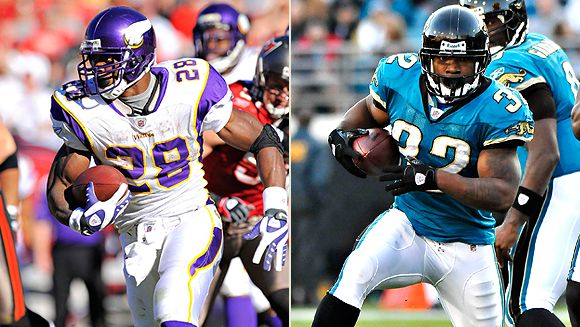
3. Adrian Peterson, Bears (1.01)
It looks like Brett Favre isn’t going to be under center for the Vikings, so the offense will again be extremely dependent on Peterson’s ability to run the football. Even though he faced a host of eight-man fronts last season, he still averaged 4.8 yards per carry, in no small part because Minny has one of the best offensive lines in football. AP is a threat in the passing game, but the Vikings don’t make much of an effort to get him the ball in space. One downside – he led the league in fumbles (9) in 2008.
Projected stats: 340 carries, 1632 rushing yards, 11 rush TD; 20 rec, 160 rec yards, 1 rec TD…271 fantasy points

4. LaDainian Tomlinson, Chargers (1.06)
LT2 didn’t turn in the kind of season that we were all expecting, but he still had a solid year, finishing as 2008’s RB10. (Had he scored one more TD, he would have been RB6.) He fought through groin and toe injuries, but looks completely healthy now and head coach Norv Turner expects him to challenge for the rushing title. Tomlinson is on the wrong side of 30, and has carried the ball 2657 times in his career. But he’s always been special, so there’s a good chance he can buck the odds and squeeze another top 5 season (or two) out of those old bones.
Projected stats: 260 carries, 1092 rushing yards, 11 rush TD; 45 rec, 338 rec yards, 2 rec TD…266 fantasy points

5. Steven Jackson, Rams (1.05)
Even though he missed (or was limited) in five games in 2008, Jackson still finished the season as RB19 and was one of only five backs – Forte, DeAngelo Williams, Brian Westbrook and Reggie Bush being the other four – to average at least 19 fantasy points per game. Clearly, he’s a top 5 back when healthy, but can he stay healthy? He has missed eight games over the last two seasons, so it’s a legitimate concern. Still, his upside is too good to pass up at 1.05.
Projected stats: 280 carries, 1148 rushing yards, 9 rush TD; 45 rec, 383 rec yards, 2 rec TD…264 fantasy points

You may be wondering where Michael Turner’s name is, but as the Falcons open up the playbook more and more for Matt Ryan (along with the addition of Tony Gonzalez), I don’t think Turner will approach 370 carries again this season. Besides, he’s not involved enough in the Falcons’ passing game to warrant a spot on this list, at least in a PPR league.

Of course, I always reserve the right to change my mind (or my projections), but as it stands today, this is the order in which I would go if I were drafting in a high performance PPR league. In the meantime, be sure to follow “FantasyTips” on Twitter, where we’ll be publishing even more fantasy content as the season gets closer.

Related content: Surprises and Busts: Trying to predict the unpredictable in fantasy football

« Older posts Newer posts »