Tag: Fantasy football draft strategy (Page 14 of 20)

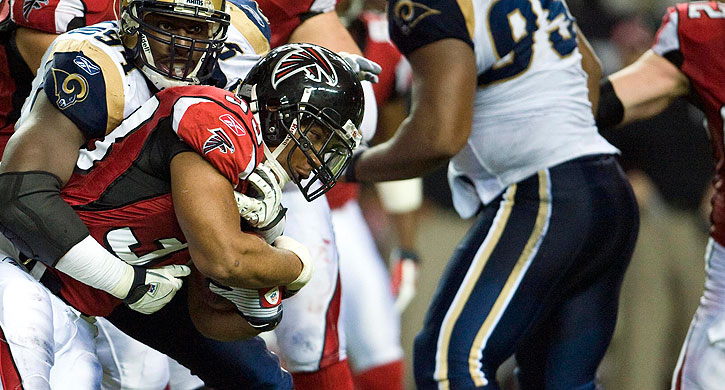
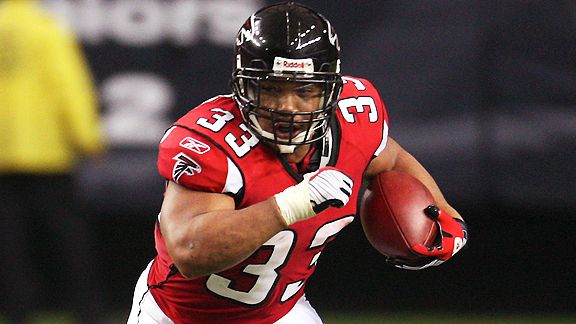
Another reason to be down on Michael Turner this season…

I’ve already mentioned the “Curse of 370,” but Michael Turner is facing yet another challenge this season — a much tougher schedule.

Here’s a look at Turner’s performance last year against good, mediocre and bad rush defenses:

– In three games against top 10 rush defenses (Chicago, Philly and Minnesota), Turner averaged 20.3 carries for 60.7 yards and 0.3 TD, which translates to 8.1 fantasy points.

– In seven games against teams ranked #11-#20 in rush defense (New Orleans x 2, Carolina x 2, Tampa Bay x 2, and San Diego), Turner averaged 23.4 carries for 92.0 yards and 1.0 TD, which equals 15.2 fantasy points.

– In six games agains teams ranked #21 to #32 in rush defense (Denver, St. Louis, Detroit, Kansas City, Green Bay and Oakland), Turner averaged 25.2 carries for 145.5 yards and 1.5 TD, which is 23.5 fantasy points.

In short, Turner killed poor rush defenses, did pretty well against mediocre defenses and struggled against good ones. That makes sense, right?

Heading into the 2009 season, Turner’s schedule is shaping up to be tougher. He has six matchups with teams that finished in the top 10 last year, nine matchups with teams that finished #11-#20, and just one game against a team that finished #22-#32 (#22 Buffalo). On average, he’s going from a schedule that has an average rank of 19.3 against the rush to one that has an average rank of 13.6. Not good.

So assuming that Turner has the same averages against each of the three groups, and last year’s finish is a reasonable expectation for how these defenses will fair (a big assumption, I know), then Turner would project to 358 carries for 1338 yards and 13 TD. Those are still good numbers, but a far cry from the 1699 yards and 17 TD he posted last year.

Assuming he continues to be a non-factor in the Atlanta passing game (and with the addition of Tony Gonzalez, this is not a big assumption), and posts another six catches for 41 yards, then these rushing and receiving totals translate to 221 fantasy points (in a high performance PPR league). That would have made him RB15 last year.

I still like Turner — hell, I have him in a keeper league, so I’m rooting for the guy — but I just don’t think he’s first round material this season in PPR leagues.
Will the ‘Curse of 370’ slow Turner down?

Michael Turner carried the ball 376 times last season, which is a bad omen if you believe in the “Curse of 370.”

The stat was “discovered” by Football Outsiders founder Aaron Schatz in 2004.

The “370 Curse” has reared its head in the Falcons locker room before.

Running backs who rush for more than 370 carries in a season will either have a significant decline or get hurt the following season. Only one running back, Eric Dickerson, has been able to beat the curse.

After Jamal Anderson powered the Falcons to the Super Bowl with 410 carries in 1998, he suffered a torn anterior cruciate ligament in 1999 and was never the same.

Gerald Riggs ran for 1,719 yards on 397 carries in 1985. He followed up that season with 1,327 yards on 343 carries but although he played five more seasons, he never eclipsed the 1,000-yard mark again.

Some of the latest players to succumb the curse include Seattle’s Shaun Alexander, Kansas City’s Larry Johnson, Tennessee’s Eddie George and Miami’s Ricky Williams.

For their part, the Falcons don’t believe Turner was overused, and when they need to run the ball, they’re going to call Turner’s number.

I like Turner this year, but I don’t think he’s going to rack up 370+ carries again this season. Assuming he doesn’t get injured, I expect him to carry the ball 320-350 times. He’s not a big part of the Falcons’ passing game, so that hurts his fantasy stock in PPR leagues.

It’s going to be interesting to see if Turner can avoid the “curse” this season.

What is Favre’s fantasy value?

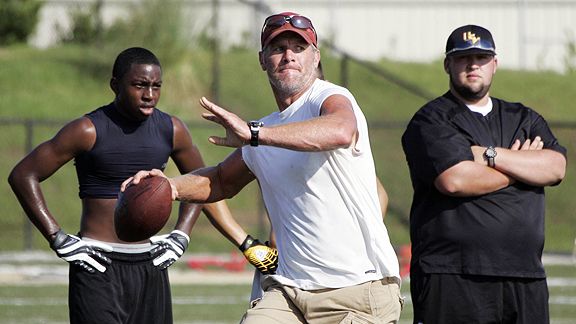
In case you missed it, pending a physical, Brett Favre is about to become a Viking.

People are justifiably interested in talking about the on-again/off-again Brett Favre saga, and how the Vikings bent over backwards, allowing #4 to skip training camp because…well…he doesn’t like to practice.

But what about his fantasy impact?

First things first, the Vikings have one of the easiest schedules for a QB. Whether it’s Brett Favre, Sage Rosenfels or Tarvaris Jackson, the Minnesota QB is only projected to have one tough matchup all season.

Fans around the country have been dumping on Favre since the Jets’ December swoon last season, but let’s not forget the fact that he was in the MVP conversation as late as Week 12 after he led the Jets to a 34-13 victory over the then-undefeated Titans in Nashville. At that point, Favre was averaging 224 yards, 1.8 TD and 1.2 INT per game. Had he continued on that pace, he would have finished as fantasy’s #9 QB, ahead of David Garrard and behind Matt Cassel. Somewhere around this point in the season, Favre tore his biceps which led to his late-season swoon. Even so, he finished as QB13.

In early July, when Favre-to-Minnesota looked inevitable, he was going in the 12th round. I suspect that he might go a bit earlier (maybe the 9th-11th) now that it’s (almost) official. This puts him the QB15-QB20 range. I’d probably take him after Cassel/Hasselbeck/E. Manning/Garrard but before Orton/Edwards/Flacco/Delhomme.

Favre is still starter-caliber when healthy, but his age makes him better suited to be part of a QBBC. With that in mind, I re-ran the QBBC numbers, assuming that Favre would score 251 fantasy points (in a high performance scoring system) figuring that last year’s total (which included five games with a torn biceps) would be a fair estimate of his 2009 production. It turns out that Favre’s schedule combines well with Shaun Hill (#14 combo), Garrard (#20) and Cassel (#27), so if you’re trying to get one of my recommended QBBC combos — Cassel/Hill, Garrard/Hill or Garrard/Cassel — Favre works with all three of those QBs. Put him alongside Trent Edwards on your list of backup options if you miss out on one of those players.

As for the rest of the Vikings, the threat of Favre in the passing game should boost the value of Adrian Peterson, while his experience and talent should help Bernard Berrian, Percy Harvin and Visanthe Shiancoe.

If you do draft Favre, be sure to grab Sage Rosenfels as his backup. Prior to the Favre signing, Rosenfels was leading the QB competition and has the best chance of being Favre’s backup.

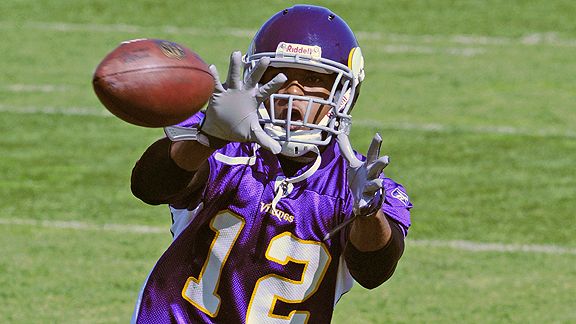
This dude is really, really high on Percy Harvin

I didn’t put him on my list of late-round sleepers, but after reading this glowing piece on Rotoworld, maybe I should.

If Harvin’s special talent is undeniable, then why is his ADP still hovering around the late eighth to early ninth round? A long-accepted maxim in fantasy football circles states that rookie wide receivers will always be over-valued on draft day because the production fails to match the hype. Randy Moss and Anquan Boldin serve to remind us that they’re the exception, not the rule. Receivers take too long to get acclimated to their new offenses, coaches and quarterbacks don’t quite trust them, and they simply don’t touch the ball enough to accrue fantasy value.

But what if a rookie receiver came along who already had the trust of his coaches, immediately showed a high football IQ, was already incorporated as a major component of the offense, and was set to touch the ball 10-12 times per game? We’re talking about not only a unique talent, but a receiver playing a newly invented position: the Percy Position.

Early indications are that the Vikings will use Harvin in much the same that Florida did. As soon as Harvin was drafted, head coach Brad Childress called offensive coordinator Darrell Bevell and asked, “Hey, where’s the list?” The list contained 20-to-30 plays – including 10-to-15 new plays – specifically designed to get the ball in Harvin’s hands in space. As the Vikings installed the Percy Plays during OTAs, Harvin stole the show. “I think the first thing I thought about was really the same feelings the first time we handed Adrian Peterson the ball,” Childress said. “When you see it with your own eyes … the thing that came to mind right away was, Wow.”

If he does average 10-12 touches a game, he’s going to be fantasy starter worthy. Figure six carries at about five yards a carry and four catches at about 8-10 yards per catch, and Harvin has about 62-70 total yards (6.2-7.0 points), four catches (4.0 points) and maybe a TD. Other than Adrian Peterson, the Vikings don’t have too many playmakers on offense, so it’s reasonable to think that Childress will get Harvin the ball early and often. This might be a case where it’s okay to draft a rookie WR in the middle rounds.

Late-round fantasy WR gems

All 2009 Fantasy Articles | 2009 Position Rankings

In the world of fantasy football, the WR position is by nature in constant flux. Every NFL team has two starters, and the potent offenses are even capable of giving a third WR some fantasy value. This means that there are 80+ wideouts that will get consistent playing time on a weekly basis, and that provides plenty of opportunity for surprise breakout stars. Compare this to the RB position, where it usually takes an injury for a lesser-known back to get a shot. Last year, Eddie Royal, Lance Moore, Kevin Walter, Isaac Bruce, DeSean Jackson and Steve Breaston all finished in the top 30 in PPR leagues, and 2009 should have its fair share of surprises.

I listed my mid-round value WRs as part of our positional preview, but here are my top 5 late-round gems (for PPR leagues), sorted by projected value in relation to price. I’ll also list several more to keep an eye on as your fantasy draft winds down. To be eligible, the wideout has to have an average draft position (ADP) in the double digits (i.e. he’s going in the 10th round or later).

And off we go…

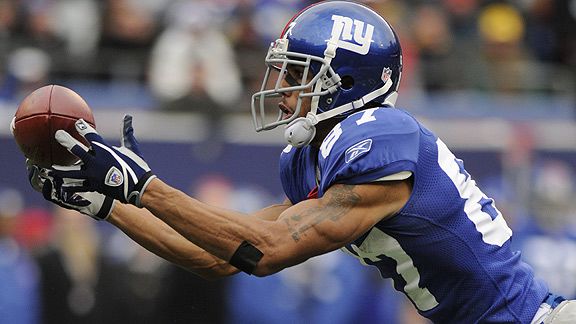
1. Domenik Hixon, Giants (12.07)
With Plaxico Burress sitting in court, pondering his decision to stuff a gun in the waistband of his sweatpants, the Giants have a gaping hole at WR. Hixon hopes to fill it, and he’s already shown signs that he’s capable. Over the last six weeks, Hixon averaged 4.7-59-0.2. He’s just 24, possesses great speed and is entering his third season, which is a prime time for a WR to break out. Sure, the Giants’ decision to draft Hakeem Nicks is a little worrisome, but he’s been hobbled with a bad hamstring and has a long way to go to usurp Hixon, whom I’d start to think about in round 10.

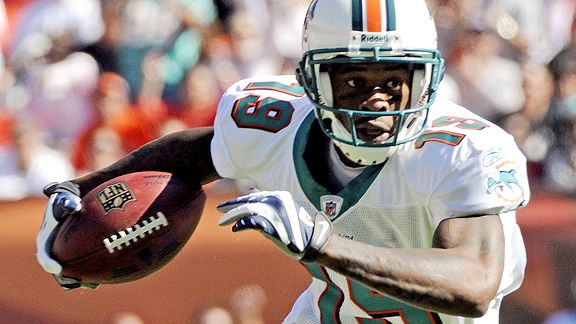
2. Davone Bess, Dolphins (16.03)
As a rookie, Bess stepped in for the injured Greg Camarillo, and posted 5.8-61-0 – that’s a 92-catch pace – over the last six games. He only scored one TD all year, so obviously he’s better suited for a roster spot in a PPR league, but he’s tough, quick and has good hands. I like Ted Ginn as well, but Bess is a better value in the waning rounds, especially since he’s still in the starting lineup despite the fact that Camarillo is healthy again.

3. Chaz Schilens, Raiders (14.10)
It’s always dicey to count on an Oakland WR, but in the later rounds, Schilens is definitely worth a flier. The Raider beat writers say that he is the team’s clear #1 WR, and he has performed well in the preseason, building on his momentum from the last two games of last season (6 catches for 98 yards and two TD against the Texans and Bucs). Schilens could be primed for the rare (but not unheard of) second-year breakout. It certainly helps that JaMarcus Russell seems to be consistently looking his way.

Continue reading »

« Older posts Newer posts »