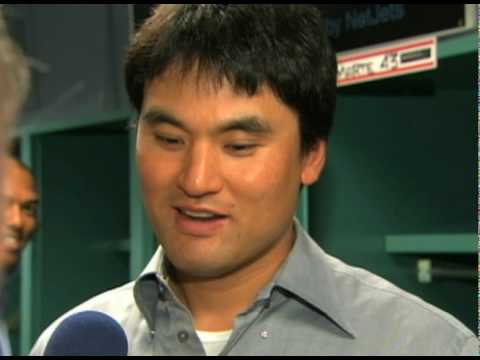
After getting rocked in his first appearance as a Yankee, Chan Ho Park had this to say…
I love the laughter in the background and Park looking around like he really doesn’t know what’s so funny.
After getting rocked in his first appearance as a Yankee, Chan Ho Park had this to say…
I love the laughter in the background and Park looking around like he really doesn’t know what’s so funny.

Click Here to see Previews of all 30 MLB Teams
Offseason Movement: The defending World Series champs added 2B Miguel Cairo, OF Raul Ibanez, C Ronny Paulino and pitchers Gary Majewski and Chan Ho Park this offseason. Philly also parted with OF Pat Burrell, OF So Taguchi and pitchers Adam Eaton, Tom Gordon and Rudy Seanez.
Top Prospect: Carlos Carrasco, RHP
Carrasco enters 2009 as one of the top pitching prospects in all of baseball and if Chan Ho Park struggles as the fifth starter, there’s a chance that Carrasco might make an appearance at some point this season. He appears to have a very high ceiling and while he’s still a bit erratic at times, Carrasco will likely smooth out his rough spots in Triple-A before making the big league roster.
RealClearSports.com recently ranked the top 10 worst MLB free agent signings of all-time.
#1 Chan Ho Park Signed by Texas in 2002, five years, $65 million.
Coming off 18-10 and 15-11 seasons in the pitchers’ heaven that is Dodger Stadium, Texas gave Park one of the most lucrative contracts ever given to a pitcher at that time. Injuries limited his workload, which wasn’t a bad thing considering his ERAs with the Rangers: 5.75, 7.58, 5.74, 5.66, before he was finally unloaded to San Diego in 2005.#2 Juan Pierre (signed by Los Angeles in 2006, five years, $44 million) and Andruw Jones (signed by Los Angeles in 2007, two years, $36.2 million).
You know it’s a really bad signing when the team inks someone a year later to play the same position, and he does even worse. Pierre took his below-league-average on-base ability and minuscule power into the offensive void of Dodger Stadium with predictable results: .664 and .655 OPS in his two seasons so far. Andruw Jones received a raise off his worst season in 2007, and demonstrated that bad year in Atlanta was no fluke, batting .158 with three home runs in 209 at bats in 2008. The Jones signing also shifted Pierre to left field, where his wretched bat for a centerfielder would be an even greater liability. By the end of the season, the Dodgers recognized their CF answer had been there all along, in the person of Matt Kemp.#3 Mike Hampton and Denny Neagle – Signed by Colorado in 2000; Hampton for eight years, $121 million, Neagle for five years, $51 million.
The vertiginous problem of pitching in Colorado led to some terrible decisions. Even though importing a free agent had failed in the case of Darryl Kile (ERAs of 5.20 and 6.61 in his two seasons before he was traded to St. Louis), the Rockies tried again in the 2000-01 offseason, giving $172 million to two lefthanders. Hampton was hampered by injuries and ineffectiveness in his two seasons in Colorado, going 21-28 with ERAs of 5.41 and 6.15 before being shipped off to Florida (and then on to Atlanta); his free-agent contract finally expired last year. Neagle was a decent 31-year-old pitcher with a 105-69 record and 3.92 career ERA when the Rockies elevated him to the front of their rotation; he gave them three seasons of 19-23, 5.56, before earning his release with two years left on his contract.
I’m a little surprised Barry Zito didn’t make the list, but I guess people are willing to give him one more year of brutal pitching before really laying the hammer on the massive free agent bust.
“Momentum is always as strong as your starting pitcher is the next day.”
– Joe Maddon
Leave it to the well-read Rays manger to come up with such a profound statement. Chances are this saying is nailed up in his teams’ clubhouse alongside others from the likes of Albert Camus and Jean-Paul Sartre. Maddon’s right, and he’s used this pitching-first philosophy to propel his team into the ALCS.
If there’s one quality that ties each of the remaining four teams together, it’s that each of them can hit. They each have at least two big bats, lead-off men that can hit for average, and a bottom of the order that can consistently do some damage. When teams are this evenly matched at the plate, it’s often a single blunder on the part of a pitcher that can decide a game. As we’ve seen in the Division Series between the Angels and Red Sox, it comes down to the pitching. Both teams boasted fabulous rotations and excellent hitting, but it was the Red Sox middle relief and closer that really won the games.
The same will go for both matchups in the Championship Series. The Phillies, Dodgers, Rays, and Red Sox all have three starters who can win games at home and on the road. However, these series are best out of seven games, which creates a dilemma for each of these ball clubs as there isn’t a strong fourth starter to be found. Subsequently, these teams might start their aces after three days rest, or even force them to pitch for a third time if the series extend to seven games. This will be a test of player’s stamina and sound decision-making on management’s part. While managers struggle with whether to start a tired arm or an unpredictable one, a bullpen becomes even more valuable. They can come to the rescue (Matsuzaka in the ALDS), consistently put the lid on a victory (Papelbon and Lidge all year), or sometimes pitch the majority of the game after a starter bombs (Wade, Park, Kuo, and Saito of the Dodgers).
These games are going to be decided in the late innings, and this factor alone will make watching them gratifying. Here’s the breakdown:
Los Angeles Dodgers vs. Philadelphia Phillies
At their healthiest, the Dodgers have a better pitching staff than the Phillies. If set-up man Hong-Chi Kuo and closer Takashi Saito hadn’t injured themselves at the end of the season, this series would undoubtedly favor the Dodgers. As a result, they need their starters to go as long as possible. If Derek Lowe, Chad Billingsley, and Hiroki Kuroda can each go seven innings in all of their starts, I think the Dodgers can rely on their bullpen to pull through. Chan Ho Park and Cory Wade are both capable of maintaining a lead. The problem lies in the intimidating left-handed Phillies hitting. The Dodgers only have three southpaws on their roster: starter Clayton Kershaw, reliever Joe Beimel, and the aforementioned Kuo. Word is that the left-handed Kuo has been comfortable in recent simulated sessions. The Dodgers have said that Kuo might pitch an inning per game. A successful eighth inning with Kuo in relief opens the door with recent go-to closer Jonathan Broxton. Of course, this is idealistic. Yet, the fact remains that the Phillies cannot match this formula. It’s true that Brad Lidge outshines any of the Dodgers relief, but he’s only as good as the lead he’s protecting. The Dodgers dominated the opposition’s starting pitching better than any other team in the Division Series. They pounded Ryan Dempster, Carlos Zambrano, and Rich Harden of the Cubs, a rotation far more intimidating than the Phillies’. During the regular season, the clubs were evenly matched, with each sweeping the other at home and splitting their decisions. What’s important now is how late into the game their starters can pitch before handing it off to their relief.
The Dodgers have a couple advantages over the Phillies. The first lies in Derek Lowe. He’s thrown “Cy Young” quality pitching for the past two months and has more playoff experience than the Phillies starters combined. The Dodgers can pressure Lowe into pitching Games 1, 4, and if need be, 7. With a two or three run cushion, Lowe can hold steady into the eighth inning, even on three days rest. Given the Dodgers recent activity at the plate, they should be able to support their ace. If Lowe isn’t given the reins in Game 4, the Dodgers could either go with Clayton Kershaw or Greg Maddux. Both can outduel Joe Blanton of the Phillies. Kershaw, the likely choice, has pitched capably against Jimmy Rollins, Chase Utley, and Ryan Howard who have struggled against left-handed pitching.
Boston Red Sox vs. Tampa Bay Rays
The two best teams in the American League advanced. This statement is obvious as both the Red Sox and the Rays made due with critical injuries that severely altered their team’s chemistry. Josh Beckett’s recent injury was visibly apparent in Game 3 against the Angels, as he gave up three runs on eight hits in five innings. Still, Jon Lester, the strongest pitcher in the postseason, led the Red Sox to a Game 4 clincher. The Rays will likely be without veteran closer Troy Percival, who had a magnificent first half. With Percival gone, they’ve moved Dan Wheeler into his spot. Wheeler blew five out of 18 chances during the regular season. Even without a strong closer, the Rays offense produced a large enough lead for their starters to secure wins against the White Sox.
Tampa Bay enters this series with the third best team ERA in baseball. Though they finished 10-8 against the Red Sox, both teams were swept twice at home. James Shields, Scott Kazmir, Andy Sonnanstine, and Matt Garza are a very good rotation, and they’ve proven they can hold a lead when given it. Nevertheless, Jon Lester, Josh Beckett, Daisuke Matsuzaka, and Tim Wakefield stack up better pound for pound—when they’re injury-free. And they’re not. The Rays need to win all their games against an ailing Josh Beckett and a struggling Tim Wakefield. Also, it’s essential to build a lead substantial enough to render Papelbon useless. If Shields, Kazmir, or Garza can outpitch either Lester or Matsuzaka in at least one decision, the Rays have a very good chance.
For Boston, Papelbon is just as key now as he’s ever been. Of the teams that remain, no other closer is as valuable. While the Rays have a fairly talented set-up in Grant Balfour, J.P. Howell, and David Price, Dan Wheeler doesn’t bring the sense of security that comes with Papelbon. If he’s on the mound, the Red Sox are going to win—there’s just no way around it. To advance to the World Series, the Rays need to get to Lester or Matsuzaka in one of their starts. It’s difficult, but not impossible.
Any way you slice it, this year’s World Series is going to be entertaining. Each of these teams carry their own unique story. Whether it’s Manny and Torre in L.A., Charlie and the Phillies, the Red Sox domination, or the endearing Rays, whoever wins will be a deserving champion.

© 2026 The Scores Report – The National Sports Blog
Theme by Anders Noren — Up ↑