Tag: 2010 NBA free agents (Page 54 of 54)

NBA announces 2009 salary cap, warns about 2010

The new salary cap figure is out, and it dipped slightly from last season.

The new figures for 2009-10 just announced by the league have set the salary cap at $57.7 million per team — down $1 million from $58.7 from 2008-09 — and the luxury-tax threshold at $69.9 million.

More importantly, the league is projecting a much bigger drop (as much as $8 million) heading into the 2010 season.

The official league memorandum, obtained by ESPN.com, forecasts a dip in basketball-related income in the 2009-10 season of 2.5 percent to 5 percent, which threatens to take the 2010-11 cap down some $5 million to $8 million from last season’s $58.7 million salary cap.

A significant drop for the luxury-tax threshold is also projected going into the summer of 2010. If basketball-related income drops by 2.5 percent in 2009-10, league officials are projecting a 2010-11 salary cap of $53.6 million and a luxury-tax line of $65 million. If BRI, as it is referred to in the NBA, decreases by five percent, teams would be looking at a $50.4 million salary cap and a luxury-tax line of $61.2 million in 2010-11.

What does this mean? Well, a team like the New York Knicks, who are projected to have a payroll of about $23 million heading into 2010 would have had about $35 million to spend had the cap stayed at $58 million. That’s plenty of money to sign to superstars. If the cap drops $5-$8 million, it means that they’re projected cap space will be in the $27-$30 million range. That makes signing two “max” players quite tough.

This is probably good news for teams looking to retain their superstars, since they can go over the cap to re-sign players. If the cap does indeed drop to $50 million, it would increase the chances of LeBron James, Dwyane Wade and Joe Johnson staying put.
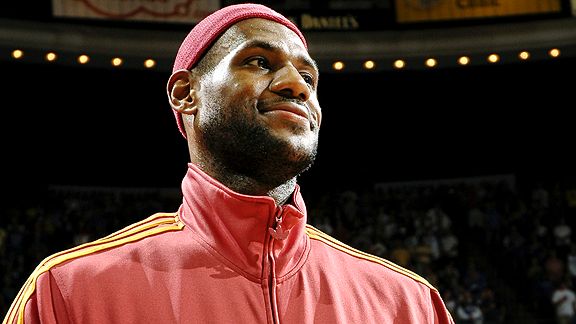
LeBron pledging to stay in Cleveland?

Yes, at least according to a “source” close to Trevor Ariza…

The Cleveland Cavaliers got some bad news followed by some potentially terrific news on Sunday. In a last-ditch effort to recruit Trevor Ariza away from the Houston Rockets, LeBron James told Ariza he would remain with the Cavaliers past 2010, according to a person close to Ariza.

Even that wasn’t enough to get Ariza, who verbally committed to join the Rockets last Thursday, to change his mind and go to Cleveland.

But the Cavaliers will gladly settle for the consolation prize; if indeed James’ statement to Ariza was more than an empty sales pitch.

“Trevor asked LeBron if he would be in Cleveland after next season,” the source said. “And LeBron said, ‘I’ll be there. Of course, I’ll be there.'”

When James told Ariza he’d be a Cavalier past next season, Ariza was less than convinced.

“He thought it was just a recruiting tool,” the source said. “LeBron definitely said it, but until he signs the contract it doesn’t mean much.”

If James was indeed being sincere in his intentions to re-sign with the Cavs, this is about the best news that the city of Cleveland could get on a Tuesday morning in July. Of course, a lot can happen in a year and he could just be saying this to try to convince a free agent or two to join the Cavs. There’s also the distinct possibility that this “source” is full of it.

The LeBron Watch continues…

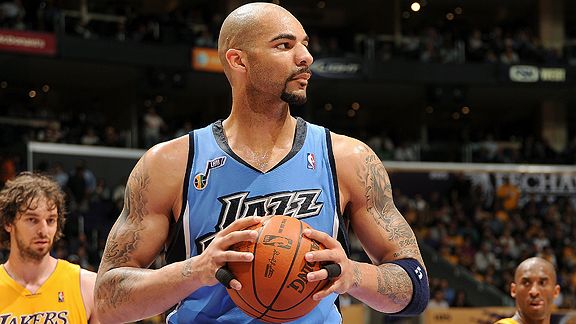
Boozer may stay with the Jazz for another season

For a time, it seemed like it was inevitable that Carlos Boozer would opt out (or not opt in, in this case) and hit the open market as an unrestricted free agent. But the economic climate has changed and the market for his services does not appear to be as strong as it was once thought to be. Boozer might very well play another year in Utah.

Boozer has until 5 p.m. on Tuesday to decide whether to exercise a player option on his contract with the Utah Jazz. The contract is set to pay Boozer $12.7 million next season if he opts in. Could he make more than that on the open market?

For months it was assumed that Boozer would land in Detroit. But last week Pistons sources told ESPN.com that Boozer wasn’t the team’s highest priority and that if they pursued him, they weren’t willing to give him the $13-15 million a year he’s looking for.

The Jazz aren’t in a great position to re-sign him either. Utah has to sign another free agent, Paul Millsap, and possibly a second, Mehmet Okur, if he opts out of his contract. Okur’s agent told The Associated Press on Monday that his client was leaning toward opting out. Those two contracts would put the Jazz near the luxury tax threshold. It’s unlikely they would go over to re-sign Boozer.

“As soon as it looked like the Pistons were the only team with the money and desire to pay him,” one Eastern Conference GM said, “I knew Boozer would be changing his mind. Unless I knew for sure that the Pistons would pay me big bucks, you just can’t make that gamble. I fully expect him to be back with the Jazz next year.”

Earlier this week, I estimated Boozer’s market value at about $12-$13 million per season. I think that if he does opt out, he’d eventually get that kind of a contract because a team willing to spend would work out a sign-and-trade to acquire him. The problem there is that Utah would have to take on near-equal salary for the first year and that would potentially push them over the luxury tax threshold (assuming Mehmet Okur returns and the Jazz sign Paul Millsap to a lucrative deal).

Assuming the Pistons don’t step up with a deal averaging $10-$11 million, Boozer’s absolute worst case is signing a one-year mid-level deal (~$5.8 million), which would cost him about $7 million this season. If he plays another year in Utah, he’ll have the opportunity to prove that he can stay healthy and would join the vaunted free agent class of 2010, where there will be a greater market for his services. Teams are saving up for that summer, so Boozer would be a nice consolation prize for those teams hoping to add Chis Bosh or Amare Stoudemire.

The downside of staying in Utah for another season is the lack of the security. Is it better to sign a five-year deal at a discount (say, $11 million per season) and have a guaranteed $55 million or play another year in Utah and risk a career-ending injury for the prospect of signing for an extra $10-$15 million in 2010? There’s a saying — a bird in the hand is worth two in the bush.

This is the quandary that Boozer is in today. It’s a tough call.

His decision is due in a few hours.

Cavs’ front line in flux

Ben Wallace is considering retirement, Anderson Varejao is likely to opt out of the final year of his contract, and Zydrunas Ilgauskas will play out the final year of his.

Wallace is guaranteed the money and has every right to come back and accept the checks under terms of the deal. More likely if he couldn’t play, the Cavs would look to perhaps get insurance to cover some of the salary and look to trade him. He’d be a valuable commodity because of the expiring contract and teams looking to dump salaries covet them.

There is also a possibility that Wallace could negotiate a buyout of his deal and take a percentage of what he’s owed. But even in that case it would potentially make him a huge trade asset. A team could trade for him at the value of his contract ($14 million) and then save money by buying him out.

I’m not quite an NBA salary cap expert, but I have a pretty good understanding of the rules. Even so, I’m not sure what the financial impact would be of what Wallace is considering. Without Wallace and Varejao, but with Ilgauskas, the Cavs are on the hook for about $53 million, possibly a bit less since there are a few contracts included that aren’t 100% guaranteed. If Wallace were to come completely off the books, that would put the Cavs about $5 million under the cap, which really doesn’t help them all that much since they can already sign a player at the mid-level for about $5.8 million. Where a team really gains an advantage is when they have substantially more than the mid-level in cap space.

Continue reading »

What do the Cavs do now?

This is not how it was supposed to go.

The Cavs were destined to make the Finals and face the Lakers, with LeBron turning in a fantastic Game 7 performance in front of his loyal fans at the Q to bring the city of Cleveland its first championship since 1964. With a title already under his belt, and a few more on the horizon, he would happily re-up for another four or five seasons. Or at the very worst, the Cavs would lose to the more talented Lakers, leaving fans with the feeling that “one more piece” would be all that is needed to finally bring a title to Cleveland. Under that scenario, there would be no way that LeBron could leave, right? Not when the Cavs were thisclose to a title…

Just over a year ago, I wrote that “The Cavs have failed LeBron James,” which was posted about three months before GM Danny Ferry pulled the trigger on the trade that brought Mo Williams to Cleveland. That trade, along with LeBron’s renewed focus and an improved work ethic (which was inspired by his seeing first hand how Kobe prepared during the 2008 Olympics), pushed the Cavs to a league-best 66 wins this season. Williams was named as an alternate to the All-Star Game (after grousing about not being voted in by the coaches) and all was well with the world.

The Cavs received some more good news when Kevin Garnett struggled with injuries down the stretch of the regular season and was eventually shut down for the playoffs. At the time, the Celtics were considered the Cavs’ biggest threat in the East, but KG’s injury might have allowed the Magic, one of four teams that beat the Cavs twice during the year — the Celtics, the Lakers and…um…the Wizards were the other three — to advance to the Conference Finals when they otherwise wouldn’t have survived to face the Cavs. The Magic were a very bad matchup because the Cavs simply didn’t have anyone that could cover Dwight Howard. When they didn’t double-team him, he would make a living on the post, and when they did send another guy, it would free up the Orlando sharpshooters for open jumpers.

Continue reading »

Newer posts »