Tag: 2009 NBA free agents (Page 14 of 18)

NBA Free Agency Rumors: Turk, Charlie V, Millsap and more

Pistons, Blazers interested in Hedo Turkoglu.

The Oregonian reports Blazers general manager Kevin Pritchard and assistant general manager Tom Penn called agent Lon Babby last night to begin the courtship of Hedo Turkoglu.

With Carlos Boozer out of the picture, an NBA source tells the Chicago Sun-Times that Turkoglu is now the Pistons’ first choice in free agency.

While the Blazers’ interest has long been rumored, Detroit’s interest is a little surprising. They already have a very good small forward on the roster in Tayshaun Prince, so unless they’re planning to play Turkoglu at the four, someone is going to lose some minutes. Of the two teams, the Pistons have more cap space, so if they want him, they can get him. (And what about Ben Gordon?)

Charlie V ahead of Turkoglu on the Pistons’ wishlist?

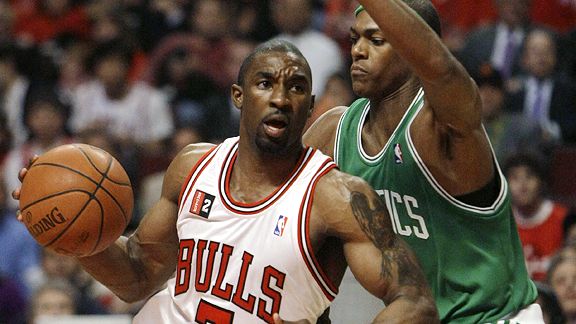
Chicago’s Ben Gordon remains the backcourt player deeply coveted by the Pistons, but the prospect of a Gordon-and-Villanueva combo likely would be slightly cheaper than trying to sign Gordon and Turkoglu with Detroit’s nearly $19 million in projected salary-cap space.

The Pistons may also be interested in Paul Millsap, but anytime a team signs a restricted free agent to an offer sheet, that money is tied up for a week while his current team decides to match. That makes signing an RFA a dicey prospect.

I wonder if the Bucks are regretting letting Villanueva given the amount of interest he’s generating from their division rivals (Detroit and Cleveland).

Continue reading »

NBA Free Agency Rumors: Kidd, Turk, Gordon and much more

Pistons not willing to pony up for Boozer?

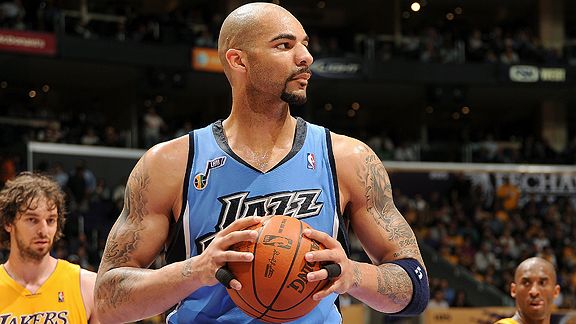
The Pistons would love to sign Carlos Boozer should he decide today to opt out of the final year of his contract with the Jazz and become a free agent.

However, if Boozer opts out, he would leave $12.6 million on the table in Utah. Thus, there is a good chance Boozer, as has been widely speculated, would look to start his next contract at $14 million or $15 million.

If that is the case, the Pistons most likely would walk away.

Just because a guy asks for a contract starting at $14-$15 million doesn’t mean that the Pistons have to give it to him. If Boozer opts out, the Pistons are his most likely landing spot, so they set the market, not him. If he wants an unreasonable deal, they shouldn’t walk away, they should make an offer and give him some time to find a better one. Chances are that he won’t, and he’ll end up taking Detroit’s deal.

Assuming Boozer does not dramatically reduce his asking price, the Pistons would go after Bucks forward Charlie Villanueva.

Villanueva will turn 25 in August and is coming off his best season. He averaged 16.2 points and 6.7 rebounds for the Bucks.

The Pistons could conceivably sign Gordon and Villanueva and still have money left over to pursue re-signing Antonio McDyess.

I estimate Gordon’s value to be about $9 million, though he has turned down bigger offers from the Bulls in the past. Villanueva will probably get lots of MLE offers, so the Pistons would likely have to trump those to convince him to play in Detroit instead of Cleveland (or for another contender). So if Detroit signs both, expect them to pay at least $15.5-$16.0 million combined. That doesn’t leave a lot of space for McDyess.

Continue reading »

Boozer may stay with the Jazz for another season

For a time, it seemed like it was inevitable that Carlos Boozer would opt out (or not opt in, in this case) and hit the open market as an unrestricted free agent. But the economic climate has changed and the market for his services does not appear to be as strong as it was once thought to be. Boozer might very well play another year in Utah.

Boozer has until 5 p.m. on Tuesday to decide whether to exercise a player option on his contract with the Utah Jazz. The contract is set to pay Boozer $12.7 million next season if he opts in. Could he make more than that on the open market?

For months it was assumed that Boozer would land in Detroit. But last week Pistons sources told ESPN.com that Boozer wasn’t the team’s highest priority and that if they pursued him, they weren’t willing to give him the $13-15 million a year he’s looking for.

The Jazz aren’t in a great position to re-sign him either. Utah has to sign another free agent, Paul Millsap, and possibly a second, Mehmet Okur, if he opts out of his contract. Okur’s agent told The Associated Press on Monday that his client was leaning toward opting out. Those two contracts would put the Jazz near the luxury tax threshold. It’s unlikely they would go over to re-sign Boozer.

“As soon as it looked like the Pistons were the only team with the money and desire to pay him,” one Eastern Conference GM said, “I knew Boozer would be changing his mind. Unless I knew for sure that the Pistons would pay me big bucks, you just can’t make that gamble. I fully expect him to be back with the Jazz next year.”

Earlier this week, I estimated Boozer’s market value at about $12-$13 million per season. I think that if he does opt out, he’d eventually get that kind of a contract because a team willing to spend would work out a sign-and-trade to acquire him. The problem there is that Utah would have to take on near-equal salary for the first year and that would potentially push them over the luxury tax threshold (assuming Mehmet Okur returns and the Jazz sign Paul Millsap to a lucrative deal).

Assuming the Pistons don’t step up with a deal averaging $10-$11 million, Boozer’s absolute worst case is signing a one-year mid-level deal (~$5.8 million), which would cost him about $7 million this season. If he plays another year in Utah, he’ll have the opportunity to prove that he can stay healthy and would join the vaunted free agent class of 2010, where there will be a greater market for his services. Teams are saving up for that summer, so Boozer would be a nice consolation prize for those teams hoping to add Chis Bosh or Amare Stoudemire.

The downside of staying in Utah for another season is the lack of the security. Is it better to sign a five-year deal at a discount (say, $11 million per season) and have a guaranteed $55 million or play another year in Utah and risk a career-ending injury for the prospect of signing for an extra $10-$15 million in 2010? There’s a saying — a bird in the hand is worth two in the bush.

This is the quandary that Boozer is in today. It’s a tough call.

His decision is due in a few hours.

Bucks let Charlie Villanueva go

Unless the guy is a major disappointment, a team will usually extend the qualifying offer required to make a player a restricted free agent. In the last year of their rookie contract, players are generally still affordable, so average to decent players usually end up as RFAs for a year before hitting unrestricted free agency the following summer.

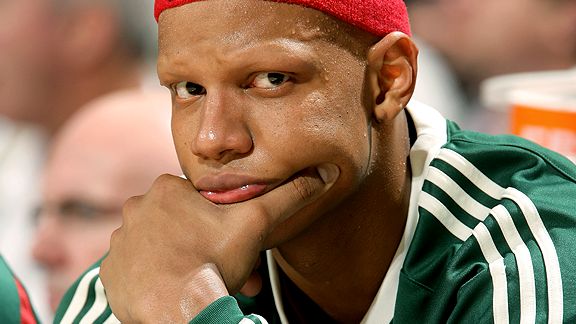
I told you all of that to tell you this — the Bucks elected not to make the qualifying offer of $4.6 million to perimeter-oriented power forward Charlie Villanueva, who averaged 16.2 points and 6.7 rebounds last season. In 47 games as a starter, he averaged 17.7 points and 7.3 rebounds. He can now sign with any team he likes and the Bucks will receive no compensation. I expect that he’ll garner at least a mid-level deal on the open market. His defense is definitely suspect, but he’s young (24) and can really put the ball in the hole.

I sure hope that general manager John Hammond explored all of his options before making this decision. It seems like Villanueva holds enough value to pry a first round pick or a prospect away from a contender (how about a J.J. Hickson-for-Villanueva swap with Cleveland?), but this decision, coupled with the Richard Jefferson giveaway last week indicate that the Bucks are in serious cost cutting mode.

The good news is that, with the move, Milwaukee should be better able to match offers for Ramon Sessions, who is a TSR fave.

2009 NBA Free Agency Preview: The top restricted free agents

Yesterday, I ranked the top unrestricted free agents of 2009, but now it’s time to look at this summer’s crop of restricted free agents (RFA). Teams can sign an RFA to an offer sheet, then his team has seven days to match that offer to retain him. If the player doesn’t sign an offer sheet and can’t come to terms on a new contract with his current team, then he will play for a year for the qualifying offer and then become an unrestricted free agent the following summer.

For each player, I’ll provide his position, age, Player Efficiency Rating (PER) and an estimate of what kind of contract he’s likely to sign. They’re ranked in order of total value, which is based on overall talent, age, injury history and cost.

1. Paul Millsap, PF (24)
PER: 18.71
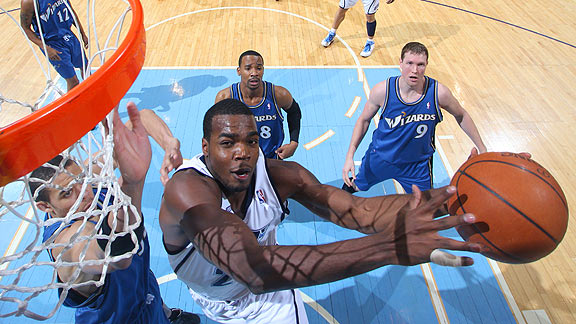
In his third year, this former second round pick had the best season of his career. He averaged 13.5 points and 8.6 rebounds, while shooting better than 53% from the field. While Carlos Boozer was out in December and January, the Jazz got a preview of what this kid can do when he gets starter’s minutes. He was a 17/11 guy during those two months, but the Jazz only went 11-13 in games in which Millsap played during that span. His camp expects a deal similar to the one David Lee is asking for, so something in the $10 million per season range. Is he worth it? Probably. And from the sound of it, the Jazz plan on offering him a deal that will keep him from testing the market. If he does explore his options, it may pay off as the Thunder and Pistons are rumored to have interest.
Value: $9.5 – $10.5 million per year

2. David Lee, PF (26)
PER: 19.07
GM Donnie Walsh said that the Knicks’ picking Jordan Hill in this year’s draft has nothing to do with Lee, but the two play the same position, so of course it’s going to have an effect on how the Knicks and Lee each view their relationship. The other issue is that two of the Knicks’ targets in 2010 are Chris Bosh and Amare Stoudemire might also play the same position as Lee, though Mike D’Antoni would likely play either at center, allowing Lee to play power forward. He gets most of his points off the glass, so he’d be a good fit with either of those guys. The Knicks are projected to have about $35 million in cap space heading into the summer of 2010 and whatever deal they sign Lee to will cut into that. If they want to keep Lee and sign two big-name free agents, then they’re going to have to rid themselves of either Jared Jeffries or Eddy Curry prior to 2010. I like Lee, but he’s not a guy that you can give the ball to on the block and expect him to score, and that limits his value somewhat as a big man. The Thunder, Kings, Grizzlies, Raptors and Pistons could all make a serious run at Lee, though anytime a team tries to poach a restricted free agent, it’s a delicate balance between offering him enough to convince the other team to let him go, while getting a reasonable deal at the same time.
Value: $9.0 – $10.0 million per year.

Continue reading »
« Older posts Newer posts »