Page 282 of 2957

A cure for LeBron’s late-game blues

Miami Heat’s LeBron James pauses during a break in play against the Dallas Mavericks during Game 4 of the NBA Finals basketball series in Dallas, Texas June 7, 2011. REUTERS/Mike Stone (UNITED STATES – Tags: SPORT BASKETBALL)

Over the last few days, much has been written about LeBron James and his late-game performances in Game 3 and in Game 4. People say he has been too passive, disinterested, or that he doesn’t have the mental makeup to succeed in big moments.

I think the issue is with his involvement in the offense. In Game 2, LeBron controlled the ball late and wasn’t able to generate good shots. The Mavs won. In Game 3, Miami gave the ball to Dwyane Wade and let him do his thing. The Heat won. So in Game 4, they did the same thing, only Dallas was ready for it and Wade wasn’t nearly as productive down the stretch. The Heat lost. Criticism rained down on LeBron for his 3-of-11 shooting and his eight points.

But think about it — LeBron has been used to handling the ball on every possession for the last seven years. Suddenly, he’s spotting up on the wing watching Wade run a pick-and-roll with Chris Bosh and waiting for a pass that’s probably never going to come.

He’s not involved, and when he is involved, he’s running a version of Mike Brown’s drain-the-clock-and-force-a-bad-shot offense from his days in Cleveland. Or maybe Mike Brown is an offensive genius and LeBron refused to run his brilliant plays, who knows.

Regardless of the cause, here’s the solution: Go post, young man.

For years, I have been harping on LeBron for his lack of a post game. He’s a 6-8, strong-as-an-ox 250 lb small forward with terrific vision and passing skills and he refuses to go down to the block. Granted, he has posted up a little bit since arriving in Miami, but I haven’t seen it much (if at all) against the Mavs when he’s being guarded by the likes of Jason Kidd (6-4, 210 lbs) and Jason Terry (6-2, 180 lbs). LeBron’s unwillingness to post (or Spoelstra’s play-calling) is the reason the Mavs are able to get away with those matchups. So LeBron stands on the perimeter, covered by a guard who is used to covering people on the perimeter. How does this make sense?

As regular readers know, I played for (current Wisconsin coach) Bo Ryan while at the University of Wisconsin-Platteville and his #1 offensive priority was to get the ball in the post. He preached that throwing the ball inside led to better quality shots and more free throws, leading to more efficient offense. And he was right. As the years went on, he became more willing to let knockdown three-point shooters do their thing, but the Heat don’t have many of those, so it’s not really relevant. (Why am I mentioning it? Because I was a knockdown three-point shooter who wasn’t allowed to do his thing. Grrr.)

Anyway, Spoelstra and LeBron could take a page from Bo’s book and run the offense through LeBron in the post. If he has a smaller guy on him, the Mavs would be forced to double-team or LeBron would be able to score at will (assuming he has any post moves, which is a big assumption). If the put Marion on him, he could setup in the mid-post, catch the ball and go.

But this strategy is predicated on the notion that LeBron and Co. have actually practiced this type of offense and it’s pretty clear that they haven’t, not enough to utilize it in the Finals, anyway.

The Heat may very well go on to win the Finals doing what they’re doing. If they do, I wouldn’t expect LeBron to suddenly become a serious post player. If they lose, perhaps he’ll be motivated enough to improve his game in the same way that Michael Jordan and Kobe Bryant did mid-career. Both players realized that they needed a way to punish teams for covering them with smaller defenders, and both players became excellent shooters/scorers in the post. LeBron would be able to add the extra dimension of passing out of the post as teams cheat or double.

A few years ago, LeBron said that playing on the block was “boring.” There’s still time for this leopard to change his spots, but perhaps it would take another Finals loss to finally convince LeBron to take his talents to the post.
Bill Simmons on LeBron James

Miami Heat’s LeBron James speaks during a media conference for the NBA Finals basketball series against the Dallas Mavericks in Dallas, Texas June 8, 2011. REUTERS/Lucy Nicholson (UNITED STATES – Tags: SPORT BASKETBALL HEADSHOT)

If you haven’t heard already, Bill Simmons and ESPN have launched a new website at Grantland.com. It will feature longer form articles from Simmons along with other writers, including notable scribes like Malcolm Gladwell.

There’s never a shortage of topics for someone as prolific as Simmons, but he must have been thrilled to kick off his new site immediately following the bizarre Game 4 performance by LeBron James. His first column is classic Simmons, as he analyzes the LeBron situation from every possible angle, starting with The Decision:

Fact: The Decision special drew a better rating than the 2008 Finals, became an iconic moment, turned Jim Gray into a punching bag, gave bloggers a month of free shots at ESPN and turned “Taking my talents to South Beach” into a jack-of-all-trades phrase that meant you were about to leave your job, take a dump or pleasure yourself.

I wonder how long he had that line in his pocket . . .

Anyways, he gives his overall assessment of LeBron James, and I agree with most of it:

a. I think he’s one of the greatest athletes who ever lived. I will never forget watching him in person with a full head of steam, blowing through opponents like a Pop Warner running back who’s 30 pounds heavier and three seconds faster than everyone else. I am glad he passed through my life. I will tell my grandkids that I saw him play.

b. From game to game, I think the ceiling for his performance surpasses any other basketball player ever except for Wilt and Jordan.

c. As a basketball junkie, I will never totally forgive him for spending his first eight years in the NBA without ever learning a single post-up move. That weapon would make him immortal. He doesn’t care. It’s maddening.

d. In pressure moments, he comes and goes … and when it goes, it’s gone. He starts throwing hot-potato passes, stops driving to the basket, shies away from open 3s, stands in the corner, hides as much as someone that gifted can hide on a basketball court. It started happening in Game 3, then fully manifested itself in Game 4’s stunning collapse, when he wouldn’t even consider beating DeShawn Stevenson off the dribble. Afterward, one of my closest basketball friends — someone who has been defending LeBron’s ceiling for years — finally threw up his hands and gave up. “It’s over,” he said. “Jordan never would have done THAT.” (Footnote: That’s the third time LeBron opened the door for someone to say that. The first: Game 5 of the Boston series. The second: choosing to play with Wade.)

The only part of the above I disagree with is the following: “In pressure moments, he comes and goes … and when it goes, it’s gone.” This implies that he only has epic meltdowns, but this just isn’t true. Everyone will remember Game 5 last year against Boston and Game 4 against the Mavs, but there have been countless time where LeBron has had serious lapses of judgement in critical moments. It usually involves getting careless and tossing up a senseless three at times when the team desperately needs a bucket without even trying to get into the offense, let alone setting up for a post-up move or other high-percentage shot. As a Cavs fan I saw this repeatedly, to the point where it became hard to root for the guy. Go back and watch the Cavs-Orlando series from 2009. People remember LeBron’s big three to win Game 2, but that was negated by numerous brain farts throughout the series.

I have no idea what LeBron will do tonight. As Simmons points out, he’s capable of having a legendary game, but he’s also capable of wilting under pressure. Anything is possible, and that’s why most fans can’t wait to watch . . .

NFL to lose a reported $1 billion if the preseason is canceled

NFL Commissioner Roger Goodell does a television interview before the 2011 NFL football Draft in New York, April 28, 2011. REUTERS/MIke Segar (UNITED STATES – Tags: SPORT FOOTBALL)

Back in January a friend of mine asked me if I thought the entire 2011 NFL season would be wiped out because of the labor dispute. My response to him was simple:

“Nobody is that stupid to leave that much money on the table.”

I’ll admit that after months of bickering, lawsuits and plenty false hope, my opinion has changed a little. I still don’t think the 2011 season will be lost for good but it doesn’t seem like the two sides are any closer to settling this labor fight then when the owners locked the players out back in March.

But there’s one fear that can end this dispute in the blink of an eye and it’s something I touched on when I responded to my friend’s question six months ago: The fear of losing money.

The NFL Network’s Albert Breer just wrote a solid piece about how the time for both sides to negotiate is now. That’s because keeping the lockout in place past August 1 will cost the NFL $350 million according to Breer. That number would escalate to $1 billion if the league cancels the preseason.

Nobody wants to lose money and as Breer points out, the two sides are now entering a crucial 30-day window. The owners and players can talk about what’s fair and unjust all they want but when you start throwing around real number losses, that’s when things start to get interesting. That’s when the true panic will set in and maybe then and only then will both sides finally start to get serious.

I don’t pretend to know even a fraction about what’s going on with the lockout. Labor disputes are nasty business and I feel like I should have a law degree to talk about what’s going on in the courts. But I’m old enough to know the effect money can have on our society and I know nobody likes pissing it away. If Breer’s numbers are correct, then I wouldn’t be surprised if a new CBA deal is done by the first of August.

But maybe that’s just more false hope creeping in.

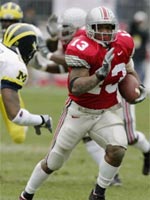
Maurice Clarett sticks up for Jim Tressel and Ohio State

As an Ohio State fan, I was dreading what Maurice Clarett might say when I heard that he would be appearing on the Dan Patrick radio program this morning. The bad news has been coming out daily regarding Terrelle Pryor, and the last thing Buckeye fans needed was more allegations from Clarett.

Instead, Clarett defended Jim Tressel and Ohio State, laying the blame instead on the culture surrounding college football and the difficulty have putting inner-city kids in a situation where they’re treated like gods but have to live on a modest stipend that doesn’t cover the real costs of living in a place like Columbus.

Here’s Clarett on Tressel:

“People respect Jim Tressel because he’s a man,” Clarett said. “He’s a man’s man, you know what I mean? The guy has integrity. He has class. I look at Jim Tressel every day and just Google his name and see articles come up with reputable people sticking their necks out for him. He’s a good man who got caught up in a bad situation. You can’t be a fraud for 30 years. It’s impossible, you know what I’m saying? People could smell a fraud within the first few months. You’re going to be exposed. But for 30 years that man has been respected by the people who are very respectable throughout the country. It’s not right for that man to get done like that.”

This one is surprising, since Clarett made all sorts of allegations about Tressel in the past. Has Clarett grown up? Is he able to see Tressel’s entire body of work now that he has some perspective? Is he trying to win back favors from Ohio State fans? Life in Columbus can be very lucrative for former Buckeyes who were winners, and Clarett blew that opportunity in the past.

More importantly for Ohio State, Clarett doesn’t implicate the university in the recent scandals or with his own problems in the past:

During a sometimes rambling 13-minute interview on the Dan Patrick Radio Show on Wednesday morning, Maurice Clarett insisted there is no organized system of providing extra benefits to Ohio State football players.

“There’s no secret regime, no secret congregation of people who sit around at Ohio State and give young guys money, who say, ‘Let me give you X amount of dollars or thousands of dollars,’ nothing like that,” Clarett told Patrick on his nationally syndicated show. “Anything that any players goes and gets is all based on him and who he meets in the community. When he goes out and meets a fan or he meets somebody, he’s going to meet that person himself and create a relationship himself and do what he does. A coach has no control over what the young guys are doing, know what I’m saying?”

In light on the NCAA’s absurd decision to vacate USC’s national championship, some Buckeye fans have been dreading any news from Clarett that might stretch an investigation all the way back to the 2002 National Championship. Ohio State will face some stiff penalties, but the Buckeyes need to contain the damage.

In the end, Clarett adds to the drumbeat of players, coaches and commentators saying that the current system is deeply flawed. The flawed system doesn’t exonerate Pryor or Reggie Bush, guys who seem to have gone well beyond minor violations for petty cash, but guys like Clarett have a point when they describe the circumstances that will inevitably lead to violations in every major program.

« Older posts Newer posts »