Page 1730 of 2957

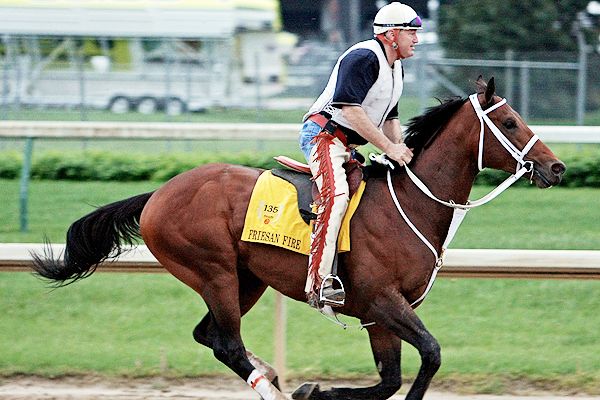
Kentucky Derby 135 Predictions

I know absolutely nothing about horse racing, although I did watch closely as Big Brown’s bid to become the next Triple Crown winner come up short last year, so I firmly believe that I am more than qualified to make predictions on the sport.

The 135th running of the Kentucky Derby is today, with post time set for approximately 6:04 p.m. ET. The biggest news coming out of Churchill Downs is that the favorite, I Want Revenge, was scratched from today’s race because of a foot injury. Ironically, Quality Road, who was the favorite before I Want Revenge, was also scratched for the race last week due to a foot injury himself.

Here are the 2009 Kentucky Derby Odds:

Advice 25/1
Atomic Rain 50/1
Chocolate Candy 8/1
Desert Party 10/1
Dunkirk 4/1
Flying Private 50/1
Friesan Fire 4/1
General Quarters 5/1
Hold Me Back 12/1
Join In The Dance 50/1
Mine That Bird 50/1
Mr Hot Stuff 30/1
Musket Man 25/1
Nowhere To Hide 50/1
Papa Clem 12/1
Pioneerof the Nile 4.5/1
Regal Ransom 15/1
Summer Bird 30/1
West Side Bernie 40/1

Here are my shot in the dark predictions:

Win: Pioneerof the Nile
Pioneerof the Nile has finished first in all three of his 2009 outings, including a victory at the Santa Anita Derby on February 5. He also placed first in his final race of 2008 at the CashCall Futurity in Hollywood Park.

Place: Friesan Fire
I’m a little concerned because Friesan Fire hasn’t raced since March 14, but he’s been on fire (pun definitely intended in the cheesiest way possible) lately, winning all three of his last three races and placing second in his final race of 2008.

Show: Musket Man
Call this my deep sleeper of this year’s Kentucky Derby. M-Squared has placed first in five of his last six outings, including a victory at the Illinois Derby in Hawthorne on February 4. He’s a 25/1 long shot, but I see a lot of potential in this colt’s hindquarters.

Those are my picks. Avoid them at all cost.

Report: A-Rod was involved in pitch-tipping while playing for Rangers

Along with reports by SI.com Selena Roberts that state he used steroids while in high school and as a member of the New York Yankees, Alex Rodriguez is also being accused of tipping pitches to the opposition when he was a member of the Rangers.

SI.com: How did this pitch-tipping originate?

Selena Roberts: I don’t know the history of how it has worked in the major leagues, but from my reporting and the people I spoke with on the Rangers, what they noticed was a pattern of behavior by Alex over a pretty lengthy period of time, two or three years, where it just became more noticeable that his mannerisms on the field were different in games that were already over, its 10-2, something like that. When games were already decided, they noticed this behavior with Alex where he would do very obvious signs, presumably to an opposing hitter who would be a middle infielder on an opposing team, where they believed that he would tip the signs.

SI.com: Why was he doing this?

Roberts: What this was all part of was a quid pro quo, according to the people I spoke with. Alex would tip his middle infielder buddy on the other team and the player on the other team would in turn tip Alex. What it was was slump insurance. You could count on your buddy to help you break out of your slump, if you’re 0 for 3 or you’ve had a bad week. There was no intent to throw a game or change the outcome.

SI.com: How would he tip the pitches?

Roberts: If it was a changeup, sources say, he would twist his glove hand. To indicate a slider, he would allegedly sweep the dirt in front of him, and he would bend in the direction of where the pitch was going to be, inside or outside. I don’t know that it’s easy to decode. You’re talking about people who see a player on an every-day basis, day after day, year after year. I don’t know that it would be at all obvious to people who are watching or to a television audience. These are people who would know how to detect when things don’t feel right. If it happened once or twice, people might say, Let’s give him the benefit of the doubt, maybe we didn’t see what we thought we saw. But according to the people that I spoke with, this was a pattern of behavior.

As a baseball fan, this bothers me more than the steroid allegations.

If a ball player takes performance-enhancers, they will help him get stronger, recover faster from injuries and therefore gain an edge on the field. That’s cheating, but at least the players on steroids still have to have a fair amount of talent. It’s not like a 20-year old who has never picked up a bat before can juice up and all of a sudden turn into Mark McGwire.

But A-Fraud telling his fellow cheating friends what pitch is coming is flat out despicable. I don’t care if the game is 2-0 in the seventh or 20-0, you don’t help out the opposition so they can pad their stats and in turn, so you can pad your stats. That’s freaking ridiculous and I hope MLB is investigating these allegations instead of turning a blind eye to them like they did when they found out players were using steroids. (I’d be interested to find out what A-Rod’s numbers were in Texas during late innings of blow out games.)

If these allegations are true, then Rodriguez is even more of a joke than he was when he admitted to using roids. Someone who tips pitches to their opponent obviously doesn’t respect the game and he should be suspended, fined or completely banned from ever playing again. (And that goes for all of A-Fraud’s cronies that allegedly helped him in this charade, too.)

Top 10 Active MLB Triples Leaders

To hit home runs and doubles usually requires power, but to hit triples requires a bit of power and a lot of speed. Or sometimes, luck, such as when an outfielder misjudges a ball and lets an otherwise slow runner reach third. But the leaders in MLB in this category are seasoned speedsters, and have mostly done it for several years. Here is the active Top 10 in triples, including only players on active rosters in 2009:

1. Johnny Damon, New York Yankees (93)—At age 35 and having battled injuries throughout his career, Damon has lost a step or two. But between 1998 and 2002, this sparkplug reached double digits in triples three times.

2. Jimmy Rollins, Philadelphia Phillies (90)—Rollins is the heart and soul of the Phillies, and is one of the reasons they won a title in 2008. He’s only 30, but has reached double figures in triples five times, including a career high 20 in 2007.

3. Carl Crawford, Tampa Bay Rays (85)—Crawford is a game-changer, and in his still young career has averaged 15 triples and 53 stolen bases per season.

4. Cristian Guzman, Washington Nationals (78)—Still a very good hitter, but Guzman isn’t the triples or stolen base threat he was in his earlier days with Minnesota. His career high, like Rollins, was also 20 triples, set in 2000 with the Twins.

5. Jose Reyes, New York Mets (73)—Arguably one of the two or three fastest players in the game, Jose has averaged 16 triples and 65 steals over the last four seasons. So how in the world do the Mets not score more runs?

6. Omar Vizquel, Texas Rangers (72)—This one is more about longevity, but Omar did have a career best 10 triples with the Giants in 2006, at the ripe old baseball age of 39.

7. Juan Pierre, Los Angeles Dodgers (71)—Ol’ Juan has slowed down just a bit too, but he’s hit double digits in triples four times during his career, including three straight times from 2004-2006.

8. Carlos Beltran, New York Mets (64)—Does anyone remember that Carlos Beltran played seven seasons in Kansas City? I mean, did he really?

8. Ichiro Suzuki, Seattle Mariners (64)—Ichiro bats for average and steals more bases than he does hit extra base hits. But he’s averaged 8 triples per season during his American big league career.

10. Derek Jeter, New York Yankees (57)—Jeter is just a true professional and great baseball player, but his career high in triples, 9, came ten seasons ago.

Source: Baseball Reference

Twittering Athletes


As I write this, I’m amazed that I could simultaneously post a message on my Twitter account that reads: Writing a new post for Scores Report. Very excited. Still haven’t showered. The thing is, while I’m in awe of the technology, I’m not overly excited about it. I could never fathom why anybody would want to know what I’m doing throughout my day. I imagine that my friends (or “followers”) would finish reading my “tweet,” and have the mental thought of, “God, what a loser. Why would he post this?” Maybe not. However, after reading various friends’ and professional athletes’ Twitter posts, I’m always let down. What was I expecting? These people are just as boring or normal as I am. Instead of sitting here reading what other people are doing, I could be doing something more constructive. So, no, I don’t have a Twitter account. I don’t have a MySpace page or a Facebook account, either. If friends want to know what I’m doing, they can hit me up on my pager. Just kidding. Nevertheless, I do see the upside of certain sports figures posting frequent updates about the state of their teams or careers. It’s just when it borders on the excruciatingly mundane or stupid that I yearn for the days of the telegram.

Upside

On April 24th, those who checked Lance Armstrong’s Twitter learned that French anti-doping authorities had thankfully dropped charges against the cyclist that could have banned him from the Tour de France. Really think about that for a second. This information, which is important to so many people, was available before any media outlet could report it. Yes, blogs have shown the ability to run news and rumors more quickly than traditional media, but Twitter reveals “stories” first-hand, because it comes straight from the horse’s mouth. I think that’s incredible. Of course, there are two sides to every coin, and what one athlete “tweets” can obviously contradict a more truthful report – the kind television and newspaper journalists spend hours putting together. In a society of whirlwind information, we need those institutions now more than ever. Anybody who’s seen Season 5 of “The Wire” can attest to this statement. Although, blogs and now Twitter provide instantaneous content, those who operate them understand their audience and the “quick fix” it expects. What I appreciate about newspapers is the fact that they compile information from a myriad of sources before presenting this data in a single story. Still, it’s only a matter of time before ESPN starts a show called “The Chirp” (or something equally insipid) that does a run down of the best of athletes’ Twitter accounts. If not, they’ll at least include it in their rolling crawl at the bottom of the screen.

Continue reading »

A-Rod refuses to address latest allegations

To the surprise of absolutely no one, Alex Rodriguez has decided not to discuss latest allegations that he used steroids as a member of the New York Yankees.

“I’m not going there,” he said after homering in an extended spring training intrasquad game in Tampa, Fla. “I’m just so excited about being back on the field and playing baseball. My team has won two games (in a row) up there and hopefully I can come back and help them win some more.”

The Daily News reported in Thursday’s edition that Roberts’ book offers an unflattering portrait of the MVP slugger as a needy personality who wanted his ego stroked constantly.

Rodriguez said he wasn’t worried that the steroids issue was being brought up again.

“No. Not really,” he said. “I’m in a good place. I think more importantly physically I feel like I’m getting better everyday. We’ve had a great week here. We’ve worked extremely hard, and I’m just very anxious to do what God put me on this earth to do, to play baseball.”

The book also goes on to say that two anonymous Yankees said they believed A-Rod was using banned substances based on visual side effects, and that a clubhouse staffer said management had a suspicion that that the third baseman may have been juicing.

What’s interesting to me is the differences between A-Rod and Barry Bonds when it comes to each player (allegedly in the case of Bonds) using steroids.

Bonds took steroids (again, allegedly) because he knew he was getting older, his body was breaking down and he wanted to add years onto his playing career. He wanted to play as long as he could so that he could break records and (try) to be remembered as the best to have ever played the game.

But by all accounts, it seems that A-Rod really just took them for vanity purposes. Everything you read on this guy is that he’s not a bad person – he’s just a weird dude with several complexes. He’s self-conscious and always worried about how he’s perceived. He’s arrogant, but he’s not a total jerk (unlike Bonds, who was both). He didn’t need to take steroids to help his on-field performance, but probably wanted to take them to improve his total look, which is probably just as important as his numbers in his eyes.

Bonds felt the need to take steroids to prolong his career. It seems like A-Rod needed them to feel good about himself and project a certain image. In both cases, it’s sad.

« Older posts Newer posts »