Page 1101 of 2957

Cromartie deal off the table between Chargers and Lions?

Lions beat writer Tom Kowalski of Mlive.com reports that a trade between Detroit and San Diego involving cornerback Antonio Cromartie is now unlikely to happen.

Yesterday, Chargers’ beat writer Kevin Acee reported that Cromartie could be traded to the Lions “soon” and that the 25-year-old cornerback had played his last down in San Diego. But as Kowalski reports, Detroit balked when the Bolts asked for Maurice Morris in return.

The Lions don’t have an abundance of depth at the running back position and Morris proved to be valuable last year when Kevin Smith tore his ACL and battled shoulder problems. Morris would be Detroit’s every down back if the season started today, so the Lions don’t want to create a bigger hole at running back, even if it would mean acquiring a young corner in the process.

So where will San Diego turn now? They probably haven’t found any shortage of teams that need a young cornerback, but the problem is that Cromartie carries plenty of baggage. His contract also expires at the end of the year, so the team acquiring him won’t be willing to give up more than a mid round draft pick in case they can’t sign Cromartie to a long-term deal.


Photo from fOTOGLIF

2010 Fantasy Baseball Preview: Catchers

All 2010 Fantasy Articles | 2010 Position Rankings

If you’re like most guys, you hate shopping. You’ll wait until one of the sleeves is coming off your shirt before you even think about heading to the mall to buy new clothes. And even then, it takes your significant other to say, “Are you seriously going out in public like that?” before you actually turn the keys in the ignition and embark on one of the most annoying days of the year.

Once you’ve pinpointed where you want to shop, the clearance rack usually calls out to you like that 50-inch plasma at Best Buy. It draws you in and once you’ve selected six shirts for a grand total of $22.50, you’ve completed your clothes shopping for the year.

Drafting a catcher in fantasy baseball is sort of like when guys go shopping for clothes. Once you finally come to realization that you need them, shopping in the bargain bin (or the clearance rack, or whatever other analogy you prefer) isn’t a bad way to go.

Unless your opponents fall asleep on Joe Mauer and he drops in your draft, nabbing one of these seven catchers is a good way to fill category voids that were created in earlier rounds. By the end of the year, there probably won’t be a huge gap between one of these catchers and one of the top 3 (Mauer, Brian McCann and Victor Martinez) that your buddy just had to have. (He’s probably the same guy that likes dropping $100 on a new shirt and buys another once the color starts to fade.)

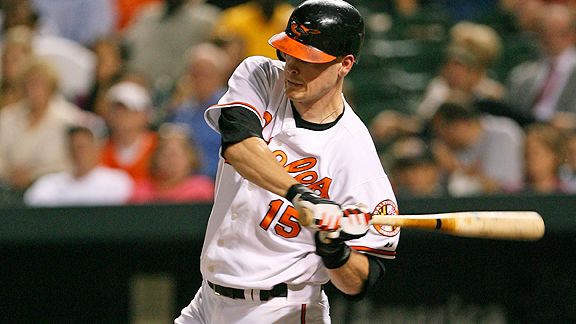
Matt Wieters, Orioles
There’s a good chance that you’ll miss out on Wieters because there will be someone in your league that has an infatuation with youngsters that have extreme upside and will take him a round or two early. That’s okay. But if he does happen to fall, grab him because 2010 might wind up being the 23-year-old’s breakout season. After hitting .259 in a little over a month before the All-Star break, Wieters finished his rookie season on a tear while hitting .288 with nine dingers and driving in 43 RBI in 96 games. In September, he hit .362 with three homers and drove in 14 RBI while hitting in the No. 3 spot of Baltimore’s improving lineup. Assuming his success at the end of the 2009 season carries over, Wieters is the one player in this group that is worth taking a round before you’re ready to select a catcher (assuming he’s still available, that is).

Continue reading »

Kahn: Rubio is coming to Minnesota

Minnesota GM David Kahn thinks that Ricky Rubio will likely come to Minnesota in a year and a half.

“We developed a very solid relationship with his representatives, and more importantly, perhaps, his family, this past summer,” he told Abbott. “It wasn’t an issue of him having any concern about Minnesota whatsoever. I think at the end of the day he just felt that him having a couple more years in Europe would be the smart and prudent thing for him to do. He had a lot of input from his Spanish National team members, who all think he can play here, but also thought that a few more years of development would help him. I don’t have any reason not to think that’s true, either.”

I don’t know if Kahn is just toeing the company line or if he truly believes that Rubio wants to play in Minnesota, but if he really didn’t think he was ready to play in the NBA, why did he put his name into the draft in the first place? Obviously, something happened on draft night (or thereafter) that convinced Rubio that he should stay in Europe. Prior to the draft, it looked like he was a sure bet to play in the NBA this season. The only thing that changed was that he was drafted by the Minnesota Timberwolves. Suddenly, he’s signing a two year contract with another team in Europe.

On paper, Rubio to Minnesota is a nice fit, but when you look at the T-Wolves’ stars — Al Jefferson and Kevin Love — a wide-open offensive attack doesn’t spring to mind. However, they are tied with the Suns for third in overall pace (98.2 possessions per game) so someone is telling these guys to push the ball. I wonder if that’s designed in part to convince Rubio to come to Minnesota.


Photo from fOTOGLIF

Rams’ second round pick could be extremely valuable

The SI.com duo of Don Banks and Peter King make a great point about the Rams’ second round pick being the most valuable first pick of a second round in NFL history.

Here’s why:

Think about being the Rams: In a very good year for draft prospects, teams will reset their draft boards after the first round, look up and see that one of their top 12 or 14 players is still on the board. Notre Dame quarterback Jimmy Clausen. Cal running back Jahvid Best. Texas pass-rusher Sergio Kindle. Idaho guard Mike Iupati. One of the leftover good tackles — maybe Anthony Davis of Rutgers.

The desperado Rams will need the pick, obviously, because they need players. But some teams will want that pick badly; I’m sure of it. And some team just might pay through the nose to get it. You only have to look at last year to see how this could develop.

King goes on to write that the Jets paid dearly (a third, fourth and seventh) to move up 11 spots in order to select running back Shonn Greene with the first pick in the third round last year. The Rams hold the first pick in the second round, which is obviously more valuable and thus, should be more sought after.

As King points out, the Rams would certainly love to hold onto the pick and select a future starter at No. 33. But most teams that have had success in the NFL have done so by moving down in the draft, not up. Assuming they won’t be in love with a prospect at No. 33, the Rams could move down in the second round and pick up multiple selections from a team desperate to move up. After all, St. Louis would still be able to get a good player at some point during the second round.

This could be an interesting development on the second night of the draft.


Photo from fOTOGLIF

An argument for the NBA’s one-and-done rule

You don’t hear this often from anyone not named David Stern, but Brandon LaChance of BullsHome.com says that the NBA should keep its age-limit rule because it allows the NBA to get a better look at prospects. Let’s go point-by-point:

The draft entrance law does hurt the college game. There is no doubt about it. Players leaving after one year hurts a team’s roster and team chemistry. The star player gets all the shine while the rest of the players and the school itself are forgotten. I know who John Wall is but couldn’t list one of his Kentucky teammates.

No offense, but if LaChance can’t name DeMarcus Cousins, Patrick Patterson or Eric Bledsoe, maybe he shouldn’t be commenting about how a rule affects the college game.

If a school has a problem with a player leaving after one year, then don’t recruit the athlete. Instead of Derrick Rose, OJ Mayo or Kevin Durant, go after Tyler Hansbrough.

That’s fine, but there are only so many Tyler Hansbroughs in the world. When you force a kid to go to college for a year, he doesn’t want to be there and he doesn’t want to go to class. It makes a mockery of the so-called “student-athlete.” Basketball programs are going to do what is in their best interests in terms of winning, and under this flawed system that means some will recruit clear one-and-done players like John Wall. You can’t force a flawed system on the NCAA and expect everyone to forgo the best available talent. One-and-done players only have to pass a few credits in their first semester to become eligible to play in the NCAA tournament. They don’t even have to go to a single class in in their second semester. This is ridculous.

One and done gives the NBA and the players a showcase, practice and a scale to place talent. There are millions of college hoops fans turning on their television sets to watch a big game or Sports Center for highlights.

The stud player is showcased to the world. The fans hearing how good he is at the college level will more than likely pay attention to him at the next level. Carmelo Anthony helped Syracuse win a championship in his one year. Anthony did his one year before the rule was a rule. Denver drafted him and their ticket sales went up along with media coverage of the Nuggets. The NCAA showcased his talent for the world to see and the NBA cashed in on it.

Yes, the one-and-done rule gives NBA teams a better look at a prospect, but that’s not the point. It’s wreaking havoc on the college game. High schooler LeBron James went ahead of Anthony in that draft and he’s doing just fine.

Remember a guy named Kwame Brown. Brown was drafted straight out of high school by the Washington Wizards in 2001 with the number one overall pick. He is one of the biggest busts in NBA history. In 2003, his best statistical year, he only averaged 10 points and 8 rebounds. This may not be completely accurate, but if he would have played a year in college, the Wizards may have noticed weaknesses. Brown may have needed the year to further develop. He might have decided to stay longer to develop skills if he couldn’t be a big time performer in the college level.

Ah, yes, the Kwame Brown argument. Yet there are plenty of examples of players that were busts coming out of college. What’s the NBA’s excuse there? On the whole, players drafted straight out of high school have a much higher success rate than those that played in college. In other words, why is the NBA forcing their rule on the NCAA to fix a non-existent problem?

The one and done deal may not be the best solution ever but it is the best now. University’s get one year of excitement and the NBA gets to cash in off of the marketing the NCAA does for the players. I think it is a great system and should stay in place. If the NCAA wants students to stay longer or participate, they have to do something.

What is the NCAA supposed to do? You can’t force a kid to stay in college — the only entity that could do that is the NBA (by requiring any players not drafted straight out of high school to play two years of collegiate ball before entering the draft again). That’s the system I support. Allow players that are good enough to go to the NBA straight out of high school to do so, but if they enroll in college they have to play for two years. That way, the NBA gets a good look at the fringe NBA talent, the NCAA gets some semblance of continuity, and those same kids get an opportunity to develop for two seasons at the college level.

Everyone wins.


Photo from fOTOGLIF

« Older posts Newer posts »