Category: MLB (Page 12 of 448)

One of Baseball’s Wacky Rules

I saw the Mets play the Padres on Friday, and something strange happened. I’d always thought a run that scored on an inning-ending play only counted if the third out had been made on a tag. A force out means no run, right? Wrong.

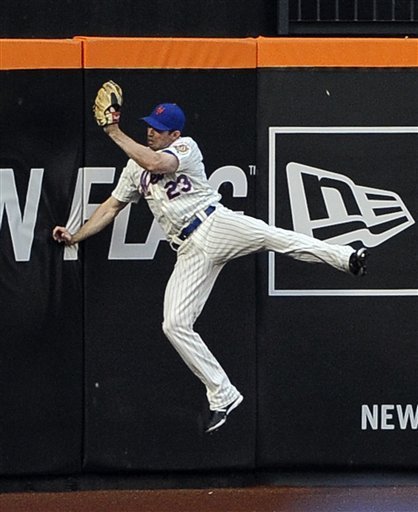
Get this: in the first inning, Dillon Gee walked the first batter, Will Venable, and got the next one out on a pop-up before giving up a single to Yonder Alonso that moved Venable to third. Then, with runners on the corners and one out, Jesus Guzman hit a shot that looked to be an easy double off the wall, that is, assuming it didn’t clear the fence. Mike Baxter put an end to all that by making the incredible catch you see above before doubling Alonso up at first. Here’s the video.

Venable had crossed the plate before they made the third out, but so what? It was on a force, the run didn’t count, or so I, along with most everyone in the stadium, thought. That “everyone” includes the Mets’ first baseman, Ike Davis, who told the AP, “I gave a first pump because I thought the run wouldn’t count.”

But alas, Ike and I have something in common: we were wrong. Well, that and the fact that we’re both hitting under .200 this year. Then again, I haven’t had 156 at bats (hint: I haven’t had any). Anyway, we both thought the run would be nullified by the double play. It was not, because as is the case with so many of baseball’s finer points, the devil is in the details.

Remember when I told you it was wrong to think a force out means no run? Well, I was lying. See, it’s not that this play was an exception to the rule, that the run counted despite being a force out. Rather, it’s that the second out on a tag up double play like this one isn’t actually a force out. Why, you ask? Well, that requires some definitions. To the rule book, let’s go!

Alright Robin, now that we’ve got our atomic batteries to power and our turbines to speed, I’ll tell you. Rule 2.00 of the Official Baseball Rules states that a force play is one in which “a runner legally loses his right to occupy a base by reason of the batter becoming a runner.” Likewise, Rule 7.08 tell us that “if a following runner is put out on a force play, the force is removed and the runner must be tagged to be put out,” and Rule 7.10(a) states “Any runner shall be called out, on appeal, when after a fly ball is caught, he fails to retouch his original base before he or his original base is tagged.”

So what happened on Friday is this: the force on Alonso was removed when Baxter made that catch, and the third out, which came from the ball getting to first before he could tag up, was technically a tag out. That’s despite it looking so much like a force play.

Funny, isn’t it? Because the definition of a force out is so specific, that of a tag out is the opposite. A tag out doesn’t actually require a runner being tagged with the ball, a base can be “tagged” as well. So basically, a tag out is anything that isn’t a force out. But hey, it’s these little complexities that make baseball so great. It’s one thing for me or Ike Davis to be surprised, we’ve only got 40 years of baseball-watching between us, max. But it’s entirely another that my grandfather, who was there as well, can learn something new about the game he loves after seeing it played for over 75 years. In baseball, there actually is something new under the sun, and that’s what makes it such a beautiful game.

Baseball’s Two Biggest Surprises

Every team in Major League Baseball has now played over 40 games. That’s more than a quarter of the season, which means we can no longer say Albert Pujols is having a slow start or the Orioles are just getting lucky. Let’s take a look at the two most surprising team performances so far, one bad, one good. Along the way, we’ll have a little fun at the expense of ESPN’s absolutely expert preseason predictions.

Hell’s Angels

I’ve tallied the expert predictions and made all sorts of charts. The most surprising thing to the team over at ESPN  has got to be the performance of the Los Angeles Angels, and more specifically that of Albert Pujols, their $240 million man. Jayson Stark said as much in his own quarter-season roundup, and the charts don’t lie. Of the 49 ESPN experts, 24 picked the Angels to win their division and 45 said they’d make the playoffs. As if that wasn’t enough, 18 of those savvy professionals picked them to win the World Series. That’s more than any other team by 10, in second place with eight picks were the division rival Texas Rangers.

Obviously, things are not going as well as was expected for the Angels. I mean, it’s not really going well by any means of calculation. They’re in last place with an 18-25 record, eight games behind the AL West leading Rangers, and to top it all off they’ve lost three straight.

If there’s one thing that’ll rile up a fan base, it’s the underperformance of a big money off-season signing. Just ask a Giants fan what they think of Barry Zito. Zito was one of my favorite players during his time on the A’s, and I wanted the Mets to get him, bad. Luckily I’m not the team’s GM, so we dodged a major bullet. For any Giants fans reading, I’m sorry to have brought that up. If you want I can riff about Mo Vaughn a while to make you feel better. No? Alright, moving on.

The trouble with Pujols is not that he’s underperforming, but that he doesn’t seem to be performing at all. The three-time NL MVP is hitting .212 with 3 home runs and just 18 RBI. His Wins Above Replacement (WAR) is at -0.1 according to baseball-reference, meaning he’s only a little bit worse than your average Triple-A shmo. He’s on pace to hit 12 total homers this year, or one for every million dollars he’s being paid. Fear not Angels fans, it’s far from a lost season, and I do believe Pujols will turn it around once he’s adjusted to all the AL pitchers he’s almost never seen. That said, I’m not sure I’d put any money on seeing him in the playoffs this year.

The Unbelievable Orioles

When I say unbelievable, I mean it. I don’t think anyone expected this kind of performance out of the O’s. If we look back at those preseason predictions, not one of the ESPN wunderkinds predicted the Orioles would grab a wildcard spot, let alone win the highly competitive AL East.

But look at them now. Forty-three games into the season, the O’s are at a cool 27-16, two games ahead of the Rays and five and a half in front of the tied-for-last Red Sox and Yankees (whom 37 of the analysts predicted would win the division). Like I said, a quarter of a season is far too long to call this a hot streak, lucky, or anything else of the sort.

If the fans in Baltimore have one man to thank, it’s manager Buck Showalter, who’s led his team to a 15-6 record while on the road. The Braves are the only team in the bigs with more wins on the road (16), but they’ve also got four more road losses (10). Furthermore, Showalter has helped Adam Jones develop into the star we’ve been told he is for oh so long,  as well as getting fantastic performances from his starting rotation. Perhaps most importantly however is what Showalter has gotten out of his bullpen. Those of you who read my column last week know how I feel about closers. Showalter may not feel quite as strongly as I do, but he uses his pen with more logic than just about any other manager. It’s working too, the bullpen has converted 19 of 24 save opportunities and includes five different pitchers (Jim JohnsonPedro StropDarren O’DayMatt Lindstrom, Luis Ayala) with ERA’s of 1.75 or under in more than 13 appearances. Just don’t tell anyone who likes what I had to say about closers that the 5 blown saves have come from pitchers other than Johnson.

All that said, just as the Angels have plenty of time to turn things around, the Orioles have plenty of time to regress. Some statisticians see the team’s dominance as unsustainable. The team has relied fairly heavily on home runs to score, their league-leading 65 jacks has helped them score more runs (199) than just five other teams. Home runs, of course, are the fossil fuel of baseball energy, and you never know when the O’s will pass peak oil. If the team hopes to maintain its success they’re going to have to get a little more eco-friendly, meaning upping their team batting average (.249, or twelfth in the league) and OBP (.310, 21st).

If these preseason predictions tell us anything, it’s that preseason predictions are worthless. But hey, that’s what makes baseball great. Any team can get hot and come out of nowhere (or go into a total nose dive) at any time. Then again, it’s a long season and the baseball gods still have more than enough time to correct themselves if they see fit.


MLB Hall of Famer Whitey Ford

When you think of the history New York Yankees, the most storied franchise in baseball history, most fans will immediately think about the long line of sluggers and great hitters, with Babe Ruth, Lou Gehrig, Joe DiMaggio, Mickey Mantle, Reggie Jackson, Don Mattingly and Derek Jeter leading the way. When you think of the great Yankee pitchers, it’s hard to come up with a list that matches the hitters, but one name that always jumps out is Whitey Ford.

Most baseball fans recognize Ford as a Hall of Fame pitcher, but some of his accomplishments still don’t get the attention they deserve given the notoriety of teammates like Mickey Mantle. For example, with 236 wins, Ford is the all-time leader in wins in a Yankee uniform. His first 20-win season came in 1961 when he finished 25-4 record and won the Cy Young Award. But that’s also the season when the entire nation was glued to the home run chase between Mickey Mantle and Roger Maris.

You don’t have to explain this to die-hard Yankee fans however, as Ford was the best pitcher on one of the greatest dynasties in baseball history. In two separate stretches he pitched game one of the World Series four years in a row! Overall he was 10-8 after 22 starts World Series starts. Nobody has won or started more World Series games.

When you look at his career, there are a couple of fascinating things that jump out. Ford has the best all-time winning percentage (.690) among all pitchers with at least 300 career decisions. Ford had a lifetime ERA of 2.75 and his worst ERA was 3.24. Since the advent of the Live Ball Era in 1920, Ford’s lifetime ERA is the lowest. One interesting record involved his excellent move to first base, as he set a record in 1961 for not allowing a stolen base over 243 consecutive innings.

Ford served in the Korean War, so he was a veteran like many of the greats from the 40s, 50s and 60s. He once joked, “Army life was rough. Would you believe it, they actually wanted me to pitch three times a week.”

As a member of those iconic Yankee teams with greats like Mantle, Ford will always be beloved by Yankee fans. For them he’ll always be the Chairman of the Board. But he’s also one of the greatest left handed pitchers in history.

What’s in a Closer?

Closer. It’s one of the toughest jobs in baseball, in all of sports even. Or so we’re led to believe. What is it about getting three outs in the ninth inning that’s so different from getting three outs in the seventh? Why do managers make situational decisions in the seventh (e.g. bringing in lefties to face lefties) but insist on using their pre-assigned “closer” in the ninth? What if the situation in the seventh is far more dire than that of the ninth (e.g. if the three, four, and five hitters are due up or the bases are loaded)? Why isn’t the best pitcher on the mound in the biggest spots?

I’ll tell you why: saves, the only statistic that changes the way the game is played, as well as the way it’s financed. A save situation is the only time a manager makes a decision based on arbitrary numerals rather than what’s going to help his team win. The only time he’d do it on purpose anyway. To quote Michael Lewis in Moneyball:

The central insight that led [Billy Beane] to turn minor league nobodies into successful big league closers and to refuse to pay them the many millions a year they demanded once they became free agents was that it was more efficient to create a closer than to buy one. Established closers were systematically overpriced, in large part because of the statistic by which closers were judged in the marketplace: “saves.” The very word made the guy who achieved them sound vitally important. But the situation typically described by the save—the bases empty in the ninth inning with the team leading—was far less critical than a lot of other situations pitchers faced. The closer’s statistic did not have the power of language; it was just a number. You could take a slightly above average pitcher and drop him into the closer’s role, let him accumulate some gaudy number of saves, and then sell him off. You could, in essence, buy a stock, pump it up with false publicity, and sell it off for much more than you’d paid for it.

Before I really get started I suppose I should give full disclosure. I’m a Mets fan, woe be upon me, and that’s why this stuff’s on my mind. For some reason Terry Collins insists on calling Frank Francisco his closer. Frank Francisco, he of the 8.59 ERA and 2.05 WHIP. He of the three losses, 14 earned runs, eight walks, and 22 hits in just 14.2 innings pitched. He is our closer, and nobody else. All those questions in the first paragraph, yeah, I’ve been shouting them at my television over the past few days.

Yet it’s not those numbers that most horrify me, it’s these: two years and $12 million, or Frank Frank’s contract. It’s because of them that Francisco remains in his position, “for now.”

Like so many other closers, Francisco has but one man to thank for those numbers. That man is Jerome Holtzman, the sportswriter who invented the save in 1960, leading to it becoming an official statistic in 1969.

There was a time when the best relievers were called “firemen,” and they pitched when they were needed most. Bases loaded with one out in the eighth? That’s fireman time. Closer time is the ninth inning, with a three run lead and nobody on base, which has lead some to call it “the most overrated position in sports.

Those who believe in the sanctity of the closer will tell you the ninth inning is different, there’s more pressure, it gets in your head the way no other inning can. To them I say this: bullshit. Dave Smith of Retrosheet conducted a study of late-inning leads from 1944 to 2003 and an additional 14 seasons prior. He found that regardless of strategy, teams that enter the ninth inning with a lead win 95 percent of the time. The figure doesn’t even vary all that much, the high was 96.7 percent (1909), while the low was 92.5 percent (1941).

Granted, those figures apply to any lead, not just “save situations,” so they’re not really relevant to this discussion, right? Wrong. Smith calculated the figures for those scenarios as well, and they’re not all that different. Going into the ninth inning, a team ahead by one run wins 85 percent of the time, if they’re two runs up it’s 94 percent, and a three-run lead gets you 96 percent.

The problem for most teams is that they obsessively save their closer for the ninth, he might go a week without seeing action during a losing streak. As a result, they lose in the middle innings. The Mets have the exact opposite problem. Their fireman situations often come in the ninth inning, but only because Francisco creates them. They save the guy they think is their best reliever, because he’s making the most money, and waste better pitchers like Bobby Parnell, Tim Byrdak, and Jon Rauch in the middle innings. Now, the Mets think Francisco is their best for a reason, and maybe he is. But he’s not their best right now, and until he is there should be someone else on the hill in critical situations, regardless of what inning it is.


MLB Hall of Famer Robin Roberts

There’s been a lot of discussion lately of how the Washington Nationals might shut down phenom pitcher Stephen Strasburg after he reaches 160 innings even if they’re in contention for the pennant. While the debate is understandable given his past injuries, it still highlights the differences in the expectations for modern pitchers versus some of the all-time greats.

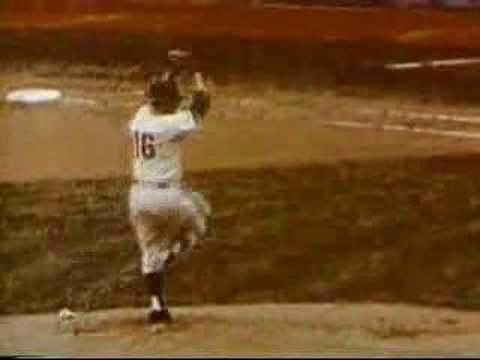
Consider the career of Robin Roberts, the great Hall of Fame pitcher for the Philadelphia Phillies. Roberts played for 19 seasons and compiled a 286–245 record with 45 career shutouts. He notched a lifetime ERA of 3.41, along with a staggering 305 complete games and 4,688⅔ innings pitched in 676 games. Even in a era when pitchers were expected to complete games and pitch on only four-days’ rest, Roberts was known for his incredible stamina. When interviewed after Roberts passed away, his teammate and fellow Phillies starter Curt Simmons said, “He was like a diesel engine. The more you used him, the better he ran. I don’t think you could wear him out. The end of the 1950 season, I was in the Army and I think Bob Miller had a bad back. I know Robin had to throw almost every day.” In a six-year span starting in 1950, Roberts won 20 or more games and pitched at least 304 innings in six consecutive seasons.

In many ways, Major League Baseball seems to be entering into a new era of the pitcher, as offensive production is decreasing and the game is once again being dominated by great pitchers like Strasburg. But it’s doubtful we’ll ever see workhorses quite like Robin Roberts again. Even the great Jack Morris pitched his amazing 10-inning game winner in game 7 of the World Series over 20 years ago.

While modern players will likely never match Roberts for his stamina, he remains a role model for all professional athletes for the class he displayed on and off the field. Just listen to the interview above for an example of why Roberts was widely respected as a true gentleman. When he passed away in 2010 at the age of 83, Marty Noble summed up the attitudes towards Roberts in the opening paragraphs of his obituary:

For the second time in three days, baseball lost one of its foremost gentlemen. Robin Roberts, as pleasant and gracious as any man in the game, died Thursday. As readily associated with the Phillies as any player has been with any franchise, Roberts was 83 years old when he passed away in Florida due to natural causes.

The most accomplished right-handed pitcher in the history of the Phillies, Roberts was a Hall of Famer, card-carrying member of the 1950 “Whiz Kids” and an active force in the creation of the Major League Baseball Players Association. Most of all he was an agreeable, genial man whose company was enjoyed by those who met him.

Like many players of his era, Roberts was a World War II veteran who broke into the big leagues after the war. He actually went first to Michigan State where he played basketball, but then tried baseball and was signed by the Phillies in 1948. In 1969 this seven-time All-Star was named as the greatest Phillie of all time.

When you consider what it takes to have a Hall of Fame career, durability, excellence and class are some of the most important characteristics. With his career and his life off the field, Robin Roberts should be an enduring example to the modern player. And while modern team General Managers try to protect “investments” like Strasburg, they should be reminded that the true great will rise to the challenge, if you let them.

« Older posts Newer posts »