Category: College Football (Page 48 of 296)

Is Da’Quan Bowers’ stock falling?

Nick Fairley can take solace in the fact that he isn’t the only defensive line prospect whose stock appears to be falling the closer we get to the draft.

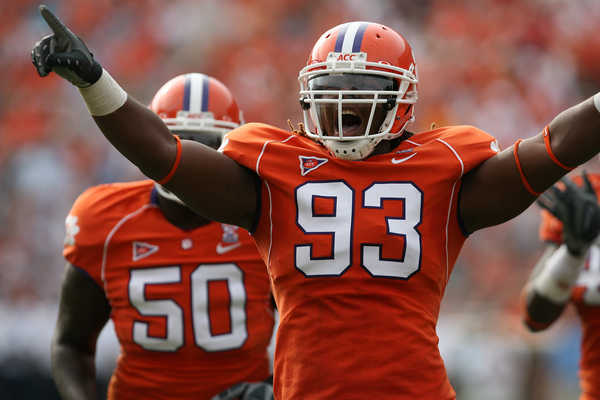
Clark Judge of CBS Sports is reporting that Clemson defensive end Da’Quan Bowers was “flagged” by physicians on his medical examination at the scouting combine two weeks ago due to a knee injury. Bowers only participated in the bench press at the combine and has postponed his Pro Day from March 10 until April 1 as he continues to recover from what was thought to be a minor knee scope.

Since the end of the college football season, Bowers has been viewed as potential top-5 pick. But players with medical concerns fall all the time in the draft. Texas’ linebacker Sergio Kindle was viewed as a top-15 pick last year before concerns about his medical history caused him to drop all the way to No. 43 (Ravens) in the second round. After having surgery to repair a sports hernia in 2008, Maryland Clemson defensive lineman Phillip Merling (also considered a first round pick) fell to the Dolphins at No. 32 at the top of the second round.

Of course, just because Kindle and Merling fell doesn’t mean that Bowers will, too. Kindle and Merling were considered first round picks by many draft pundits, but neither of them was viewed as a top-5 prospects like Bowers is. Still, Bowers’ knee injury is a major concern and there’s a possibility that he could fall out of the top 10 if enough teams are scared off by this latest information. (Or if he doesn’t perform well at his Pro Day in April.)

This is considered a very deep draft for defensive linemen, so who knows how far Bowers will fall if he gets out of the top-10 picks. That said, assuming he fully recovers from the knee surgery at some point this offseason, he could wind up being the steal of the first round depending on how far he drops.

In my latest mock, I have the Bills selecting Bowers at No. 3 (although this latest information may have considerably changed things).
2011 NFL Mock Draft 3.0: The Rise of Cam Newton

Auburn Tigers Heisman Trophy wining quarterback Cam Newton warms up for the Tigers game against the Oregon Ducks at the BCS Championship game at University of Phoenix Stadium in Glendale, AZ, January 10,2011. UPI/Art Foxall

I’ll tell you what sports fans, I don’t know how anyone can compile a mock draft these days without wanting to slam his or her head on their desk about 25 times. I’ve made roughly 6,000 changes to this latest mock since the scouting combine wrapped up and I still hate it.

I hate it!

One thing I don’t hate is the addition John Paulsen has brought to Mock 3.0. He’s a statistical madman and recently thought of the idea to use players’ combine numbers to draw comparisons to prospects from previous years. He explains in more detail below.

More Draft Content: NFL Mock Draft 1.0 | NFL Mock Draft 2.0 | Ten Combine Winners | Ingram’s 40 Time an Issue? | Thoughts on QBs

John: I compared each prospect’s combine scores with players from the last six combines to determine the best athletic comparison. There are eight categories: height, weight, 40-yard dash, shuttle, 3-cone, vertical leap, broad jump and bench press. Not all prospects compete in all six tests, so certain comparisons are more confident than others.

Realize that we’re not suggesting that these players will turn into their comparisons – we’re simply saying that athletically, this is whom each prospect compares to based on their combine numbers.

All right, let’s rock out with our mocks out…what?

No. 1 Carolina Panthers: Cam Newton, QB, Auburn
I’m not going to run from the fact that this is now the sexy mock pick, but it does make sense. Ron Rivera attended Newton’s Pro Day recently and the Auburn QB looked sharp. Blaine Gabbert is still a possibility here and so is Patrick Peterson but at the end of the day, the Panthers might as well go big or go home. There isn’t a more polarizing player in this entire draft than Newton, who is the very definition of “boom or bust.”
Combine Comparisons: Vince Young; Tim Tebow.

Continue reading »

A college football head coach cheated? Shocking!

I have to say, I’m shocked this morning. I’m shocked that so many people are shocked that the head coach of a major college football program would stoop so low as to lie or cheat in order to gain an advantage on the field.

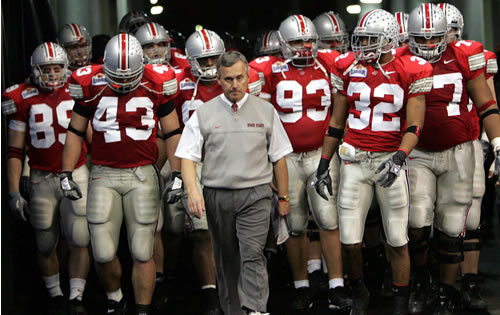
As I wrote yesterday, the media loves to get on their high horse when it comes to scandals like Jim Tressel’s at Ohio State. For those unaware, the Buckeye head coach knew about “Tattoogate” eight months before the NCAA disciplined his players and on Tuesday, Ohio State suspended Tressel two games and fined him $250,000 for not coming forward about what he knew. (He received e-mails from an attorney in April 2010, which indicated that his players were receiving improper benefits.)

In other words, he cheated. He knew his players were violating rules and he did nothing about it. He kept quiet so that his season wouldn’t implode and he convinced the NCAA to allow Terrelle Pryor and the other suspended players to participate in the Sugar Bowl so he could finally get the SEC monkey off his back. (Thanks to Pryor, the Buckeyes beat Arkansas in a 31-26 thriller.)

But back to my point: Is any of this surprising? Because it’s “The Vest” we’re surprised that a college football coach in this day and age is capable of something like this? Everyone lies and cheats to get ahead in college football. Whether it’s Lane Kiffin, Bobby Petrino, Nick Saban, Rich Rodriguez or yes, even Tressel, we’ve reached a point where nothing should surprise anymore. I’m not saying that what Tressel did was right because it’s not. But you mean he withheld information that some of his star players were violating NCAA rules because he wanted to win in 2010? No way! There’s no way a college football head coach would do that!

The only thing that matters in college football is winning and if you don’t like that statement then don’t watch because it’s true. And speaking of the media getting on its high horse, I couldn’t help but scoff when I read the conclusion of Mark Schlabach’s article on Tressel this morning:

For the record, Michigan’s football team hasn’t beaten Ohio State in 2,663 days.

But the Wolverines won on Tuesday.

At least they had fired their cheating coach.

No, they fired a losing coach. That’s the difference.

Welcome to the present day world of college football. You’ll feel right at home if you lie, cheat and steal to get ahead because it’s almost become expected. Just make sure you win, baby.

Jim Tressel to be fired because he was aware of violations? Please.

Will Jim Tressel be fired if the allegations are true that he knew his players violated NCAA rules last year by selling memorabilia to the owner of a tattoo shop? Ha! You’re adorable.

Winning coaches don’t get fired in college football. This situation would present the perfect opportunity for a program to get rid of a lame duck coach, but not someone like Tressel who has compiled a 106-22 record in 10 seasons at Ohio State. Not someone who has led his program to six straight BCS bowls and two national championship appearances.

Don’t get me wrong: the allegations against Tressel are serious. Yahoo! Sports is reporting that he knew about the Buckeyes’ gear-for-tattoo scheme last April, which means he knew what his players were doing a good eight months before the school was made aware of the situation. If that’s the case, then he had a responsibility to the program to make the university aware of what was going on.

But this is college football, where coaches lie, cheat and steal in effort to get ahead. If he’s guilty, I’m not suggesting that Tressel wasn’t wrong not to tell OSU officials as soon as he found out. But how many BCS coaches would have in that situation? How many coaches would submarine their chances to play in a national title game because a handful of their star players were caught trading autographs for “I Heart Mom” tattoos? (My guess would be less than half.)

Whenever a story like this comes out, fans and the media want to get on their high horse or preach from their soapbox. But I’ve got news for you: the college football underworld is about as seedy as they come. I’m sure damn near every BCS team is breaking the rules in some way and while it doesn’t make it right, it is reality. Sorry.

Assuming the allegations are true, I’d be shocked if Tressel were to lose his job over this. If he were coming off back-to-back 7-5 years and two-straight appearances in the Alamo Bowl, then it would be a different story. But unless he allegedly locked a player in a closet a la Mike Leach at Texas Tech, I don’t envision Tressel standing in the unemployment line anytime soon.

Update: ESPN.com is reporting that Tressel will receive a two-game ban and will be fined. When asked if he ever considered firing Tressel, Ohio State president Gordon Gee said: “No, are you kidding? Let me be very clear. I’m just hoping the coach doesn’t dismiss me.”

Oregon comes under scrutiny for $25K payment to recruiting service

Once again this week, the University of Oregon has come under fire for potential recruiting violations.

Andy Staples of SI.com reports the Ducks paid $25,000 to a Texas man named Will Lyles who is connected to at least two current players. While Oregon maintains that the payment to Lyles was for legitimate recruiting video services, some are questioning the expensive price.

Oregon Ducks head coach Chip Kelly is interviewed at Media Day for the BCS Championship game at the media right in Phoenix, AZ January 7,2011. The BCS Championship between the Ducks and the Auburn Tigers will be held at University of Phoenix Stadium on January 10. UPI Photo/Art Foxall

“This is no different than services purchased by a number of colleges and universities throughout the country,” a statement released by the school said. But a longtime provider of recruiting video services — who counted Oregon as a client before his company was absorbed by video giant XOS Digital — said the $25,000 payment seems high. “For $25,000, it better provide a hell of a lot,” Scouting Evaluation Association founder Dick Lascola told SI.com late Thursday. “That’s an exorbitant amount of money to pay for something.”

Lyles did not return calls from SI.com. His Web site features a “JUCO price list” that offers videos for a particular state for $3,000. A multi-state region costs $5,000. A “trifecta package” that includes any three states costs $8,000, while a “national package” costs $15,000. No single service is priced at $25,000.

Staples goes into further detail in his article, which you can read here.

One question I have is why Oregon would even bother putting the $25,000 payment on an expenditure report if the school was violating a rule? Is it a case of hiding something in plain sight or is Oregon clean?

If the Ducks are clean, then they should have evidence of what they purchased from Lyles. This doesn’t seem to be a hard concept to grasp: If they paid Lyles for videos, then those videos should be in the schools possession, right? The NCAA still could question Oregon for what it paid so much for Lyles’ services, but at that point all the school would have to say is, “Hey, we got ripped off.”

It’ll be interesting to see where this story goes from here. At this point, Oregon still doesn’t have much to worry about but it seems every day something new comes to light.

« Older posts Newer posts »