Category: Barstool Debates (Page 5 of 8)

Decade Debate: 10 Biggest NBA Draft Blunders

The single most important thing to do when rebuilding an NBA franchise is to find good players in the draft. Young players are cheap, and if a team finds a good one, they’ll likely have them at a bargain for the first few years of his career. As a part of our ongoing Decade Debate series, here is a list of draft picks from the ’00s that…um…didn’t work out so well. I’ll rank them in order of magnitude of the blunder, which takes into account the talent of the pick as well as the players that the team passed up.

10. The Grizzlies select Mike Conley (#4), passing on Jeff Green and Joakim Noah.

Conley has played better of late, and may eventually prove to be a good pick, but he certainly hasn’t had the kind of consistency that the Grizzlies hoped for when they took him with at #4 in the 2007 draft. What’s funny is that GM Chris Wallace made this pick when the Grizzlies still had Pau Gasol on the roster. Then he traded Gasol, and now he’s drafting for size (Hasheem Thabeet, DeMarre Carroll). What’s even funnier is that he’s still the GM in Memphis.

9. The Knicks select Jordan Hill (#8), passing on Brandon Jennings and Ty Lawson.

When it became clear that the Knicks might miss out on Stephen Curry, they settled on Hill as their fallback option. Jennings is the current ROY frontrunner, while Hill is seeing regular DNP-CDs. Even at the time, the pick was strange since Hill plays the same position as current double-double machine David Lee and Mike D’Antoni is dying to find a point guard that can run his offense. While Jennings may not have the pass-first mentality of Steve Nash, he can certainly push the ball and find open people. Were the Knicks worried about Jennings being a ball-dominant guard when they hope to add a ball-dominant small forward named LeBron next summer? Even if Jennings wasn’t the right fit, what about Lawson, who is getting 21 minutes per game on a good Denver squad? This Hill pick was not Donnie Walsh’s finest hour, but as a sometimes-proud Bucks fan, I couldn’t be happier that Jennings fell in Milwaukee’s lap.

8. The Pistons select Rodney White (#9), passing on Joe Johnson.

This blunder is overshadowed by another pick from the same draft (’01, we’ll get to it), but it’s ponderous nonetheless. Johnson was picked at #10. At the time, the Pistons’ top four players were Jerry Stackhouse, Corliss Williamson, Clifford Robinson, Chucky Atkins and Ben Wallace. I think Joe Johnson could have found a place on that team.

7. The Raptors select Rafael Araujo (#8), passing on Andre Iguodala, Andris Biedrins and Al Jefferson.

The list of big man busts is extensive, and back in ’04 the Raptors were looking for a center to protect Chris Bosh at power forward. They could have had Biedrins (#11) or Jefferson (#15), but took the BYU product instead. It’s a shame, because Biedrins would be a perfect fit for the up tempo style the Raptors want to play. Iggy would look pretty good at off guard as well.

Continue reading »

Decade Debate: Greatest Fantasy Players

In the world of fantasy football, a decade is a long time. It’s rare for a player to achieve fantasy stardom for five straight years, much less ten. As part of our Decade Debate series, here is a list of the top players of the ’00s, by position, under a high performance scoring system. The criteria is simple — we’re looking for sustained excellence.

QB: Peyton Manning, Colts

Let’s see, from 2000 to 2008, Manning has averaged 4,195 passing yards, 31.2 touchdowns, and only 13.6 interceptions. He is the model of consistency, never missing a start and finishing in the top 6 each and every season. In 2009, he’s on pace for another 4,967 yards and 35 TD. At just 33 years of age, the durable Manning has a shot at being the top fantasy QB of the ’10s as well.
Honorable Mention: Tom Brady, Drew Brees, Brett Favre, Donovan McNabb, Daunte Culpepper

Continue reading »

Decade Debate: 6 Greatest Sports Rivalries

The word rivalry is defined as “competition for the same objective or superiority in the same field.” Rivalries exist in all facets of life, but they are no more apparent than in the world of sport. With the end of the decade looming, here are the six most intense rivalries of the last ten years.

6. Tiger Woods vs. Phil Mickelson

Competition between Tiger Woods and Phil Mickelson may not produce the mystique that Arnold Palmer and Jack Nicklaus once did, but their rivalry has been exciting nonetheless. Without Tiger Woods, professional golf’s popularity would be a mere morsel of what it is today. The man has won 14 majors, holds his own tournament (the AT&T National), designed two beautiful courses, is the only golfer with his own video game, and garners public intrigue on the same level as world leaders. Still, his status as figurehead of professional golf wouldn’t have any merit without some stiff competition. Enter Phil Mickelson, Tiger’s only adversary with any staying power. When Mickelson won the 2000 Buick Invitational, he also officially ended Tiger’s streak of consecutive tournament wins at six. Over the years, Mickelson would hire Butch Harmon, Tiger’s former coach, and joke about Tiger’s use of “inferior equipment.” Still, their rivalry always remained amicable, even as Phil won his first major in ’04 (The Masters), the PGA Championship in ’05 another Green Jacket in ’06. During this year’s Masters, Tiger and Mickelson were finally paired together in a major event. Trudging down the final back nine at Augusta, the two golfers put on a show that thankfully lived up to the hype. –- Christopher Glotfelty

Continue reading »

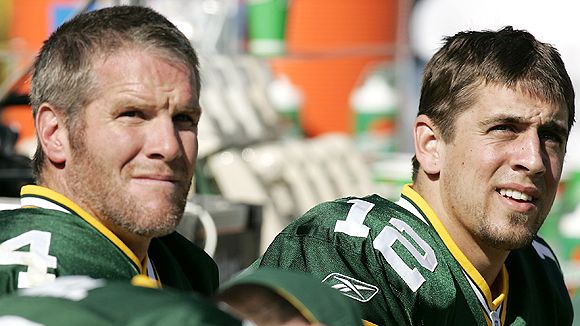
Barstool Debate: Who’s better right now — Brett Favre or Aaron Rodgers?

In the summer of 2008, the Green Bay Packers ended the Brett Favre era by trading him to the New York Jets. While some would argue that Favre ended the era himself by hemming and hawing about his retirement, the Packers ultimately made the decision to move on and hand the keys over to Aaron Rodgers.

With Monday night’s game only a few days away, it begs the question – are the Packers better off with Rodgers under center? To discuss this issue, I’m going to enlist the help of our lead NFL writer, Anthony Stalter.

JP: Anthony, if you’re an NFL GM and you think you have a Super Bowl caliber team, who would you rather have at quarterback this year – Brett Favre or Aaron Rodgers?

AS: Injuries are a major concern with Favre compared to Rodgers, who is younger and can better withstand the rigors of a full season. I realize Favre has never missed a start in his career, but that doesn’t mean he’s always been healthy. Last year he played through biceps injury during the final month and it sunk the Jets’ season. I worry that Favre would suffer some kind of alignment during the season that would affect his play. On the other hand, while I wouldn’t worry about Rodgers’ durability, I know that Favre is a natural winner. I know that when the chips are down, he’s usually going to make a play to win the ball game and while Rodgers has shown flashes of that in his young career, he hasn’t proven that he can win on a consistent basis yet.

JP: You know I’m kind of a numbers guy, and it’s tough to argue with Rodgers’ statistical performance thus far. In 19 starts, Rodgers has averaged 250 passing yards and 1.68 pass TD per game (versus 0.68 INT per game). Conversely, in 274 starts, Favre is averaging 240 passing yards, 1.71 TD and 1.13 INT per game. Rodgers meets or beats Favre in every category and isn’t nearly as inclined to turn the ball over. Rodgers has already made a number of great plays in tough spots in his young career, but last season the Packer defense gave up several game-winning drives to the opposition. This year, Rodgers beat the Bears by hooking up with Greg Jennings for a perfectly thrown 50-yard touchdown (when the Packers were down two and facing a third-and-1 with just 1:18 to play). Favre is known for being clutch, but I think part of that comes from his longevity. When you’re around that long, you’re bound to have some memorable comebacks. Last week’s (amazing) pass to Greg Lewis was the first time that he threw for a game-winning TD with 0:10 or less remaining in the game.

For reasons you mentioned, if I’m heading into a season, I’d take Rodgers because he’s as talented and has a much better chance of staying healthy for a full season. But if I’m heading into the Super Bowl next week and I have my pick of the two, I’d probably go with Favre because he’s been there before and I know he won’t be overwhelmed by the moment.

AS: Right, it all depends on the situation. If we’re talking about the Super Bowl or even a playoff game, I’m going to want Favre (even despite his high number of postseason INTs) because he’s been there before. I know I can count on him not to be overwhelmed or succumb to the pressure and the magnitude of the moment. Rodgers simply doesn’t have enough experience at this point in his career to trust putting under center in a one-and-done game. We just don’t know how he would react because he’s never been there before. Brett has won a Super Bowl and has been to the postseason countless times before. There’s just no substitute for experience.

That said, if we’re at the beginning of the season and I have my choice, I’m going to take Rodgers. He’s more durable than Favre, has all the physical tools to succeed and should only progress as a passer with more experience. Once he learns how to adjust to how defenses are trying to stop him, he’s going to be a very good quarterback in this league for a long time. He has all the potential to succeed.

That’s our opinion…what’s yours? Feel free to vote in our poll to the right.

National League All-Star voting–who is leading and who should be

Last week we picked apart the American League all-star voting. Well, this week we will look at the National League, and after last night the starters have all been selected (aside from pitchers). You ready?

First base
Leader: Albert Pujols, St. Louis Cardinals
Mike’s pick: Albert Pujols, St. Louis Cardinals.
Well, this one is a no-brainer. Is it possible that Albert gets better with age? Yes, and his numbers border on staggering. 81 games in, he’s batting .336 with 31 homers and 82 RBI and a slugging percentage of .748. That projects to 62 homers and 164 runs batted in. What’s more, dude has a .993 fielding percentage. There is little doubt Pujols is the best player in the game, and he gets to flaunt it in front of his hometown crowd a week from Tuesday.

Second base
Leader: Chase Utley, Philadelphia Phillies
Mike’s pick: Chase Utley, Philadelphia Phillies.
This one is also a no-brainer that the voters got correct, though as a Mets fan it pains me to say that. Utley has 17 homers, 54 RBI, he’s batting .303 with 16 doubles and a .980 OPS—all unbelievable numbers for a second baseman. This guy is a gamer.

Shortstop
Leader: Hanley Ramirez, Florida Marlins
Mike’s pick: Hanley Ramirez, Florida Marlins.
This is getting to be a trend, but the numbers in the National League don’t seem to lie, do they? Hanley is batting .344 with 13 homers and 58 RBI, 26 doubles, 12 stolen bases and a .972 OPS. By comparison, he is hitting 119 points higher than JJ Hardy and 132 points higher than the slumping Jimmy Rollins. Case closed.

Third base
Leader: David Wright, New York Mets
Mike’s pick: Mark Reynolds, Arizona Diamondbacks
. Wright was leading the league in batting for quite a while, and he’s currently hitting .333 but with just 5 homers and 42 RBI. By comparison, Reynolds has clubbed 22 home runs with 57 RBI while batting a respectable .271. At a power position, I’m giving the nod to the guy barely anyone gets to see play.

Catcher:
Leader: Yadier Molina, St. Louis Cardinals
Mike’s pick: Brian McCann, Atlanta Braves.
This is close, because Yadier’s brother Bengie has 10 homers and 46 RBI for the Giants, but McCann is batting .311 with 8 home runs and 33 driven in, with 15 doubles and a respectable .988 fielding percentage.

Outfield
Leaders: Raul Ibanez, Philadelphia Phillies
Ryan Braun, Milwaukee Brewers
Carlos Beltran, New York Mets
Mike’s picks: Raul Ibanez, Philadelphia Phillies
Ryan Braun, Milwaukee Brewers
Brad Hawpe, Colorado Rockies
Ibanez is having a career season, batting .312 with 22 homers and 59 RBI, and Braun just continues to rake, with 16 home runs, 58 driven in and a .326 average. But Beltran, while he plays in the biggest media market and makes mega-bucks, is not going to get my all-star nod over Brad Hawpe. Beltran is hitting .336, but has just 8 homers and 40 RBI. Hawpe is hitting .328 with 13 homers and 56 runs batted in, 25 doubles and a stunning .993 OPS. If Manny Ramirez was playing most of the season, he’d probably be on this list, but I can’t consider a guy who’s only played 28 games, regardless of why he missed all that time.

Starting pitcher
As you all know, pitchers are chosen by the managers and will be announced this Sunday.
Mike’s pick: Tim Lincecum, San Francisco Giants. Last year’s NL Cy Young winner got off to a slow start, but has been mowing hitters down lately, to the tune of 8-2 with a 2.37 ERA and league-leading 132 strikeouts with just 28 walks in 114 innings. Arizona’s Dan Haren is a close runner-up, with a 7-5 record for a crappy D-Backs’ team, and a league low 2.19 ERA with 113 K’s and 0.81 WHIP.

Relief pitcher
Mike’s pick: Heath Bell, San Diego Padres. When this former Met helped christen Citi Field by mowing down his ex-teammates in April, I thought it was just a phase. But dude leads the NL in saves with 22, and is 3-1 with a 1.34 ERA and 36 strikeouts in 33 innings of work. And here’s the best stat of all—Bell has saved or won 74% of his team’s wins. If he keeps that up, Bell will contend for the NL Cy Young and even garner some MVP votes.

« Older posts Newer posts »