Month: January 2009 (Page 37 of 61)

Great point about Mark McGwire and the “one-dimensional” argument

Ted Robinson of At Bat thinks that Mark McGwire is getting a raw deal from MLB Hall of Fame voters and brings up a great point about the argument that Big Mac was a one-dimensional player.

More voters are revealing their choices and it’s hard to argue that transparency is bad. I found the comments of a Boston voter puzzling and borderline deceiving. The man in question defended his anti-McGwire stance with the claim that McGwire was “one-dimensional.”

If we accept the premise, then we must ask what exactly is the problem with dominating the most important offensive dimension? McGwire, Barry Bonds and Sammy Sosa were the greatest home run hitters of their era. Bonds won the career battle but McGwire was the pioneer.

McGwire was the first to hit 50 home runs in four consecutive seasons, a mark Bonds reached only once.

One-dimensional? McGwire won a Gold Glove, an award often scoffed at by the Numbers Crowd. Although no one should confuse McGwire with Keith Hernandez, the Gold Glove is voted on by managers and coaches.

Another thought rushes to me when I consider the phrase “one dimensional” when used as an insult, the manner in which the Boston writer intended. (Disclaimer 1: here we will violate, mildly, a personal rule against invoking the comparison argument with any present Hall of Famers. It is never the intent here to denigrate anyone already so honored, however…would that writer call Nolan Ryan “one-dimensional?” Ryan’s resume leads with the career strikeout record, which he smashed and, like McGwire, is a symbol of dominance. (Disclaimer 2: I acknowledge that strikeouts are regarded by many voters as significant, a stance with which I don’t agree).

Strikeouts must be the reason Ryan is in the Hall. It can’t be his 324 wins because his career winning percentage is barely over .500 (.526). Surely, no rational person would conclude that seven regular season no-hitters warrant Hall of Fame inclusion.

It’s hard to argue with that point. Some players (Ryan is one of them) are in the Hall because they excelled at one facet of the game. Ozzie Smith was a career .262-hitter, but he was also one of the greatest defensive shortstops to ever play the game. McGwire was one of the best power hitters to ever play the game.

But the difference between McGwire and those players is that Ryan and Smith never took performance-enhancing substances to excel at their craft. McGwire did and fair or unfair, it’ll likely keep him out of the Hall for a very long time, if not forever. Stats are sacred in baseball and McGwire achieved his stats with help. Hall voters can’t look past that.

Top 10 Worst Super Bowl Teams

RealClearSports.com compiled a list of the top 10 worst Super Bowl teams of all time.

David Tyree7. 2007 New York Giants
Is it easy to discount the Giants’ unbelievable win over the then 18-0 Patriots because of “luck?” Of course it is – they needed a wild sack-escape by Eli Manning and David Tyree catching a pass on his helmet to pull-off the win. But before you get upset over the ratings of another bitter Patriots fan, consider this: the Giants were quite possibly the worst team to win a Super Bowl. Ever. And the numbers say so.

Of the 42 teams that have won the big game, the 2007 Giants are last (or tied for last) in winning percentage (0.625), point differential per game (1.4) and the Pythagorean record (0.536). Additionally, the Giants had just one Pro Bowler, went 0-4 against playoff-teams Dallas, Green Bay and New England in the regular season (losing by a combined 46 points) and finished second-to-last in margin of victory per game in the playoffs (5.0).

Is that a somewhat complicated, numbers-heavy way to say the 2007 Giants weren’t a very good Super Bowl team? Sure is.

Here’s a simpler version: In 2007, there were 10 teams with an equal or better record than that of the 10-6 New York Giants. One of those teams was the Cleveland Browns.

5. 2003 Carolina Panthers
Carolina’s 2003 season defined “average,” which makes their near win in Super Bowl XXXVIII all the more surprising. In no area did the Panthers stand out. As a team, they ranked 15th in points scored and 10th in points allowed—slightly above the norm, but by no means great numbers. Additionally, the Panthers were only 3-3 against opponents with a .500 record or better—a statistic notable for its small size (10 opponents had losing records) and mediocrity. Their season appeared more impressive than it was because of that weaker schedule, and the strides made from Carolina’s disastrous 1-15 performance in 2001, but the team was, in the end, simply not that good…

1. 1979 Los Angeles Rams
In 1979, the NFC West was just as bad as it was this year. The Rams made the playoffs by winning the West with a 9-7 record (the 9-7 mark is still the worst record for a Super Bowl team, but another NFC West team, the Cardinals, have a chance to tie that this season)…

It’s amazing that the 2007 Giants and 2003 Panthers are on a list of “top 10 worst Super Bowl teams” considering they gave fans two of the greatest Super Bowls of the last decade. It just goes to show you that in the NFL, you don’t have to necessarily have to be the best team in the league during the regular season. You just have to be one of the best two teams in the league during the playoffs.

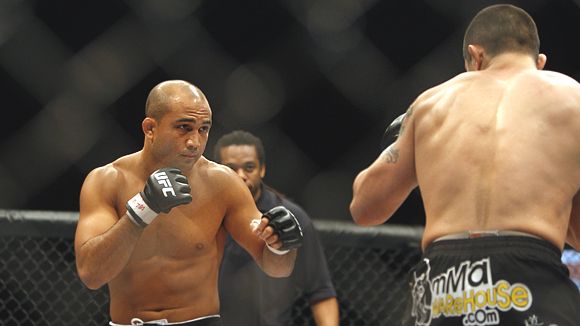
MMA Fighter Profile: BJ Penn

BJ Penn
Nickname: The Prodigy
Height: 5’ 9”
Weight: 155/170
MMA Record: 14-4-1
UFC Record: 13-3-1
Fighting Style: Brazilian Jiu Jitsu

“Baby” Jay Dee Penn was born in Kailua, Hawaii and has been fighting out of Hilo at BJ Penn MMA. He is a world champion jiu jitsu competitor, and was the first American to win the World Jiu Jitsu Championship at a black belt level in Brazil. After this victory, the UFC approached him about entering the organization.

The fighting prodigy started out with knockouts of Din Thomas and Caol Uno, both well-respected fighters. He fought Jens Pulver for the UFC Lightweight title, but lost by decision. He would fight Uno once more, drawing again to miss out on the belt. After the UFC stopped the Lightweight division, Penn moved up to 170 to face Welterweight Champion Matt Hughes. He submitted Hughes via a rear naked choke in the first round in a massive upset, earning him his first UFC title.

Contract issues and other organizations caused the UFC to strip Penn of the belt, but he would reconcile and return to face Georges St. Pierre. Even though he lost against St. Pierre and his rematch with Matt Hughes, he continued on, deciding to drop back 155, which was a more suitable and natural weight class.

Penn dominated everyone the UFC threw at him in the 155-weight class, and by doing so he earned his rematch against St. Pierre. If successful, he’ll be the only person to have two UFC titles at the same time.

On January 31st Penn vs St. Pierre 2 will show just how good the prodigy is and if he’s successful, it’ll prove he can fight in two separate weight classes as a champion.

–Written By TSR Contributor John Duke

Conley on the move?

The Racine Journal-Times is reporting that the Bucks and Grizzlies have verbally agreed on a deal that would send Mike Conley, Jr. to Milwaukee in exchange for Ramon Sessions and Joe Alexander.

I’ve been told both teams have virtually agreed on the conditions of the trade and only Bucks owner Herb Kohl had to give his stamp of approval. Bucks general manager John Hammond, reached in North Carolina where he was on a scouting trip, said it was his policy not to comment on any trade speculation.

As a Bucks fan, I don’t really want to see this trade go down. I’m not clear on why Sessions isn’t getting any run despite being the 15th most productive point guard in the league. He must be in Scott Skiles’ doghouse. That’s the only explanation. And it’s a shame because the kid has shown tremendous potential. At 22 years of age, he has a bright future ahead of him.

Neither Joe Alexander nor Mike Conley has shown a whole lot in their brief careers. Conley continues to struggle with his jumper (41%), and if the Bucks were to trade for him, it would be for his potential, not his production. I don’t understand why a team would trade for a semi-expensive, 21 year-old, unproductive point guard when they’d have to give up a cheaper, more productive 22 year-old point guard. Sessions is a better shooter and has a much better assist-to-turnover ratio (3.43 vs. 2.47). I’ve always liked Conley as a prospect, but simply stated, when comparing the two, Sessions is simply more of a proven player.

Like I said, it looks like Sessions may be in Skiles’ doghouse. While I do like the sense of discipline and defense that Skiles has brought to the Bucks, I’ll be disappointed if Milwaukee trades away a productive young player because the head coach can’t find a way to get through to him.

Picking the 2009 NBA All-Stars

The NBA All-Star Game is part meritocracy and part popularity contest. First, the fans vote, and the top five vote getters – two guards, two forwards and a center – from each conference are the starters. Then the coaches vote on the remaining seven reserves for each team.

The current vote count can be seen here, but I thought I’d put together my own list – five starters and seven reserves – for each team. To me, when it comes to naming All-Stars a winning record is just as important as great stats, so given two players with similar numbers, I’m probably going to give the nod to the guy on the better team. I’ll list the player’s Player Efficiency Rating, which gives a nice overview of the guy’s per-minute statistical production this season.

And off we go…

EASTERN CONFERENCE STARTERS

Dwyane Wade, Heat
PER: 29.14
D-Wade is back with a vengeance. He’s averaging 29.0 points, 7.1 assists and 5.1 rebounds, and is (almost) single-handedly keeping the Heat in the playoff hunt. With 24% accuracy, I don’t know why he’s shooting so many threes (3.0 per game), but that’s just nitpicking. He’s third in the league in steals (2.25).

Joe Johnson, Hawks
PER: 19.84
JJ is averaging 22.3 points, 6.1 assists and 4.6 rebounds, and has the Hawks in a battle for the #4 spot in the East. His three-point shooting is down two points, but his overall FG% is up a point. Remember when everyone laughed at the Hawks for giving up future MIP Boris Diaw and two first round picks for him?

LeBron James, Cavs
PER: 32.04
LeBron is the front-runner for the MVP thus far. He’s posting 27.7 points, 6.6 assists and 6.6 rebounds a game. His numbers are down, but that’s because the Cavs can afford to rest him an additional four minutes per game. It’s great to see his FG% over 50% (50.8%) and FT% approaching 80% (78.8%). LeBron has always been a statistical stud, but it’s the Cavs’ stellar record that has him leading the MVP race.

Kevin Garnett, Celtics
PER: 20.87
KG’s scoring is down, but given the Raptors’ struggles, he’s still the most deserving PF (over Chris Bosh) in the East. His numbers are virtually identical to last season other than a mysterious drop in free throw attempts per game (-2.1). Is KG still taking the ball to the hole?

Dwight Howard, Magic
PER: 25.71
I’d like to see Howard’s free throw accuracy (57.3%) improve, but it’s hard to argue with Orlando’s success this season. Howard is averaging 20.1 points and leads the league in rebounding with 13.8 per game. He also leads the league in blocks (3.28).

EASTERN CONFERENCE RESERVES

Devin Harris, Nets
PER: 24.88
From a statistical standpoint, Harris is outplaying all other Eastern Conference guards save for Dwyane Wade, so he is deserving of a spot in the starting lineup. However, Joe Johnson’s Hawks are playing quite a bit better, so Harris will have to settle for a spot on the bench.

Chris Bosh, Raptors
PER: 23.37
The Raptors are struggling this season but it’s not the fault of Bosh, whose numbers are virtually identical to last season. He has averaged at least 22.3 points and 8.7 rebounds in each of the last four years.

Paul Pierce, Celtics
PER: 18.32
Despite the Celtics recent struggles, The Truth is still a no-brainer All-Star pick. He’s averaging 19.0 points, 5.6 rebounds and 3.7 assists and while his FG% is down a smidgen, he’s over 40% from long range for the first time since the 2001-02 season.

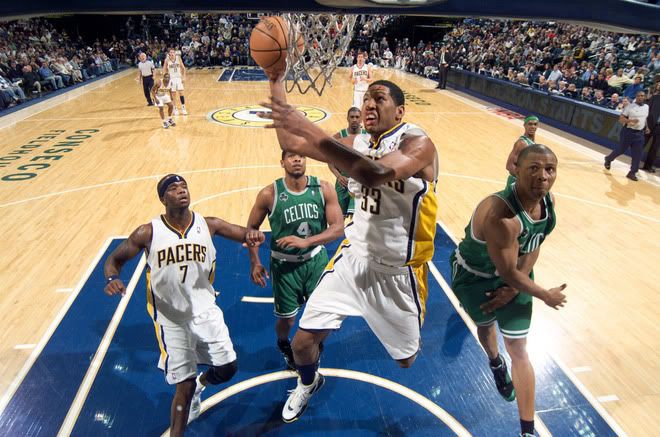
Danny Granger, Pacers
PER: 21.93
Granger is clearly one of the league’s best young small forwards. He’s averaging 26.4 points, 5.2 rebounds and 3.4 assists, while shooting a solid 46% from the field. The Pacers aren’t great, but they’re competitive, and Granger is the main reason why. Moreover, he’s averaging an eye-popping 33.3 points per game in January.
Tayshaun Prince, Pistons
PER: 16.37
The Pistons have the fifth-best record in the East right now and deserve to have a player on the All-Star team. Prince’s numbers aren’t eye-popping, but he averages 7.3 points per game and contributes in all areas despite having to cover the opponent’s best perimeter player every night.

Jameer Nelson, Magic
PER: 19.91
Given that Orlando has virtually the same personnel as last season, it’s a bit of a surprise at how much better Nelson is playing. His ppg jumped from 10.9 to 16.4 and his FG% jumped from 46.9% to 50.4%, which is tremendous for a guard. His three-point shooting (43.8%) is outstanding. Rashard Lewis (PER: 18.05) may get the nod, but I think Nelson is more deserving.

Vince Carter, Nets
PER: 21.89
I’m not a huge fan of Vinsanity, but he’s averaging 22.7 points, 5.1 rebounds and 4.9 assists while shooting better than 40% from long range. Truthfully, this spot could go to a number of guys from better teams – Rajon Rondo, Mo Williams, Allen Iverson, Mike Bibby, Zydrunas Ilgauskas, Rashard Lewis – but Carter smokes them all numbers-wise.

Bubbling under: Rajon Rondo, Mo Williams, Allen Iverson, Caron Butler, Zydrunas Ilgauskas, Mike Bibby, Jose Calderon, Rashard Lewis

WESTERN CONFERENCE STARTERS

Chris Paul, Hornets
PER: 30.53
After a rough 5-5 start, Paul has the Hornets back in the thick of the hunt for the #2 playoff spot in the West. He has the second-highest PER in the league and is averaging 20.4 points and 11.3 assists per game. He also leads the league in steals (2.82) and is on the short list of serious MVP candidates.

Kobe Bryant, Lakers
PER: 25.48
Kobe’s minutes are down 3.0 per game, which explains why his numbers have taken a bit of a dip. Still, he’s averaging 27.0 points, 5.2 rebounds and 4.6 assists, and his FG% is up over 48% for the first time in his career. The Lakers have the best record in the West and Kobe would be favored to win his second consecutive MVP if not for the Cavs’ winning ways.

Dirk Nowitzki, Mavericks
PER: 23.78
If Carmelo Anthony hadn’t gotten injured, he might have earned this spot, but Dirk’s Mavs are just three games back of the Nuggets in the standings and he’s having another great season. He is averaging 25.3 points and 8.4 rebounds, and is shooting better than 40% from the field.

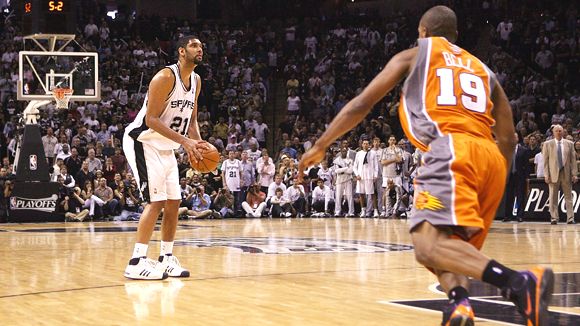
Tim Duncan, Spurs
PER: 24.33
Two words: sustained excellence. TD is averaging 20.4 points and 10.1 rebounds while shooting almost 52% from the field. Plus, he’s one of the best (if not the best) defensive big men in the game.
Yao Ming, Rockets
PER: 22.67
Yao has had to play without Tracy McGrady for a good portion of the season, but the Rockets are right in the thick of the playoff hunt in the West. He leads the Rockets in scoring, rebounding, blocks and is shooting almost 87% from the free throw line.

WESTERN CONFERENCE RESERVES

Brandon Roy, Blazers
PER: 25.06
Roy’s scoring is up to 22.8 points per game this season (from 19.1 ppg last season) in no small part due to his increased accuracy (+2.1%) from the field. The Blazers look like a playoff team and Roy is a big reason why.

Carmelo Anthony, Nuggets
PER: 18.18
‘Melo’s Nuggets are playing well even though his FG% has taken a dive to 43.7% this season. His scoring is down, but he’s rebounding well (7.3) and his three-point accuracy is up to 42%, which is a huge improvement.

Tony Parker, Spurs
PER: 23.23
Parker is setting career highs in points (21.3) and assists (6.7), he’s never been more accurate from long range (40.0%) or from the charity stripe (81.5%). Manu Ginobili has been solid, but Parker is the second-most deserving Spur this season.

Pau Gasol, Lakers
PER: 22.49
Despite the return of Andrew Bynum, Gasol’s rebounding (9.4) as well as he ever has, and he’s continuing to thrive in his role as Kobe’s sidekick. He’s averaging 17.8 points and is shooting over 55% from the field.

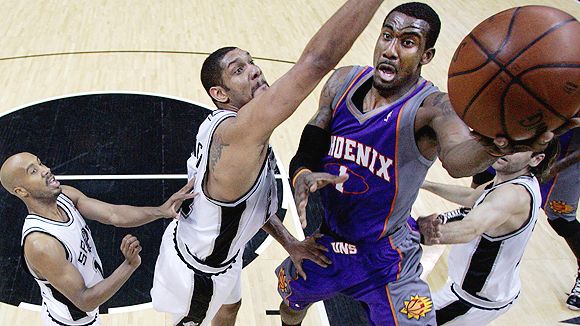
Amare Stoudemire, Suns
PER: 22.44
Stoudemire is averaging 21.8 points and 8.5 rebounds, and is shooting almost 55% from the field. Even though the Suns have slowed the pace down, Stoudemire’s numbers are still stellar.
Chauncey Billups, Nuggets
PER: 20.98
Billups is averaging 18.7 points and 6.8 assists for the Nuggets, but more importantly he has brought a defensive culture to Denver (and that’s not easy to do).

Shaquille O’Neal, Suns
PER: 23.75
A revitalized Shaq is producing 17.4 points and 9.0 rebounds in just 30.1 minutes. There are a number of players that could replace him on the All-Star team, but I think everyone around the league recognizes just how good Shaq is when he’s motivated.

Bubbling under: Manu Ginobili, Al Jefferson, David West, Paul Millsap, LaMarcus Aldridge, Deron Williams, Andrei Kirilenko, Mehmet Okur

Voting continues at NBA.com through January 19th.

1/22/09 Update: The starters have been announced.

« Older posts Newer posts »