Tag: Rodney Stuckey (Page 1 of 2)

NBA Draft Lottery: Who wouldn’t pick John Wall #1?

The NBA Draft Lottery is tonight, and as always, there is a lot riding on a few ping pong balls. Here is a list of the lottery teams (with their chances of winning the top pick in parenthesis) along with some discussion of their possible strategy if they do win the #1 pick.

ALMOST A SURE THING

Nets (25%)
The Wall-to-New Jersey/Brooklyn rumors have been strong all season, thanks to the Nets’ woeful record and Devin Harris’s struggles. Harris is now viewed as expendable, which means Wall would be a Net if the balls bounce their way tonight.

Wizards (10.3%)
Winning the right to draft Wall would allow the Wizards to cut ties with Gilbert Arenas and the franchise’s gun-toting past. It might also convince a free agent or two to sign for the chance to play with Wall.

76ers (5.3%)
Jrue Holiday is nice, but he’s not going to dissuade the Sixers from drafting a franchise-savior like Wall.

Pistons (5.2%)
See 76ers above but substitute “Rodney Stuckey” for “Jrue Holiday.” That is all.

Pacers (1.1%)
Indiana arguably needs a point guard more than any other team in the lottery, but with just a 1.1% chance of winning, they’re hoping against hope.

Grizzlies (0.7%)
Memphis would be buzzing with the arrival of Wall, who would seemingly be a great fit with O.J. Mayo, a re-signed Rudy Gay, Zach Randolph and Marc Gasol. Memphis would likely make the playoffs next season.

Raptors (0.6%)
The chances are very slim, but winning the right to draft Wall would offset the likely loss of Chris Bosh this summer. Neither Jarrett Jack nor Jose Calderon would be enough to convince the Raptors to draft Evan Turner.

Continue reading »

Rodney Stuckey collapses

Stuckey had some sort of seizure and collapsed on the court during Detroit’s game against the Cavs.

LeBron James had 40 points, 13 rebounds and six assists as the Cleveland Cavaliers beat Detroit 99-92 on Friday night in a game delayed when Pistons guard Rodney Stuckey collapsed late in the third quarter.

Stuckey’s vital signs were stable, and he was conscious and breathing on his own at the Cleveland Clinic, according to the Pistons. He was transported there for tests.

Stuckey was wheeled off the court on a stretcher after he collapsed into a coach’s arms on the bench. Play was halted for 12 minutes as the medical staff worked on him, placing an oxygen mask on his face and wheeling him into an ambulance.

The Detroit News reports that he is breathing on his own and is conscious at the Cleveland Clinic, where he was taken after his collapse.

Which NBA teams project to have the most cap space over the next two years?

In previous columns, I ranked the top 10 free agents of 2010 and identified several players with expiring contracts that might be moved before the Feb. 19 trade deadline. Now it’s time to talk about cap space.

We’ve been hearing a lot lately about how teams are “clearing cap space” so that they can sign a big-name free agent in the summer of 2010 (or in some cases, 2009). But what exactly does this mean?

The NBA has a “soft cap” which is currently set at $58.7 million. Teams that are over the cap can’t sign a free agent from another team for more than the mid-level exception, which usually starts at around $5 million per season. Teams that are under the cap can offer free agents whatever cap space they have up to the level of a max contract, which starts at about $14 million per season under current conditions.

HoopsHype has all the salary data for each team, but I thought it would be useful to compile it all into one table so we can easily see who will have money to spend over the next two summers.

First, my assumptions:

– Given the current state of the economy, the salary cap is likely to stay at about $59 million over the next two seasons, so I used the current cap ($58.7 million) to calculate each team’s cap space.

– Certain players have already indicated that they’re planning to “opt out” of the final year of their contracts so that they can enter free agency. For those that have not announced, I used my best judgment to determine whether or not a player is likely to opt out. For example, LeBron James is very likely to opt out of his contract in the summer of 2010, but Michael Redd, who stands to make more than $18 million that same season, is likely to play out the final year of his deal because he’s not going to get anything close to that kind of money on the open market.

– I’ll also list the major (and some minor) decisions that each franchise will have to make over the next two seasons. These are typically decisions about whether or not to re-sign a player whose contract is up (or is entering restricted free agency). For example, if the Knicks decide to sign David Lee to a long-term deal, it’s going to have an impact on the team’s available cap space.

Without further ado, here’s the table, sorted by total projected cap space in the summer of 2010.
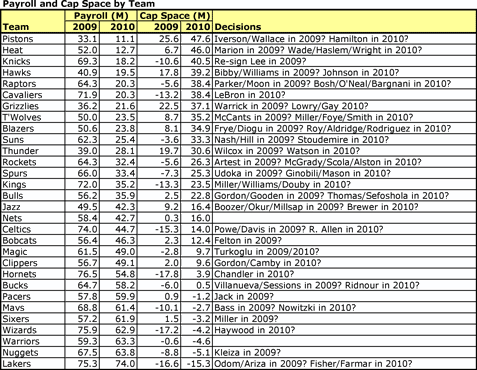
The data is interesting. If teams didn’t spend another dime until the summer of 2010, there would be seven teams capable of signing one player to a max-type contract and 11 teams capable of signing two players to max deals. This isn’t realistic, however, as most teams are going to re-sign their current players when they enter restricted or unrestricted free agency, and that’s going to take a bite out of their cap space. Plus, there are a number of stars – Carlos Boozer, Shawn Marion, Allen Iverson – and several starter-quality players that will sign free agent deals this summer. That’s going to gobble up cap space as well.

Of the four teams that have significant cap flexibility this summer – Detroit, Memphis, Atlanta and Oklahoma City – only two, the Pistons and the Hawks, have major decisions to make this summer. The Hawks have to decide whether or not the 30 year-old Mike Bibby is worth a significant long-term deal. If they do sign him to a contract averaging, let’s say, $10 million per season, it is going to reduce their cap space for the summer of 2010 by that amount. They can always re-sign Joe Johnson (because he is “their” free agent), but they may not have enough space to sign another top tier player. That space would be reduced further if they elect to sign Marvin Williams to a long-term deal.

The Pistons have to make a decision about Allen Iverson and Rasheed Wallace. Both players are getting on in age, so I wouldn’t be surprised if the Pistons allow both contracts to expire and use the new cap space this summer or next, building around Rodney Stuckey and Tayshaun Prince.
The Grizzlies have a ton of projected cap space over the next two years, but their challenge is not the money – it’s attracting a top-tier free agent to a small city and a bad team. No one really thinks that Memphis has a shot at any of the top five free agents of 2010 – LeBron, Dwyane Wade, Amare Stoudemire, Chris Bosh and Joe Johnson – though there’s a slim chance that Amare or Bosh might want to play with O.J. Mayo and Rudy Gay. Small market teams like Memphis that are struggling to win are going to have to overpay for second-tier free agents. The Thunder, Timberwolves, Raptors and Kings are four other teams that will have significant cap space over the next two seasons but are unlikely to attract a top-tier free agent.

These numbers will obviously change over the next two seasons as teams make trades and sign free agents (and draft picks). However, I can’t remember a time when this many teams had this much cap space. Under normal circumstances, it would lead to a frenzy of spending in the short term, but with the current state of the economy, teams may be quite a bit more cautious as they open those checkbooks.

No Love?

The rosters for the T-Mobile Rookie Challenge have been announced and there are a few surprises.

The rookie roster consists of Derrick Rose, Russell Westbrook, O.J. Mayo, Eric Gordon, Rudy Fernandez, Michael Beasley, Brook Lopez, Greg Oden and Marc Gasol.

The sophomore roster includes Rodney Stuckey, Aaron Brooks, Kevin Durant, Wilson Chandler, Jeff Green, Al Thornton, Luis Scola, Al Horford and Thaddeus Young.

Kevin Love isn’t on the nine-man roster for the Rookie Challenge, and it’s a big, glaring snub. ESPN’s John Hollinger agrees.

For starters, the decision to select Eric Gordon ahead of Kevin Love for the rookies was completely inexcusable.

Don’t get me wrong; Gordon is going to have a fine career, it seems, and in almost any other year he’d be a shoo-in for the team. But he made this squad mainly because the forlorn Clippers have no choice but to play him extensive minutes.

As good as he’s looked, Gordon is the only rookie team member with a Player Efficiency Rating below the league average, while Love has a better PER than every player on the rookie team except Greg Oden. Love leads the league in offensive rebound rate, as I mentioned the other day, but his prodigious work on the boards has gone largely unnoticed because he plays only 23.2 minutes a game, far less than Gordon’s 32.2.

Love’s absence is especially surprising considering how the rookie roster is loaded with four guards (Rose, Westbrook, Mayo, Gordon), one G/F (Fernandez) and only one true forward (Beasley). You’d think that if it were a tossup between Gordon and Love (which it isn’t) that they’d at least want to get another true forward on the roster to balance things out.

Hollinger goes on to rail against the sophomore roster snubs, which included Wilson Chandler over Jamario Moon, Al Thornton over Carl Landry and the worst of all (he says) — Aaron Brooks over Ramon Sessions.

Interestingly, seven of the top 11 picks of the 2007 draft — Mike Conley, Yi Jianlian, Corey Brewer, Brandan Wright, Joakim Noah, Spencer Hawes and Acie Law — did NOT make the sophomore roster. (I counted Greg Oden amongst the four since he made the rookie roster.) Conversely, six of the top 11 picks in the 2008 draft did make the rookie team.

Allen Iverson debuts in Pistons’ loss

It was an inauspicious beginning to the AI Era in Detroit.

Iverson himself was respectable (24p, 6a), but the Pistons lost to the Nets, 103-96.

According to ESPN’s Chris Sheridan, the Billups-for-Iverson trade might be more about how Detroit feels about Rodney Stuckey than either of the players involved.

When Detroit needed buckets in the fourth quarter, it was Stuckey running the show at the point, with Iverson off the ball.

And when the Pistons needed stops in the second half, it was Stuckey who continually was getting burned by Devin Harris (career-high 38 points, with 22 of his 24 free throw attempts coming in a second half in which Detroit surrendered 64 points to one of the NBA’s worst teams). All that time, Pistons coach Michael Curry refused to switch Iverson onto Harris — even as Stuckey was committing five fourth-quarter fouls on Harris.

“Stuckey’s the point, and Harris is the point. What we do here in Detroit, you guard your position. And when he comes into the game, Allen slides to the 2. and if Devin Harris is outplaying you, you’re going to have to get better. That’s what you’re going to have to do — play your matchup,” Curry said.

A couple of things jump out from this game: 1) Devin Harris blew up, and he was on my list of “Six NBA players who are about to break out” and 2) Curry refuses to go with the best matchup defensively, instead insisting that each player guard his position (even if it is to the detriment to the team).

I don’t know too many coaches that don’t try to utilize the best matchups defensively. Regular readers know that I played for (current UW coach) Bo Ryan at the University of Wisconsin-Platteville. The other starting forward was the better defender, so Ryan would have him cover the other team’s best scoring forward. That left me with an “easier” matchup, and since I was one of my team’s primary scorers, going with that matchup would save my legs so I could hit crucial jump shots at the end of the game.

So why is Curry insisting that Stuckey – who is actually more of a combo guard – cover the lightning-quick Harris when he has his own lightning-quick guard on the court? It might be pure stubbornness, thickheadedness or he could be trying to light a fire under Stuckey defensively.

But back to the decision to play Iverson off the ball. More and more this trade is looking like one that is meant to keep butts in the seats for this season while giving the team salary cap flexibility to sign one or two big name free agents over the next two summers. Joe Dumars likely saw that, with Billups, the team was going to be competitive, but it wasn’t going to be a legitimate contender. With the backcourt shakeup, it looks like the team is going to give the ball to Stuckey and ask him to create, and it doesn’t really matter if this is the best thing for the 2008-09 Detroit Pistons.

« Older posts