Tag: ohio state scandal (Page 5 of 5)

RichRod defends Jim Tressel

Former Michigan head coach Rich Rodriguez recently appeared on Colin Cowherd’s ESPN radio show and wound up defending Ohio State coach Jim Tressel in the wake of “Tattoogate.”

From the Detroit News:

Cowherd told Rodriguez he no longer trusts Tressel; Rodriguez responded by defending Ohio State’s coach.

“If you run a program at Ohio State or at Michigan or something like that, so much of what you do is public,” Rodriguez said. “There’s not all this crazy cheating and things like that going on that people think. There are some guys out there that bend the rules a little bit or they get around the rules and try to get a competitive advantage. I don’t think that was the case in this at all. There were five guys who sold items who shouldn’t have sold it. And they were wrong for doing it. Did that give Ohio State a competitive advantage? I don’t think so.”

Rodriguez continued: “There’s coaches out there that are trying to get a competitive advantage the wrong way, a handful, and they seem to get away with it. And there are other coaches that are really trying as hard as they can, doing everything in good faith, and they seem to get nailed. I think that’s the thing that frustrates coaches, like, ‘Geez look at what these guys did, and they’re winning and they did all that.’

“How do we fix that?”

Rodriguez’s overall point is correct. The NCAA has a much, much bigger problem on its hands than what Tressel did. He broke rules, made a poor decision and deserved to be punished. But he’s not in the same stratosphere as the coaches who are flat out cheating when it comes to signing recruits. I think it’s safe to say that there are a lot of coaches out there doing a lot worse.

But even though I agree with some of what he said, I think RichRod is missing the bigger picture when he talks about how there are coaches out there that “bend the rules a little bit or they get around the rules and try to get a competitive advantage.”

Rules are in place so that everyone has a fair playing field. The fact that some coaches have done far worse than what Tressel did isn’t the point: If you break rules, you should be punished. Granted, there are different degrees of punishment but nobody should be “bending the rules a little bit” or “getting around the rules” to try to get a competitive advantage. Play within the rules and then you won’t wind up embarrassing your program like Tressel did.

Now, if the NCAA decides to crack a stronger whip and terminates Tressel’s contract, then that’s a whole different can of worms. But until then, it would be nice if college coaches made wiser decisions when it came to running their programs and then something like “Tattoogate” wouldn’t be an issue.
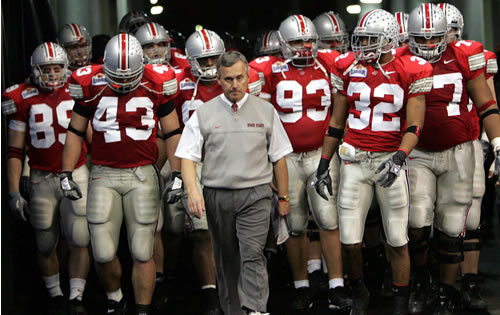
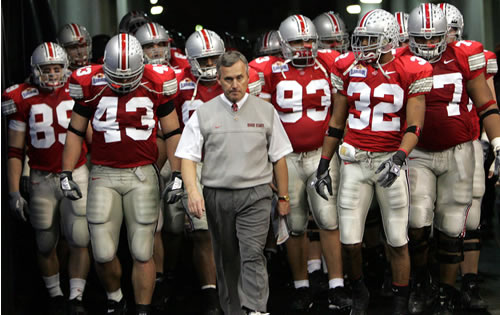
A college football head coach cheated? Shocking!

I have to say, I’m shocked this morning. I’m shocked that so many people are shocked that the head coach of a major college football program would stoop so low as to lie or cheat in order to gain an advantage on the field.

As I wrote yesterday, the media loves to get on their high horse when it comes to scandals like Jim Tressel’s at Ohio State. For those unaware, the Buckeye head coach knew about “Tattoogate” eight months before the NCAA disciplined his players and on Tuesday, Ohio State suspended Tressel two games and fined him $250,000 for not coming forward about what he knew. (He received e-mails from an attorney in April 2010, which indicated that his players were receiving improper benefits.)

In other words, he cheated. He knew his players were violating rules and he did nothing about it. He kept quiet so that his season wouldn’t implode and he convinced the NCAA to allow Terrelle Pryor and the other suspended players to participate in the Sugar Bowl so he could finally get the SEC monkey off his back. (Thanks to Pryor, the Buckeyes beat Arkansas in a 31-26 thriller.)

But back to my point: Is any of this surprising? Because it’s “The Vest” we’re surprised that a college football coach in this day and age is capable of something like this? Everyone lies and cheats to get ahead in college football. Whether it’s Lane Kiffin, Bobby Petrino, Nick Saban, Rich Rodriguez or yes, even Tressel, we’ve reached a point where nothing should surprise anymore. I’m not saying that what Tressel did was right because it’s not. But you mean he withheld information that some of his star players were violating NCAA rules because he wanted to win in 2010? No way! There’s no way a college football head coach would do that!

The only thing that matters in college football is winning and if you don’t like that statement then don’t watch because it’s true. And speaking of the media getting on its high horse, I couldn’t help but scoff when I read the conclusion of Mark Schlabach’s article on Tressel this morning:

For the record, Michigan’s football team hasn’t beaten Ohio State in 2,663 days.

But the Wolverines won on Tuesday.

At least they had fired their cheating coach.

No, they fired a losing coach. That’s the difference.

Welcome to the present day world of college football. You’ll feel right at home if you lie, cheat and steal to get ahead because it’s almost become expected. Just make sure you win, baby.

Jim Tressel to be fired because he was aware of violations? Please.

Will Jim Tressel be fired if the allegations are true that he knew his players violated NCAA rules last year by selling memorabilia to the owner of a tattoo shop? Ha! You’re adorable.

Winning coaches don’t get fired in college football. This situation would present the perfect opportunity for a program to get rid of a lame duck coach, but not someone like Tressel who has compiled a 106-22 record in 10 seasons at Ohio State. Not someone who has led his program to six straight BCS bowls and two national championship appearances.

Don’t get me wrong: the allegations against Tressel are serious. Yahoo! Sports is reporting that he knew about the Buckeyes’ gear-for-tattoo scheme last April, which means he knew what his players were doing a good eight months before the school was made aware of the situation. If that’s the case, then he had a responsibility to the program to make the university aware of what was going on.

But this is college football, where coaches lie, cheat and steal in effort to get ahead. If he’s guilty, I’m not suggesting that Tressel wasn’t wrong not to tell OSU officials as soon as he found out. But how many BCS coaches would have in that situation? How many coaches would submarine their chances to play in a national title game because a handful of their star players were caught trading autographs for “I Heart Mom” tattoos? (My guess would be less than half.)

Whenever a story like this comes out, fans and the media want to get on their high horse or preach from their soapbox. But I’ve got news for you: the college football underworld is about as seedy as they come. I’m sure damn near every BCS team is breaking the rules in some way and while it doesn’t make it right, it is reality. Sorry.

Assuming the allegations are true, I’d be shocked if Tressel were to lose his job over this. If he were coming off back-to-back 7-5 years and two-straight appearances in the Alamo Bowl, then it would be a different story. But unless he allegedly locked a player in a closet a la Mike Leach at Texas Tech, I don’t envision Tressel standing in the unemployment line anytime soon.

Update: ESPN.com is reporting that Tressel will receive a two-game ban and will be fined. When asked if he ever considered firing Tressel, Ohio State president Gordon Gee said: “No, are you kidding? Let me be very clear. I’m just hoping the coach doesn’t dismiss me.”

NCAA rears its hypocritical head with Ohio State suspensions

First, the news: Terrelle Pryor and four other Ohio State players, including star receiver Devier Posey and star running back Daniel “Boom” Herron, have been suspended by the NCAA for the first five games of the 2011 season for receiving improper benefits.

There were items sold and money made. There’s also some word about some free tattoos. The NCAA is forcing the players to repay the money to charity. OK, that’s fine. They screwed up, they have to suffer the consequences, we get it. It might seem a little harsh, but rules are rules, right?

Well, in the NCAA that’s a matter of opinion.

First of all, the players have not been suspended for the Sugar Bowl against Arkansas because there was a misunderstanding of the rules. To some, this might seem like a very transparent attempt to have Ohio State’s best players available for the game, which figures to be a huge money maker. If you’re thinking that, you’re right.

The NCAA and the BCS — two separate entities, mind you — are consistent when it comes to one thing, and one thing only: We make money, you don’t. It’s that simple, and until we all just accept it, we’re going to spend a lot of time getting pissed off about things like this. Not that we shouldn’t be pissed off, but I’ve found the games are more fun to watch if I just pretend the NCAA and the BCS don’t exist when it comes to college football.

Then there’s the whole, “Hey, didn’t the NCAA find wrongdoing in the Cam Newton case, but not suspend him at all?” Why yes, that’s also true. Sure, these are two different transgressions, but transgressions nonetheless. The NCAA interpereted its own rules to allow Newton to play for Auburn. The fact that he’s the best player on perhaps the nation’s best team probably had everything nothing to do with it.

Newton — the NCAA, SEC and Auburn decided — didn’t know what was going on behind his back as his father shopped him for $180,000 to Mississippi State. Newton’s ignorance of the situation wasn’t not knowing the rules, his was not knowing his own father was shopping him. Completely different.

There is one thing that’s similar in these two cases, however. The BCS and the NCAA don’t suffer anything when it comes to their bottom lines, as Newton gets to keep playing, and will be in the NFL by the time the NCAA decides to actually make a real punishment in this case. Pryor, Herron and Posey, along with the other two Ohio State players, also get to play on the big BCS stage and keep the game against Arkansas interesting. Without them, who really thinks we have a competitive Sugar Bowl?

So yes, the NCAA does actually enforce its rules — when it realizes it’s not the only one making money, that is. And that enforcement is also subject to whether or not its BCS brothers will have as much of an opportunity to make money as possible.

Glad we’re all clear on that.

Newer posts »