Tag: Nate Robinson (Page 5 of 5)

Concerns over Mobley’s heart condition holding up Randolph trade

Zach Randolph has joined the Clippers, but he can’t play until Cuttino Mobley sees a heart specialist.

The source said Mobley would see a heart specialist on Tuesday.

When asked about ESPN.com’s report by reporters after the Clippers game on Monday, coach Mike Dunleavy said: “From the standpoint of Cuttino’s concern, there’s nothing they have or don’t have that hasn’t been known to us or hasn’t been approved by us and all the other teams he’s played for. Neither one of those guys has had any issues with any of the things that are even being talked about.

“All I know is that if Cuttino has anything, he’s been asymptomatic,” Dunleavy said. “He’s never had any issue with us. There’s never been one time that he missed a practice or missed a game or had any issues in any physical of any kind for us. I mean, I’ve been told by our doctors that the things that are under concern is not something that we haven’t known about or have had any issues with. So hopefully, it won’t be an issue.”

Another source told ESPN.com that Mobley’s condition has been present throughout his career and has never been a grave concern, although the Knicks were prudent in their diligence.

On the surface it would be hard to imagine the Knicks wanting to void the trade because they achieved their goal of clearing Randolph’s contract (which carried two more years and $33.3 million after this season).

No disrespect to Cuttino Mobley, but why would the Knicks even care if he has a heart condition? This trade is mostly a salary dump, though there is the possibility that Mobley and Tim Thomas may see some minutes this season. But really, if Mobley weren’t able to play, would the Knicks really take Randolph (and his salary) back?

If your goal is to free up cap space to make a run at LeBron James in 2010, and you’ve successfully found a sucker to take on Zach Randolph’s contract, then why would you jeopardize it by holding up the deal?

Click here for an in-depth analysis of how the Randolph trade affects the Knicks’ future salary cap flexibility.
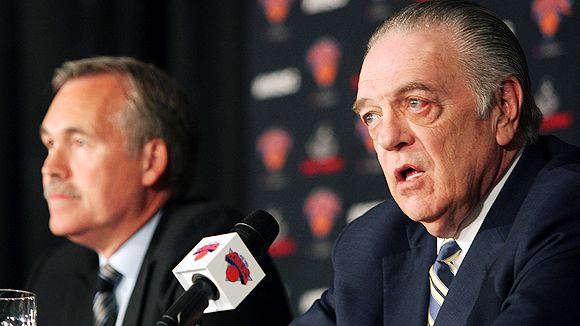
For Knicks, Randolph trade is all about 2010

GM Donnie Walsh has pulled the trigger on another trade. After trading Jamal Crawford for Al Harrington, Walsh sent Zach Randolph and Mardy Collins to the Los Angeles Clippers for Cuttino Mobley and Tim Thomas. The Knicks have long been looking to rid themselves of Randolph and his fat contract (which runs an additional two seasons at the tune of $33 M), even going so far as to “feature” the forward this season, allowing him to post near-career numbers (20.5 points, 12.4 rebounds), despite shooting just 43% from the field. If there are any Knicks fans wondering why Mike D’Antoni was playing Randolph 35 minutes but only giving 28 to David Lee, this is probably the reason why.

By allowing Randolph to lead the team in scoring and rebounding, the Knicks were simply baiting another team to trade for him. In this case, it was the Clippers that came knocking. The team is 2-11, and still clearly reeling from offseason loss of Elton Brand. Randolph is sort of a “Brand Lite,” in that he can do a lot of the same (offensive) things as Elton, he just can’t do them very efficiently.

But this trade should be examined from a fiscal standpoint, because in this case it’s all about the money. Mobley and Thomas both have contracts that expire in the summer of 2010, when a number of high-profile free agents (including LeBron James) should hit the free agent market. By trading away Randolph, the Knicks are now only on the hook for $20 million. In fact, no Knick is currently under contract for the 2010-11 season, but Eddy Curry ($11.3 million) and Jared Jeffries ($6.9 million) are likely to exercise their player options. And based on his improved play this season, the team is likely to exercise its option on Wilson Chandler’s rookie contract. These three deals roughly equal $20 million. There is also Danilo Gallinari’s rookie contract to consider, but the team will likely take a wait-and-see approach given the young forward’s balky back.

The trade also allows the Knicks to re-sign David Lee and Nate Robinson if they choose to do so. Over the past couple of seasons, the conventional wisdom was that the franchise would not be able to keep both players if they hoped to have the necessary salary cap space to make a run at one or two big-name free agents in 2010. With only $20 million committed, the Knicks could sign one or both players, but they need to be careful not to overpay.

Lee’s Player Efficiency Rating (PER) is down from a terrific 18.18 last season to a below-average 14.25 this season. Looking at his stats, his numbers have taken a dive in two categories: rebound rate (17.5 to 12.9) and true shooting percentage (60.6 to 56.2). The TS% is not guaranteed to bounce back, but with the departure of Randolph, there should be plenty of rebounds for Lee to gobble up.

So what is he worth? Well, it would be a coup if the Knicks could sign the 6’9” forward to a deal somewhere in the range of $6-$7 million per season. He’d be a nice fit alongside LeBron on the front line, but the truth is that Lee is the kind of player that can fit in with just about anyone.

While Lee has struggled with some of his numbers this season, Robinson is having a career year in D’Antoni’s system. His PER (18.07) represents a healthy jump from his numbers last season (15.70) and is currently the 12th-best amongst point guards. This rise can be mainly attributed to his better shooting and passing under D’Antoni.

Robinson has shown promise, he’s still just 5’9”, so the Knicks need to be careful not to pay him the kind of salary that a bigger guard (posting similar numbers) would command. Still, his production in D’Antoni’s offense has been terrific, so a salary in the $5-$6 million range seems appropriate if the team views him as its point guard of the future.

So, conceivably, the Knicks could have a core of Lee, Robinson and the improved Chandler, along with a payroll of about $33 million heading into the summer of 2010. Assuming a salary cap of $60 million (which is a conservative estimate), that’s plenty of space to sign LeBron. Given the Nets struggles with the move to Brooklyn, it suddenly looks like the Knicks are LeBron’s most likely landing spot. Playing in Manhattan would only serve to boost his monstrous profile – remember, he said his top goal is to be a “global icon” – and he’s already comfortable with D’Antoni after the two worked together the last few summers as part of Team USA. Moreover, D’Antoni’s up-tempo attack would be a perfect (and attractive) fit for LeBron’s skill set.

The Knicks would have an additional $18 million in 2011 once the contracts of Curry and Jeffries are off the books, but if the team is able to rid themselves of those contracts prior to that fateful summer, or if they elect just to re-sign only Lee (or only Robinson) they would have the cap room to sign not one, but two superstars.

Just imagine a lineup of LeBron, Lee, Robinson and Chandler along with the likes of Dwyane Wade, Chris Bosh or Amare Stoudemire, and D’Antoni’s decision to move to New York instead of Chicago becomes much more clear.

NBA’s early season PER surprises

John Hollinger’s Player Efficiency Rating (PER) is a nifty way to compare players with vastly different minutes played. For an explanation, check out this article. A score of 15.0 is average.

Here are a few surprise players that are filling the box score early in the season. All players are seeing at least 20 minutes of playing time per game.

POINT GUARDS

#8 Nate Robinson (21.33)

15.0 ppg, 4.3 apg, 3.9 apg, 2.8 spg
Thus far, Robinson is flourishing off the bench in Mike D’Antoni’s high-octane offense. He’s knocking down shots and is sharing the ball well.

#11 Ramon Sessions (19.36)
17.2 ppg, 6.2 apg, 3.6 rpg, 1.4 spg
The 22 year-old Sessions is proving that his late-season run last year was no fluke. His fine play is making the Bucks’ decision to trade Mo Williams a lot clearer. It looks like he’s the point guard of the future in Milwaukee.

SHOOTING GUARDS

#4 Nick Young (23.33)
16.6 ppg, 2.0 apg, 2.0 rpg, 55.4% FG%
Yes, his line is thin (i.e. he doesn’t do much but score), but boy can he put the ball in the hoop. The Wizards are struggling, but Young is providing points off the bench.

#7 Rudy Fernandez (21.31)
13.7 ppg, 3.2 rpg, 1.8 apg, 42.4% 3PT%
Usually, it takes rookies a little while to adjust to the NBA three-point distance, but Fernandez isn’t having a problem. He’s in the running for Rookie of the Year.

#8 Roger Mason (20.96)
16.2 ppg, 3.4 rpg, 3.4 apg, 52.7% FG%, 56.0% 3PT
Mason is doing his best Manu Ginobili impersonation. It looks like the fifth-year player is starting to break out, and once Ginobili returns, he’ll give the Spurs a much-needed fourth scoring option.

SMALL FORWARDS

#2 Trevor Ariza (24.09)
9.4 ppg, 5.0 rpg, 2.0 spg, 60.0% 3PT
Ariza has been remarkably productive in limited minutes. He should be starting, but he needs to show that he has a consistent jump shot before Phil Jackson can use him to space the court for Pau Gasol and Andrew Bynum. For now, he’s bringing great energy off the bench.

#9 Thaddeus Young (18.12)
16.5 ppg, 4.3 apg, 51.9% FG%, 47.8% 3PT
After a stellar yet underrated rookie season, Young is making the most of the extra 10 minutes of playing time. He has shown great improvement from long range and from the free throw line (74% last season, 89% this season).

POWER FORWARDS

#7 Luis Scola (21.87)
13.0 ppg, 7.4 rpg, 56.7 FG%
He did much of his damage last season with Yao Ming sidelined, so it’s impressive that he’s been able to increase his rebound rate.

#13 Jason Thompson (19.71)
11.7 ppg, 6.0 rpg, 59.6 FG%
He’s not starting, but if he keeps this up, the Kings won’t bring the rookie off the bench for long.

CENTERS

#7 Nene (21.29)
16.2 ppg, 9.0 rpg, 1.7 bpg, 66.7% FG%
What is it with Brazilians and their one-word names? Nene is doing his best to make up for the loss of Marcus Camby. We all know that Nene is talented, but he just hasn’t been able to stay healthy. Maybe this is his year.

#8 Josh Boone (18.60)
9.0 ppg, 8.2 rpg, 1.4 bpg, 55.3% FG%
It’s Boone – not lottery pick Brook Lopez – that’s starting at center for the Nets. The team needs to rebound and he’s getting it done.

#10 Spencer Hawes (17.67)
12.9 ppg, 8.4 rpg, 2.0 bpg
Hawes filled in admirably for Brad Miller, and it looks like he’s going to be a solid NBA center.

Newer posts »