Page 369 of 2956

Your quick and dirty Final Four preview

Butler Bulldogs head coach Brad Stevens encourages his team playing against the Florida Gators in the second half during their NCAA Southeast Regional college basketball game in New Orleans, March 26, 2011. REUTERS/Sean Gardner (UNITED STATES – Tags: SPORT BASKETBALL)

Butler vs. VCU

Spread: Butler -2.5; Sagarin: Butler -1.45; Pomeroy: Butler 55.3%
Butler is the slight favorite, and if this game comes down to the final few possessions, I have to give the Bulldogs the edge due to their amazing ability (fortune?) to triumph in close games. However, Butler has only won their four tournament games by a total of 13 points, so they have hardly been as dominating as the Rams, who have beaten #1 Kansas, #3 Purdue, #6 Georgetown and #11 USC by an average of 14.8 points. Their lone tight game was against #10 Florida State, which went to overtime.

The key for the Rams has been their lights-out three-point shooting. They have hit 44% of their attempts in the tourney, after shooting just 36% during the season. Will this hot shooting continue in a football stadium against Butler, which very good at defending the three-point line (32.4%)? If the Rams hit 40%+ from long range, they have a chance for a 10- to 15-point win, especially if they use their depth to press, something that has rattled the Bulldogs in this tournament.

My pick: VCU

Kentucky vs. UConn

Spread: UK -2; Sagarin: UK -2.32; Pomeroy: UK 58.4%
After watching UConn play in a tough environment against both SDSU and Arizona, there’s no doubt that the Huskies are mentally tough enough to leave Houston with a title. Kentucky has the more talented rotation, but the key to this game will be how the Wildcats defend Kemba Walker and Jeremy Lamb. Against both SDSU and Arizona, Walker carried the Huskies early, but at some point in the second half, Lamb stepped up with several big shots to help to put those two games away.

If you go with the “best player on the floor” argument, UConn probably has the edge because of Walker. He’s lightning quick and can usually get a good look at the basket whenever he wants. The Wildcats have more balance, with four players averaging double-digits and two more averaging 7.9 ppg or more. Brandon Knight has hit some clutch shots and UConn hasn’t had to wrangle a guard of his caliber so far in the tournament.

In the end, the Wildcats have the edge. They own the 4th-best Pomeroy rating and look more like a national championship-caliber squad with their elite (#7) offensive efficiency and more than capable defense (#20). That said, if Walker and/or Lamb get hot, this will be a close game.

My pick: Kentucky

Erik Ainge: “I would’ve made Charlie Sheen look like Miss Daisy.”

Jets’ quarterback Erik Ainge recently opened up about a drug problem that he has apparently had since he was 11. In an exclusive interview with ESPN’s Rich Cimini, Ainge admitted that he needed to get help before his addiction killed him.

Ainge says that he was addicted to the hardest of drugs – heroin, cocaine and alcohol – and said that at the height of his problems he “would’ve made Charlie Sheen look like Miss Daisy.” (Apparently Miss Daisy wasn’t doing crack and heroin in the back of that car? Not sure if that reference applies, but I’ll cut Ainge some slack and move on.)

Ainge isn’t the only human being to suffer from drug problems and he certainly won’t be the last. If he stays sober, then good for him. He knew he needed help and he sought it. There are many people who never reach out and they wind up six feet under, so hopefully Ainge won’t be among those who have suffered a fatal ending.

As he said in the video, maybe him going public with his issue will help those who suffer from similar addictions.

MLB Sleepers: Who will be this year’s Giants, Rangers, Reds, Rays and Padres?

Sleepers can come in a variety of forms. Not all of them win the World Series, or their division, or even make the postseason for that matter. But all sleepers do have one thing in common: They do something unexpected.

The five sleepers listed below all did something unexpected in 2010. Let’s recap.

Giants: The team that seemingly came out of nowhere to win the World Series on the strength of their young pitching and a bunch of hitters that got red-hot at the right time.

Rangers: The team that everyone knew had talent to reach the postseason but were still hesitant about predicting them to win the division.

Reds: The youngish team that everyone knew would eventually compete, but were surprised to see that “eventually” meant 2010.

Rays: The team that people knew had the talent to reach the postseason but still stuck them behind the Yankees and even Red Sox in the division.

Padres: The team that nobody thought would challenge for a postseason berth and would have been the surprise of the year had they not collapsed down the stretch run.

So who are this year’s Giants, Rangers, Padres, Reds and Rays? I’m glad you asked.

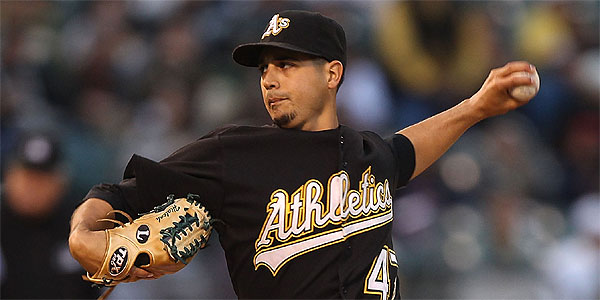
The 2011 Giants: Oakland A’s
The strength of Oakland’s club is its young pitching, led by four pitchers in Gio Gonzalez, Brett Anderson, Trevor Cahill and Dallas Braden, who are all 27 or younger. If that sounds familiar, it’s because the Giants won the World Series last year with four pitchers (Tim Lincecum, Matt Cain, Jonathan Sanchez and Madison Bumgarner) who were all 27 or younger. The Giants also had an offense that would hardly keep opposing pitchers up at night but after GM Brian Sabean re-signed Juan Uribe and added guys like Cody Ross and Pat Burrell during the year, it was enough to be dangerous. Just like SF’s offense last year, Oakland’s bats aren’t going to scare anyone but after the offseason additions that Billy Beane made this offseason (Hideki Matsui, Josh Willingham and David DeJesus) they’re enough to be dangerous. And just like the Giants, if they can reach the postseason (where pitching matters most), the A’s might be able to do some damage.

Continue reading »

What kind of point guard WAS he?

My post from a few days ago was relatively well-received at reddit, and one of the readers there said that he’d like to see the same graph for some of the all-time great point guards.

So with a little help from Basketball-Reference.com, I compiled a list of (all?) the Hall of Fame point guards: Oscar Robertson, Lenny Wilkens, Bob Cousy, Jerry West, John Stockton, Isiah Thomas, Magic Johnson, Dennis Johnson, Tiny Archibald, Calvin Murphy, Pete Maravich and Walt Frazier. Unfortunately, the NBA didn’t start keeping track of turnovers until the 1977-78 season, so there’s no assist-to-turnover data for the first four (Robertson, Wilkens, Cousy, West) and the data for Archibald, Murphy, Maravich and Frazier is incomplete, so I could only use their post-1977 numbers.

I also compiled a list of the top non-HOF point guards who are both retired and still active: Jason Kidd, Mark Jackson, Steve Nash, Gary Payton, Rod Strickland, Maurice Cheeks, Terry Porter, Tim Hardaway, Andre Miller, Muggsy Bogues, Kevin Johnson, Derek Harper, Stephon Marbury (yes, Stephon Marbury), John Lucas, Norm Nixon, Mookie Blaylock, Sam Cassell, Avery Johnson, Baron Davis, Nick Van Exel, Allen Iverson, Chauncey Billups and Mike Bibby. All of these players have at least 5,400 career assists, which seemed to be the cutoff for players I was interested in using for this study.

Lastly, I added seven of the top current point guards who have yet to break the 5,400-assist barrier: Tony Parker, Stephen Curry, Russell Westbrook, Rajon Rondo, Derrick Rose, Deron Williams and of course, Chris Paul.

I first tackled this subject two years ago, and settled on the shot-to-assist ratio to determine whether a player is “pass-first” or “shoot-first.” The higher the number, the more of a “shoot-first” player he is. To determine whether or not a player is “turnover-prone,” I calculated each player’s assist-to-turnover ratio. The higher the number, the better the player is at taking care of the ball, relative to what he’s asked to do as a playmaker for his team. The graph takes a gentle downward slope because assists are part of both calculations. (Note: While I do like FGA/A as the criteria for shoot-first/pass-first, I am not completely sold on A/TO as the criteria for turnover-prone. Perhaps (A+FGA)/TO would show shoot-first guards in a better light? Maybe I’ll try that next year.)

Continue reading »

« Older posts Newer posts »