Page 1812 of 2956

Julius Peppers unlikely to become a Patriot

Despite a report yesterday by NFL.com’s Vic Carucci, the NFL Network’s Adam Schefter and NBCSports’ Tom Curran says that the Panthers are unlikely to trade Julius Peppers to the Patriots.

Julius PeppersCommunicating with two sources close to the “Peppers to Patriots” sandstorm that blew up suddenly Monday afternoon, I’ve learned…
1. Julius Peppers would indeed be interested in playing for the Patriots.
2. It’s a virtual certainty that he will not.

The sources, obviously coming from different sides of the issue, didn’t go into greater detail beyond what I’ve shared .. no talk about contracts, salary cap, compensation back to Carolina or fits in the Patriots defensive scheme. That is, as they say, what it is.

While the unlikelihood of the pieces falling together was something I looked at last night, Adam Schefter of NFL.com and the NFL Network was a morning guest on Boston’s WEEI and poured the first bucket of ice water on the notion.

Turns out – as it often does – Schefter was pretty accurate.

I wrote yesterday that since NFL.com was reporting the rumor, that the deal would likely get done. But I guess if it doesn’t come out of Schefter’s mouth, it probably isn’t true. Carucci doesn’t come off looking to good here.

How are the officials assigned for March Madness?

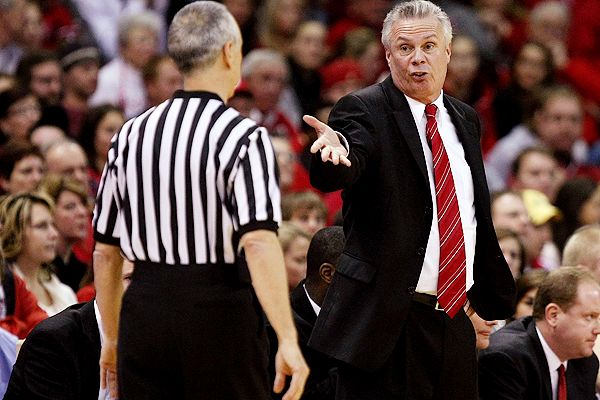
As part of Pat Forde’s latest column, he describes how the NCAA coordinator of officials assigns referees to work each game.

The Minutes caught up with NCAA coordinator of officials John Adams (48) last week to see how he will be viewing the tournament and his refs’ role in it.

On Friday at 5 p.m., the NCAA e-mailed the 96 officials who will be working the tournament to tell them they’re in. At 5:45 p.m. Sunday, Adams got an advance copy of the bracket and began slotting in crews for individual games — he’d already decided which crews were going to which sites. The job of matching crews to specific games is largely an effort to ensure there is no potential conflict of interest — putting two refs who do a preponderance of SEC games on an LSU game, for instance.

On Sunday night, the tournament site managers will get on the phone and call the officials coming to their subregion, informing them whether they’re working just one day or two. Adams, who wants to get some new blood moved into the elite ranks of officiating, said at least 10 rookies will get the call.

On Tuesday at 6 p.m., Adams will have a conference call with his refs. He’ll go over general issues and protocol — when it’s OK to look at a monitor, when it’s not, etc. And he’ll remind them of the points of emphasis that have been in place all season: traveling, illegal screens, block/charge calls, etc. He’ll reiterate that they should keep conversations with coaches to a minimum.

“We’ve spent all year getting ready for this,” said Adams, who has seen 67 games in person and countless more on TV.

Then the refs go do their thing, and Adams hunkers down in Indianapolis with NCAA staffers Greg Shaheen and Tom Jernstedt in front of a bank of televisions to watch them work. In concert with tournament administrators at every site, they’ll determine which refs keep working and which go home.

The on-site administrators will fill out rating cards on every ref with one of three judgments: strongly recommend to advance; recommend to advance; do not recommend to advance. Those cards will be sent to Adams.

The group will be cut from 96 to 48 to 36, and ultimately to nine for the Final Four — three for each game. Just like the teams, they’re all striving to advance.

“It’s very competitive,” Adams said. “They’re all trying to get to Detroit.”

Adams will be watching to see who handles the pressure of close games and heavy scrutiny. He knows basketball officials are subject to more second-guessing than ever.

“It’s hard to keep a secret anymore,” he said. “If you make a mistake, everyone sees it replayed. The media and so many people can see these games, and so many are close.

“To some people it’s rarely the kid who screws up, it’s the referee. It works better that way.”

In many ways it’s a thankless task, but it has its rewards. For nine men, the reward is a trip to the Final Four. Adams is watching to determine which nine earn it.

It’s interesting how the competition for the officials mirrors that of the players. It also seems that the officiating on the college level is far superior than that of the NBA. Why is that?

Hunting for giant killers

ESPN’s Peter Keating lists a few upset possibilities…

No. 13 Portland State (17.6 percent) vs. No. 4 Xavier (62.7 percent)

Portland State, whose adjusted statistics are only about as impressive as Iowa State’s or St. John’s, isn’t the ideal killer. But Xavier is a textbook example of a giant waiting to be slain by just about anyone: The Musketeers turn the ball over considerably more often than they generate turnovers (21.9 percent vs.18.9 percent of possessions). They are heavily reliant on making more free throws than opponents (9.1 FT margin per 100 possessions), which is always a concern in a one-and-done scenario. And they don’t score enough to blow past their flaws (adjusted offensive efficiency of 111.3). Considering everything working against Xavier, and the fact that Portland State at least has a puncher’s chance, according to our model, this is as good an upset pick as you’ll find in the first round.

No. 11 Temple (32.6 percent) vs. No. 6 Arizona State (27.9 percent)

The Sun Devils play sloooow (61.2 possessions per game, by far the fewest among giants), which means James Harden (20.8 ppg) is even more impressive than he looks. But ASU doesn’t grab offensive rebounds (30.6 percent of possessions, 250th in the country). And they give opponents too many open looks from 3-point land (27.4 percent of all field goals). Temple, on the other hand, keeps foes off the offensive glass, doesn’t turn the ball over and doesn’t rely on free throws to outscore opponents. Also, our model can’t distinguish between dominating scorers who can carry a team through the postseason and those who can be stopped as soon as they run into a good opponent, but senior guard Dionte Christmas certainly was the former in the Atlantic 10 tournament.

I don’t advocate picking either of these underdogs. Arizona State is playing good basketball and I think Xavier will have enough to get past the first two rounds. But it’s interesting to see that someone has developed a formula to predict these upsets. We’ll see how it fares.

2009 MLB Preview: #29 Washington Nationals

Click Here to see Previews of all 30 MLB Teams

Offseason Movement: Perhaps the Nats’ biggest addition was 1B/OF Adam Dunn, who will add some pop to the lineup, as well as a fair amount of strikeouts. Washington also acquired OF Josh Willingham and LHP Scott Olsen in a trade with the Marlins and signed free agents Daniel Cabrera, Alex Cintron and Javier Valentin. In the deal to land Willingham and Olsen, the Nationals agreed to send 2B Emilio Bonifaci, INF Jake Smolinski and RHP P.J. Dean to Florida.

Top Prospect: Jordan Zimmerman, RHP
Zimmermann is a serious Rookie of the Year candidate and is turning in a fantastic spring. As of this writing, he has allowed only six hits, two walks and has struck out 16 batters over 12 1/3 scoreless innings. He seems to be over shadowed on a national level, but that’s mostly because the Nationals have yet to officially hand him a spot in the starting rotation. But that should change soon and as long as he doesn’t let the bright lights of the Big Leagues eat him alive, the 22-year old could be a future star.

Continue reading »

Four observations about the East Region

1. Duke is better, but they’re still not good enough.
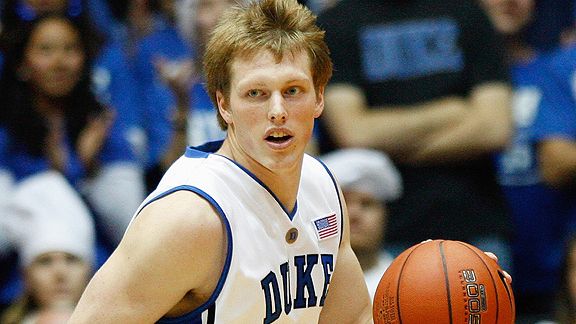
Truth be told, Duke is my favorite team and has been since the days of Johnny Dawkins. But they haven’t had a legit post presence since Carlos Boozer and Coach K has hitched his wagon to the three-ball. The Blue Devils are looking a lot better now that they inserted Elliot Williams into the starting lineup. And now that Nolan Smith is back from missing some time with a concussion, Duke can throw an athletic, perimeter-oriented lineup at their opponent. If Gerald Henderson, Kyle Singler and Jon Scheyer (who is playing great now that he’s running the point) are all on their games, the Blue Devils are tough to beat, but if they run into Pittsburgh in the regional final, they might be in trouble. The only time Pitt loses is when DeJuan Blair gets into foul trouble — he averaged 4.8 fouls in Pitt’s four losses — and Duke just doesn’t have the post presence to challenge him down low. The Blue Devils might have to run Singler at center and hope that he can get a couple of cheap ones on Blair early in the game. And Duke will be challenged before then — Texas and the potential UCLA/Villanova winner are more than capable of sending the Blue Devils home early.

2. The Florida State/Wisconsin matchup is a clash of styles.

I’m not sure what to make of the Seminoles. They flew under the radar all season before upending a Ty Lawson-less North Carolina in the ACC tourney semis. Then looked as if they were asleep for much of the first half of the championship game against Duke. How will they react to flying to Boise to play the Badgers, who love to grind the game to a halt and play tough, fundamental defense? This one might come down to the officials. If they let the two teams play, that should work in Wisconsin’s favor, as they’re used to the physical Big 10 style. But if they call it tight, the Seminoles should be able to get into the lane whenever they want.

3. Good luck beating Villanova in Philly.
Of all the top seeds, the Wildcats are the only team that is actually playing the first two rounds in their hometown. (Okay, nitpickers, Villanova is actually located in Radnor Township, a Philadelphia suburb. Big difference.) If they can get by American University in the opening round, they should have a sizable home court advantage against potential second round opponent UCLA, who is going to have a tough time getting its frontrunning fans (yeah, I said it) to travel cross country.

4. Pitt has what it takes, except tournament experience.
The Panthers have three great weapons at their disposal. Senior point guard LeVance Fields dishes out 7.6 assists per game and can score when he has to, senior swingman Sam Young is averaging 18.7 points and 6.1 rebounds per game, and sophomore big man DeJuan Blair is a double-double machine. But in their last three tournament appearances, the Panthers haven’t advanced past the Elite Eight, losing in the Sweet Sixteen twice. Now that his team has a #1 seed, can Jamie Dixon get Pittsburgh over the hump and into the Final Four? I’m betting my bracket on it.

« Older posts Newer posts »