Page 1708 of 2957

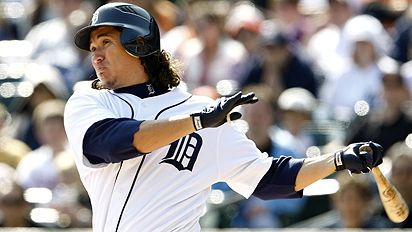
Could the Tigers release Magglio Ordonez?

Michael Rosenberg of the Detroit Free Press speculates that if Magglio Ordonez doesn’t start hitting soon, the Tigers could eventually release him this season.

It may be too early to bench or release Ordoñez , but it’s not too early to wonder about him. Here are some of Ordoñez’s numbers entering the Tigers’ game in Minnesota Tuesday night: .241 batting average, 108 at-bats, three extra-base hits, sixth in the batting order, 35 years old. I mean, the numbers could be worse. His cholesterol level could be 500. But those numbers are disturbing.

It’s not too early to ask questions. And with Ordoñez in 2009, the biggest question is this: Will he stay in the lineup?

It is a $30-million question.

At the end of this season, the Tigers will either pick up an $18-million option on Ordoñez or pay him a $3-million buyout. The Free Press Math Department tells me that’s a $15-million difference. Then there is another $15-million option for 2011.

I doubt the Tigers want to pay Ordoñez $30 million when he is 36 and 37 years old. Manager Jim Leyland has already dropped him in the lineup and started to remove him for defensive purposes. You don’t do that if a guy is worth $15 million a year.

But getting out of this contract is like getting out of the little island of Manhattan at rush hour: It seems like it should be easy, but it isn’t. Ordoñez’s agent, Scott “I know you hate me, but give me an hour and I’ll get you to pay me to hate me” Boras, negotiated trigger clauses into this deal. If Ordoñez has 135 starts or 540 plate appearances this season, his 2010 option becomes guaranteed. And if he has 270 starts or 1,080 plate appearances between this season and next, his 2011 option becomes guaranteed.

If Ordonez was hitting well, then it would be foolish for the Tigers to release him just to save money. But he’s currently one of the worst hitters on the team and as the article points out, why continue to play him so he reaches the appropriate amount of plate appearances and therefore assure that his contract is guaranteed? If he continues to struggle, why not release him and save that money so GM Dave Dombrowski can dump it into more productive players next year?

The only issue is whether or not the Tigers would be on the hook for Maggs’ salary if he reaches 135 starts or 540 plate appearances with another team. I would assume they would only be responsible for a certain amount, but I don’t know the details of his contract so I can’t answer that question.
Bill Simmons actually thinks he should get a shot as an NBA general manager

Last year, when the Bucks had a GM opening, Bill Simmons started a campaign to fill the position. Fortunately, the Bucks hired John Hammond.

Fast forward a year, and Simmons is campaigning for the open Minnesota GM job, punctuated by this beauty in his so-called “epic” conversation with author Malcom Gladwell (the guy who thinks all underdogs should utilize the full-court press).

NBA teams rarely, if ever, think outside the box, and that’s one of at least 50 reasons why I could succeed as a GM.

This started out as a semi-joke, but I think over the course of the last year, Simmons’ ego, along with a few thousand emails of support from his readers, have convinced himself that he’s actually qualified to run an NBA franchise.

Look around the league and you’ll find that NBA general managers are usually former players, had front-office experience prior to getting the keys to a franchise, have advanced degrees in business and have an deep understanding of the salary cap and of how the fiscal side of the NBA works. Bill’s greatest strength is his ability to compare an athlete to a character to some random movie from the ’80s. What’s he going to do — sit Kevin Love down and tell him that his game reminds him of Chubby from “Teen Wolf”? How does this get the T-Wolves to the playoffs?

To me, the big question is whether or not Simmons keeps this up. Is he going to campaign for every open general manager position until he gets one (or more likely, dies of old age)? Or is there a certain point when all this I-can-run-an-NBA-team talk becomes so sad that he eventually just gives it up?

There’s no doubt about it — Simmons is an entertaining sportswriter, maybe the best in the stream-of-consciousness/pop-culture business. But he needs a reality check, and there’s no way to give it to him.

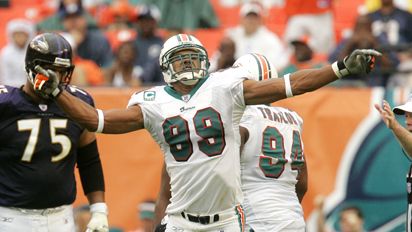
Dolphins bring back Jason Taylor

Free agent defensive end Jason Taylor signed a one-year, $1.1 million contact to re-join the Dolphins. The deal also includes a $400,000 signing bonus.

The deal is a good one for Miami, as Taylor will earn just $1.1 million in base salary, with incentives that could bring him another $400,000. He had been contracted to earn more than $8 million with Washington this season.

Rumors have linked Taylor to Miami since he was let go by Washington earlier this year, but the Dolphins seemed to be unwilling to go that route as they attempted to build their roster through the draft and younger free agents.

But coach Tony Sparano told Joe Rose on 560-AM on Tuesday that, with the draft complete and still lingering needs on defense, the front office would be taking another look at the Taylor situation this week.

“My heart has always been in Miami,” Taylor said in a statement. “I’m truly motivated to call myself a Dolphin again.

This is just another example of Bill Parcells getting the best of a situation. Taylor pissed Parcells off last year when he skipped the Dolphins’ voluntary off-season workouts and stated how he wanted out of Miami. So Parcells found a dope in Daniel Snyder and shipped Taylor to Washington for a second round pick in 2009 and a sixth round pick in 2010. And look how everything turned out – Taylor is back in Miami at a drastically discounted price, the Dolphins drafted Pat White with that second round pick, they still have the sixth rounder in their back pocket for next year and the Redskins are left with nothing.

Parcells wins again.

Celtics’ gamble on Marbury pays off…finally

I missed the start of the fourth quarter of Game 5 of the Celtics/Magic series, but apparently there was a Stephon Marbury sighting. Check out this series from the play-by-play log:

11:22 Stephon Marbury enters the game for Ray Allen
11:04 Stephon Marbury makes 19-foot jumper (Paul Pierce assists)
10:26 Stephon Marbury makes 21-foot jumper (Paul Pierce assists)
8:30 Stephon Marbury makes 24-foot three pointer (Brian Scalabrine assists)
7:56 Stephon Marbury makes 21-foot two point shot
7:16 Glen Davis makes 6-foot hook shot (Stephon Marbury assists)
5:54 Stephon Marbury makes 6-foot two point shot
5:54 Stephon Marbury makes free throw 1 of 1
5:26 Stephon Marbury misses layup
4:54 Rajon Rondo enters the game for Stephon Marbury

That’s 12 points on 5 of 6 shooting, with an assist to Davis. The Celtics didn’t make up any ground during Marbury’s six-and-a-half minute stint — when he entered and exited the game, the C’s were down by the same margin, 10 — but his hot shooting helped Boston avoid disaster. The Magic built a 14-point lead with 8:48 to play, but Marbury’s play helped whittle it down to eight with just under six minutes remaining.

Keep in mind that prior to this hot streak, Marbury had played a total of 138 playoff minutes in 11-and-a-half games, shooting 14 of 55 (25%) from the field and scoring just 36 points. So, yes, his 12-point stint in the fourth quarter was shocking, and the Celtics probably wouldn’t have been able to pull out Game 5 without it.

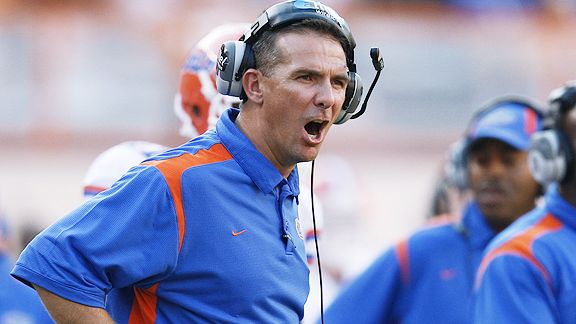
Urban Meyer is a crybaby

“Waaaaaaaaaaaaa! Waaaaaaaaa!”

During a recent Gator Club appearance, Urban Meyer slammed former Florida quarterback Shane Matthews (although he didn’t have the guts to call him out by name) for the way he criticized Meyer’s game plan on a radio show following UF’s loss to Ole’ Miss last season.

“If you want to be critical of a player on our team or a coach on our team you can buy a ticket for seat 37F, you’re not welcome back in the football office,” Meyer said, according to the report. “You’re either a Gator or you’re not a Gator.”

The rift apparently started when Matthews criticized the offense following the 31-30 loss to Mississippi — the game that produced Tim Tebow’s now-famous postgame speech.

“When I watched the Ole Miss game and Ole Miss played our wide receivers about 90 percent man-to-man, it was a slap in the face to our wide receivers and passing game. I can’t understand why we didn’t take advantage of that,” Matthews said at the time, according to the report.

You’re either a Gator or you’re not a Gator? How profound, especially coming from a Midwest guy who didn’t become a Gator himself until after stints at Ohio State, Illinois State, Colorado State, Notre Dame, Bowling Green and Utah. Matthews was a Gator long before Meyer was ever crying about the way Florida is treated.

Former Miami defensive lineman Dan Sileo said it best in the article when he noted:

“Urban Meyer’s not a Gator. He’s a caretaker of the Gator program,” Sileo said. “Most times these coaches think they’re the programs, but really, the program is the players. That’s the problem I have with coaches whose egos get too big for their britches. If Urban doesn’t like it, that’s too bad.”

Meyer is always crying about something and it’s ridiculous for him to say that a former Florida player can’t be critical of the program when they lose a game. Most college coaches have egos the size of Michigan Stadium and they all think that everyone should bow down to “their” program.

What a joke. Matthews is in the media – he’s doing his job. He would be criticized if he didn’t bash the Gators when they deserve it and fans would quickly point out how much of a homer he is.

« Older posts Newer posts »