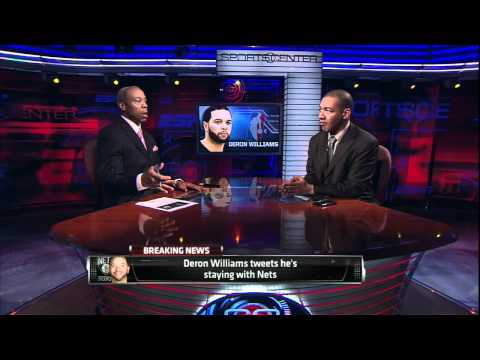
The Nets have to be breathing a sigh of relief, and now they can turn their attention to Dwight Howard.
Page 139 of 2955
 It’s the tenth anniversary of the travesty that was the 2002 MLB All-Star Game. You know, the one that ended in a 7-7 tie and led to the decision that from then on, the winning side in the game would receive home-field advantage in the World Series. Prior to 2003, the year the rule was implemented, home-field advantage alternated between the AL and NL from year to year. It’s one of three separate but inarguably connected rule-based controversies that dog the “Midsummer Classic” year in and year out. The second being that popular fan vote decides the starting hitters for each side. The third is that all 30 teams must have at least one representative in the game.
The rules are linked because what was formerly an exhibition game meant to showcase baseball’s best and brightest (in other words, a money-making scheme) now has actual value. As such, many take issue with the game’s starters being decided based on fans clicking mouses and sticking mini pencils through holes. Equally many argue that requiring a player from each team often leaves superior players off the rosters, which detracts from the notion that the contest spotlights the game’s best.
It’s impossible to gauge the impact of playing the first and last two games of the World Series at home. In the nine years the rule has been in effect, the American League has won the All-Star Game seven times. The AL won the game every year from 2003-2009, but its representatives were only champions in four of those seven years. The rule’s effects were minimal, if it had any, as the World Series never saw a seventh game. But in the past two years, the National League has had home-field. In 2010, the San Francisco Giants quickly won their first two home games, and had the Rangers playing scared en route to a 4-1 series victory. Last year was the first time the Series went seven, and the St. Louis Cardinals won the game, and the series, at home.
Even if it is impossible to truly gauge the effects, if you’re a fan of a contending AL team, does it sit right with you that Billy Butler might be in a position to decide if your team gets home-field advantage with two outs and the bases loaded in the ninth? Or if your team’s in the NL, that Huston Street (who has only pitched 21 innings this season) might have to get that final out? Those are just some examples of the possibilities of the “one from each team” rule. Let’s take a look at who the fans chose, and decide whether they deserve to be starting, or in some cases, even playing.
A year ago right now, Michael Vick was being considered as a top five overall fantasy football draft pick.
Now, he is not even being considered amongst the top five overall fantasy quarterbacks; his overall current ADP is just a remarkable 45th overall.
2011 was a step back for the entire Eagles franchise, not just Vick.
Still, he set a career high in passing attempts (423), yards (3,303), and third highest passing TD total (18). Vick’s 76 carries were his lowest season total as a starter, yet his 7.8 ypc was his 2nd highest.
589 yards from your QB on the ground? That’s 45 YPG, son, as good as many a RB #3.
Sure, w/Vick you’re always going to worry about him missing games. That’s why you grab a QB like Carson Palmer, Ryan Fitzpatrick or Josh Freeman to use in Vick’s week 7 bye or for general use, post-injury, should one occur.
Wake up– Don’t sleep on Mike Vick in 2012.
Paul Eide can be heard dispensing fantasy football advice every Friday AM during the NFL season on Jacksonville’s 930 AM “The Fox” at 8:00 EST. Listen live here. Email Paul at paul@pauleide.com

Photo by Bill Moore. Copyright 2006 Bullz-Eye.com
With the news that Joe Paterno may have been involved in a cover-up at Penn State, here’s a look back on an article that detailed Paterno’s “come back” in 2005 after Penn State officials tried unsuccessfully to ease him into retirement.
This was dug up and highlighted by SPORTSbyBROOKS and it’s instructive on how Paterno had an iron grip of the football program. Nobody would seriously doubt that, but this article fills in many of the details. Paterno told them to go to hell, and then he or someone in his camp likely leaked this story as he spiked the football in their faces. After this story there was no doubt who was the king of Happy Valley, and he would leave on his own terms.
This paragraph also jumped out at me:
He chose unforgiving punishments for players who drank too much or skipped class, like when he cut star wide receiver Joe Jurevicius from the travel roster just before the Citrus Bowl Jan. 1, 1998. Yes, he was willing to worsen his team to strengthen his way. He donated his millions to the school library and his minutes to film study. He pledged simplicity — a blue blazer wardrobe, a modest house. He decided he would never fire an assistant coach, finding it senseless to let one go when he could help make him better. “You showed you were committed to it,” former assistant Kenny Jackson said, “and he’d die with you.”
It’s all painfully ironic now, but the real message here was that Paterno was tough on players and others around the football program when they broke his rules. He was the king.
Read the entire article. It’s actually creepy thinking about it now. The bottom line is Paterno didn’t want to let go, and that singular drive may be what kept him from doing the right thing when the Sandusky allegations were explained to him.
I’m sure this was just a quick reaction, but it’s pretty impressive.
Yet it also seems quite reckless as well.
FOLLOW US!

CATEGORIES
© 2026 The Scores Report – The National Sports Blog
Theme by Anders Noren — Up ↑