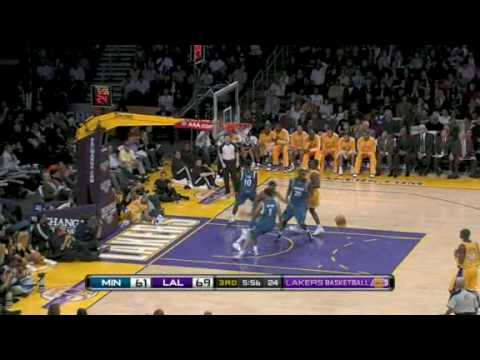
Anyone who doesn’t like Derek Fisher or the Lakers is going to enjoy this one…
Wow…though I will say, it looked like a charge to me.
Anyone who doesn’t like Derek Fisher or the Lakers is going to enjoy this one…
Wow…though I will say, it looked like a charge to me.

The term upset is simply defined as “an unexpected defeat,” but in sports it can mean so much more. For the favorite, it’s about the pressure that comes with heightened expectations. For the underdog, it’s about using those expectations as motivation. As part of our ongoing Decade Debate series, here is a list of the ten biggest upsets of the last ten years. Remember, the magnitude of the stage is just as important as the perceived disparity between the two parties involved, so extra points are given to upsets that occurred in the postseason or in a title game.
10. Federer beats Sampras at the 2001 Wimbledon
By 2001, the sports world had begun to question Pete Sampras’ ability as a dominant tennis player. The man was just 29 years old and the owner of 13 Grand Slam titles, but critics predicted an oncoming collapse. Since winning the Australian Open in 1997, Pistol Pete’s Grand Slam championships curiously only came at Wimbledon. In fact, Sampras had captured all but one Wimbledon championship since his first appearance in 1993. Naturally, if he was a sure bet anywhere, it was at the All England Club. While most will remember this time period as the declining stage of Sampras’ career, it also marked the beginning of Roger Federer’s success as a professional. After winning the Wimbledon juniors in 1998, Federer was often viewed as the likely heir to Sampras’ throne. Still, nobody expected the 19 year-old and the Grand Slam record holder to clash at Wimbledon in 2001. Furthermore, if they did happen to meet, Federer wasn’t supposed to win. Making his Centre Court debut, Federer defeated Sampras 7-6 (7), 5-7, 6-4, 6-7 (2), 7-5, thereby snapping Sampras’ 31-match winning streak at Wimbledon. Sure, it was only a fourth round match, but it symbolized so much more. This is one of the greatest upsets of the decade not simply because Sampras was favored, but because of everything that followed. Sampras would retire in two years and Federer would eventually live up to those wild expectations. And forget about Sampras getting any revenge – the two would never again face each other on the professional level. – Christopher Glotfelty
9. Edmonton upsets Detroit in 2006 Stanley Cup Playoffs
Detroit was a heavy favorite in the quarterfinals, as the top-seeded Red Wings were coming off a terrific 124-point regular season in which they captured the President’s Trophy. Meanwhile, the Oilers squeaked into the playoffs as an #8-seed after a 95-point regular season. The Red Wings won Game 1 in Detroit, but dropped Game 2. The two teams also split the next two games in Edmonton. The Oilers then closed out the series winning Game 5 in Detroit and Game 6 at home, both by one-goal margins. The series featured two double-overtime games (Game 1 & Game 6) and all six games were decided by two goals or less. – John Paulsen

The word comeback is defined as “a return to a former position or condition (as of success or prosperity).” In the world of sports it refers to the act of wrenching victory from the jaws of defeat. As part of our ongoing Decade Debate series, here are the top eight comebacks of the last ten years. Keep in mind that, to us, the actual size of the comeback isn’t quite as important as the size of the stage. In other words, the “greatest” comebacks happened in big games.
8. Capriati over Hingis at 2002 Australian Open
Jennifer Capriati and Martina Hingis led very similar careers. Both set several “youngest-ever” records before a combination of drug charges and nagging injuries challenged their potential. While Hingis chose to bow out at the height of her turmoil, Capriati soldiered onward. In 1994, Capriati was busted for marijuana possession. After a feeble return to the game, she retreated for 15 months. But never say die. By February of 1996, she finally meant business. Over the next two years, Capriati would earn three Grand Slam championships, blossoming into a dominant player during a particularly competitive era in women’s tennis. Of those wins, her match against Martina Hingis in the 2002 Australian Open final is a shoe-in for any list of ultimate comebacks. Down 6-4, 4-0, Capriati miraculously saved four match points, a Grand Slam record. The merciless sun blaring, Capriati kept fighting and fighting. As her opponent wavered, Capriati capitalized, eventually winning the match 4–6, 7–6, 6–2. – Christopher Glotfelty
7. Kings over Red Wings in 2001 Stanley Cup Playoffs
This was a great series comeback as well (Detroit led, 2-0), but the Kings’ rally in Game 4 was one for the ages. Trailing in the series, 2-1, and down 3-0 with just six minutes to play in the third period, the 7th-seeded Kings didn’t look long for the playoffs. But goals by Scott Thomas and Jozef Stumpel trimmed the Red Wings’ lead to one, and Bryan Smolinski’s game-tying goal with 0:53 remaining sent the Staples Center into a frenzy and the game into overtime. There, the rookie Eric Belanger capped off the “Stunner at Staples” with the game-winning goal. The Kings went on to win the series, 4-2. – John Paulsen

Controversy brewed during the Orlando Magic’s 120-111 loss to the Utah Jazz on Thursday night when power forward Rashard Lewis said he declined to go back in the game during the second quarter.
Coach Stan Van Gundy was upset and said he had never had a player overrule him.
“(Lewis) didn’t want to go back in. I wanted to put him back in with six minutes to go in the second quarter and he didn’t want to go back in,” Van Gundy said after the Magic (17-5) had their six-game winning streak broken. “He said it was because he had two fouls, and so if you have a guy who doesn’t want to play, I’m not going to get in an argument and put him back in if he doesn’t want to play at that time.
He said, `I’m going to back in and be out in three or four minutes and Ryan (Andersonn) is playing good.’
“I didn’t have time to get into it. It’s rare and I’ve never had that in the first half of a game. I was a little baffled by it.”
Lewis confirmed the story, but said that he wasn’t being defiant. He already had two fouls and he thought that his replacement, Ryan Anderson, was playing really well.
However…

When it comes to the rookie class, Brandon Jennings has dominated the headlines, and for good reason. His 55-point outburst against Golden State was quite the coming out party and his 22.1 ppg average in November was far and away tops amongst rookies, right?
Not so fast.
Rather quietly, Tyreke Evans has put together a nice month and a half. Here’s a comparison:
Jennings: 21p, 6a, 4r, 42% FG, 44% 3PT, 1.1s, 3.0t
Evans: 20p, 5a, 5r, 46% FG, 26% 3PT, 1.5s, 3.0t
Aside from Jennings’ superior accuracy from long range, those numbers are pretty similar. Evans has been playing more off guard since Kevin Martin has been sidelined, but the Kings are still starting him at the point. In December, he’s averaging 24-5-6 and is shooting 51% from the field. After his hot start, Jennings has cooled off, averaging 19-3-6 this month, while shooting just 39% from the field. He has only hit 9 of 31 threes in December (29%).
The Kings are a surprising 9-12, while the Bucks are a less surprising 10-11. Evans is much stronger and is probably better suited to the rigors of an NBA season (though it should be noted that he has missed a game this season, while Jennings has not). Meanwhile, Jennings attacks the defense with quickness using more of a finesse game (pull up jumpers, crafty layups, teardrops) to score. It’s going to be interesting to see these two guards battle for status as the ROY frontrunner, and what happens when Blake Griffin returns. Also, can Evans keep up this pace with Kevin Martin back in the lineup?
We will see.

© 2026 The Scores Report – The National Sports Blog
Theme by Anders Noren — Up ↑