Category: NBA Draft (Page 11 of 55)

Teams that could take Evan Turner over John Wall

For most of the collegiate season, it looked like John Wall was the only player deserving of the #1 pick — like a franchise would be crazy not to take him if it won the lottery. But as Evan Turner has come on — 20-9-6 with 52% shooting — and is pushing Wall for the Naismith award, it has become a reasonable possibility that a team that already has a good point guard might pass on Wall and take Turner (who projects to play off guard or small forward in the NBA) instead.

David Thorpe lists the Timberwolves (Jonny Flynn, Ricky Rubio), Warriors (Monta Elllis, Stephen Curry), Kings (Tyreke Evans), Sixers (Jrue Holiday), Jazz (Deron Williams) and the Bulls (Derrick Rose) as teams with lottery picks that could potentially go with Turner over Wall.

Wall is two years younger and doesn’t have Turner’s injury history. (Turner broke his back earlier in the season. Yeah. Broke his back.) The two shoot about the same from three-point range and are both good playmakers. To me, they both resemble Dwyane Wade, though Turner is longer and Wall is more athletic (of the two).

This is no indictment of Wall. Turner has played himself into this position with a brilliant season. Wall is two years younger so he has more upside, but they both project to be great NBA players, so if a franchise is already sitting on a very good point guard, it makes some sense to go with Turner.

Is Evan Turner nipping at John Wall’s heels?

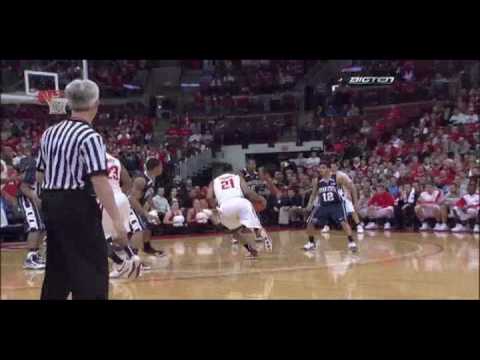
This is a pretty good highlight video that tells the story of Evan Turner’s 2009-10 season, which began with a broken back.

Most pundits believe John Wall will be the #1 overall pick in the 2010 NBA Draft, but Evan Turner is coming on. He is averaging 20-9-6 and is shooting almost 54% from the field. His range is questionable (29% from 3PT), but he’s a force when he goes to the basket. DraftExpress compares him to Brandon Roy, but with the limited range, he reminds me of a taller Dwyane Wade. Turner is 6’7″ while Wade is 6’4″.

Kyle Singler’s problem is positional

Let’s not go off the deep end here. Duke junior Kyle Singler is still having a good year. He’s averaging 17-7-2 and is shooting 38% from long range. Those numbers are virtually identical to his sophomore season. The difference is in his overall FG%, which dropped from 44.1% last season to 40.7% this year.

Having watched at least half of Duke’s games this season — including last night’s 79-72 loss to Maryland — I think Singler is struggling with his accuracy because he is now playing a ton of minutes at small forward. Over his first two seasons, he played mostly power forward and even some center, and while he was at a disadvantage on Duke’s defensive glass, he had a big advantage on the offensive end.

Singler is a classic face-up forward. He has a very nice perimeter game in that he is accurate from long range and can take it to the basket when he gets his defender out of position. And over his first two seasons, he faced a lot of opposing 4s and 5s that weren’t comfortable covering someone on the perimeter. This season, in addition to Lance Thomas, Duke is giving big minutes to Brian Zoubek, Miles Plumlee and Mason Plumlee, which means that Singler is playing more small forward than ever. This allows the defense to cover him with their own small forward, who is generally quicker and far more comfortable defending on the perimeter.

As a result, Singler is getting far fewer good looks on penetration than he has in years past. During his first two seasons, it was relatively easy to get a bigger defender out of position on the wing and drive past him for a layup or short jumper. Now, his defenders are sticking with him on those drives and forcing tougher shots. Hence, the reduction in field goal percentage.

Duke certainly has more size this season, and that’s helping on the glass, but it’s hurting Singler’s efficiency on the other end of the court. It’s a trade-off that Coach K is apparently willing to live with, but I’m guessing that if Singler shoots 41% or less in the NCAA tournament, the Blue Devils won’t be making a Final Four appearance this season.


Photo from fOTOGLIF

Evans on pace for 20-5-5 season

In his NBA Awards Watch, ESPN’s Maurice Brooks notes that Tyreke Evans is on pace to join LeBron James, Michael Jordan and Oscar Robertson as the only first-year players to average 20 points, five rebounds and five assists in a season. (Note: Evans is actually averaging 20.5-4.9-5.4, but he averaged 5.8 rebounds in February, so if he keeps that up, he shouldn’t have any problem averaging five boards a game.)

Unfortunately, this fine play has not translated to wins. The Kings have lost 25 of their last 32 games, and are now just 20-40 on the season.

Still, it makes me wonder how a 2009 NBA Draft Re-Do would go. The last one I saw still had Blake Griffin going #1 with Evans going #2. Would the Clippers really pass on a player like Evans — who really could have been named to the All-Star Game in his rookie season — for Griffin, knowing that the former Sooner was going to miss his first year with a knee injury? Griffin still projects to be a star, but Evans is the proverbial “bird in the hand” at this point, isn’t he?

In his ROY race, Brooks ranks Stephen Curry second (22-5-7 in Feb) and Darren Collison third (22-4-8 in Feb). Brandon Jennings (11-4-6, 31% shooting in Feb) has lost his touch and is ranked fourth. DeJuan Blair (11-5, 60% shooting in Feb) comes in fifth, but if Antonio McDyess misses any time with a sore knee, Blair should get some extra minutes.

In my Top 10 Head Scratchers of the 2009 NBA Offseason, I wrote the following about Blair:

10. Six teams pass on DeJuan Blair IN THE SECOND ROUND!
When I first heard that there were concerns about Blair’s knees, I thought he might fall into the bottom third of the first round. Even if the guy is missing ligaments in his knees, he was still one of the best rebounders in all of college basketball last season and he ate up #2 pick Hasheem Thabeet in Connecticut. When Blair fell into the second round I was stunned as the Kings, Wizards, Blazers, Nuggets, Pistons and Grizzlies all passed on Blair. A second round pick doesn’t require the same kind of financial commitment as a first round pick, so there’s very little downside if the guy doesn’t pan out. Blair fell and fell, right into the inviting arms of the Spurs, who will be lucky to have him on the roster for the foreseeable future.

Teams just could get their heads around the fact that Blair has no ACLs in his knees. While I sort of understand not wanting to commit first round money, it doesn’t make any sense for the aforementioned teams to pass on him in the second round, where there is very little financial investment. This goes double for the two “contenders” on that list — I’m looking at you Portland and Denver — who should be worried about the short term and not the long term impact of their second round picks. Blair would give the Nuggets some much needed toughness, and he’d sure help in Portland, where half the front line is out for the season with injury.


Photo from fOTOGLIF
Kahn: Rubio is coming to Minnesota

Minnesota GM David Kahn thinks that Ricky Rubio will likely come to Minnesota in a year and a half.

“We developed a very solid relationship with his representatives, and more importantly, perhaps, his family, this past summer,” he told Abbott. “It wasn’t an issue of him having any concern about Minnesota whatsoever. I think at the end of the day he just felt that him having a couple more years in Europe would be the smart and prudent thing for him to do. He had a lot of input from his Spanish National team members, who all think he can play here, but also thought that a few more years of development would help him. I don’t have any reason not to think that’s true, either.”

I don’t know if Kahn is just toeing the company line or if he truly believes that Rubio wants to play in Minnesota, but if he really didn’t think he was ready to play in the NBA, why did he put his name into the draft in the first place? Obviously, something happened on draft night (or thereafter) that convinced Rubio that he should stay in Europe. Prior to the draft, it looked like he was a sure bet to play in the NBA this season. The only thing that changed was that he was drafted by the Minnesota Timberwolves. Suddenly, he’s signing a two year contract with another team in Europe.

On paper, Rubio to Minnesota is a nice fit, but when you look at the T-Wolves’ stars — Al Jefferson and Kevin Love — a wide-open offensive attack doesn’t spring to mind. However, they are tied with the Suns for third in overall pace (98.2 possessions per game) so someone is telling these guys to push the ball. I wonder if that’s designed in part to convince Rubio to come to Minnesota.


Photo from fOTOGLIF

« Older posts Newer posts »