Category: Fantasy Basketball (Page 5 of 274)

Video of Lakers/Mavs fight

From NBA.com…

Lakers guard Steve Blake was driving to the basket, only to have Jason Terry shove him out of bounds. Matt Barnes tried to get into the mix and shoved Terry. Mavericks assistant coach Terry Stotts, who tried to restrain Barnes, was then shoved into a courtside spectator by Barnes, who kept screaming “get off of me.” When the dust settled, Terry, Blake, Barnes and Mavericks center Brendan Haywood were ejected. Minutes later the game had to be stopped when a spectator was kicked out of Staples for fighting and then another spectator tried to run onto the court, but was tackled by security before he could. In the final two minutes of the game, Lakers guard Shannon Brown was ejected when things got chippy between him and Mavericks forward Brian Cardinal.

If the Lakers aren’t able to catch the Spurs, there’s a good chance that these two teams will meet in the second round of the Western Conference Playoffs. If that’s the case, it looks like it will surely be a testy series.

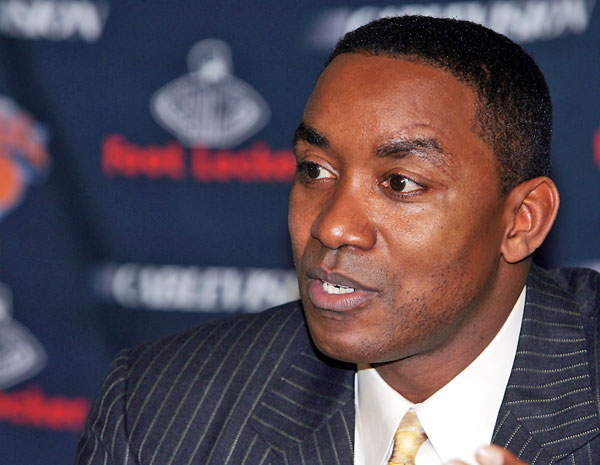
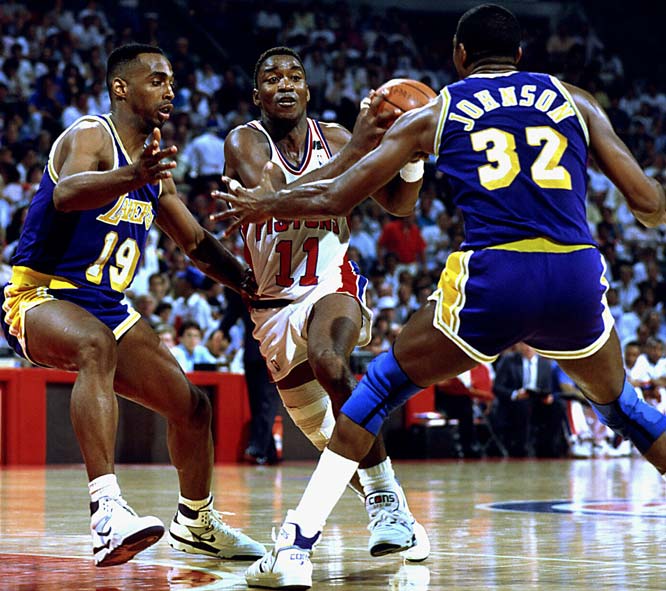
Isiah Thomas believes that inch-for-inch, he was better than Jordan, Magic and Bird

In an interview with FoxSports Bill Reiter, Isiah Thomas spoke about how his game compared to those of Michael Jordan, Magic Johnson and Larry Bird. His comments are surprising, to say the least.

“I have no problem saying this at all,” he says. “[Magic Johnson and Larry Bird are] all 6-(feet)-9 and Jordan was 6-6 and a half. If they were all 6-1, it wouldn’t even be a question. They wouldn’t even f—ing rate. If they were all my size, s—, they wouldn’t even be talked about.

“I beat the s— out of them when they were that big. If we were all the same size, f—.” He stops to laugh good-naturedly. “Make them 6-1 and let’s go on the court.”

In basketball, there’s an obvious advantage to being tall, but if it were the only (or even driving) quality necessary to be great, Gheorghe Mureşan would have been a Hall of Famer.

Little guys have an advantage in quickness and bigger guys are closer to the rim. Isiah used his quickness to get by bigger defenders, while Jordan, Magic and Bird used their size to dominate smaller players.

Had MJ, Magic or Bird been 6-1 or 6-2, they still would have been great players. They wouldn’t have been as big, but that wouldn’t affect their ability to shoot the ball or find the open man. Isiah complaining about their height no different than if they complained about Isiah’s quickness. If you’re in the NBA, you’re gifted one way or another.

Thomas says in the piece that he’s terrible at public relations, and this is another example. But the guy can evaluate talent. The Knicks drafted pretty well under his tenure — David Lee, Wilson Chandler, Trevor Ariza, Channing Frye — and he helped the Raptors settle on Marcus Camby, Damon Stoudemire and Tracy McGrady. I doubt he would accept such a role, but Thomas would make a great VP of player personnel.

The article is really about Isiah’s exile, and Reiter mentions Thomas’ abilities in the area of player evaluation as a possible way back into the league:

In 2009, ESPN used the Estimated Wins Added stat, developed by respected basketball mind John Hollinger, to judge 20 years worth of general managers. Isiah was ranked the second-best evaluator of talent…

It will be interesting to see what the future holds for Isiah, who can’t seem to stay out of his own way, PR-wise. He has talents that could be useful to NBA teams, but there is so much baggage and ego that goes along with him that it just makes it easier for teams to go another direction. However, Knicks owner James Dolan does like him, so there’s always a chance that he could end up in New York again.

Just don’t let him participate in any trade discussions.

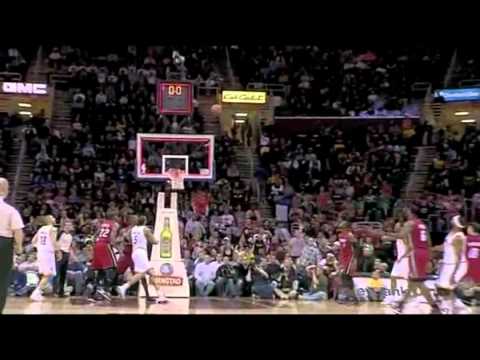
Cavs get some measure of revenge on LeBron, Heat

A 14-win team doesn’t have much to play for this time of year, but give the Cavs credit, they showed up on Tuesday night to face LeBron, riding a thirsty crowd to a 102-90 victory.

The Cavs led by 23 points with 5:06 remaining in the third quarter, but the Heat went on a 22-4 run to close the quarter and cut Cleveland’s lead to five at the break.

Mike Bibby’s seventh three-pointer of the game tied the score at 83-83, but the Cavs went on a 12-0 run (sparked by Luke Harangody of all people) that included four points from Ryan Hollins and six points from Anthony Parker.

LeBron finished with a 27-10-12 triple-double, but the Cavs had the last laugh, breaking the Heat’s five-game winning streak and knocking Miami out of a tie with Boston for the #2 spot in the East.

As a side note, Chris Bosh had another clunker, shooting just 5-of-14 from the field for 10 points to go along with four rebounds and four assists. He was thoroughly outplayed by J.J. Hickson (21 points, 12 rebounds) and Hollins (13 points, three blocks). Bosh was coming off seven double-doubles in his last eight games, but his performance in tough environments on the road is something to keep an eye on.

Here are the highlights:

What kind of point guard WAS he?

My post from a few days ago was relatively well-received at reddit, and one of the readers there said that he’d like to see the same graph for some of the all-time great point guards.

So with a little help from Basketball-Reference.com, I compiled a list of (all?) the Hall of Fame point guards: Oscar Robertson, Lenny Wilkens, Bob Cousy, Jerry West, John Stockton, Isiah Thomas, Magic Johnson, Dennis Johnson, Tiny Archibald, Calvin Murphy, Pete Maravich and Walt Frazier. Unfortunately, the NBA didn’t start keeping track of turnovers until the 1977-78 season, so there’s no assist-to-turnover data for the first four (Robertson, Wilkens, Cousy, West) and the data for Archibald, Murphy, Maravich and Frazier is incomplete, so I could only use their post-1977 numbers.

I also compiled a list of the top non-HOF point guards who are both retired and still active: Jason Kidd, Mark Jackson, Steve Nash, Gary Payton, Rod Strickland, Maurice Cheeks, Terry Porter, Tim Hardaway, Andre Miller, Muggsy Bogues, Kevin Johnson, Derek Harper, Stephon Marbury (yes, Stephon Marbury), John Lucas, Norm Nixon, Mookie Blaylock, Sam Cassell, Avery Johnson, Baron Davis, Nick Van Exel, Allen Iverson, Chauncey Billups and Mike Bibby. All of these players have at least 5,400 career assists, which seemed to be the cutoff for players I was interested in using for this study.

Lastly, I added seven of the top current point guards who have yet to break the 5,400-assist barrier: Tony Parker, Stephen Curry, Russell Westbrook, Rajon Rondo, Derrick Rose, Deron Williams and of course, Chris Paul.

I first tackled this subject two years ago, and settled on the shot-to-assist ratio to determine whether a player is “pass-first” or “shoot-first.” The higher the number, the more of a “shoot-first” player he is. To determine whether or not a player is “turnover-prone,” I calculated each player’s assist-to-turnover ratio. The higher the number, the better the player is at taking care of the ball, relative to what he’s asked to do as a playmaker for his team. The graph takes a gentle downward slope because assists are part of both calculations. (Note: While I do like FGA/A as the criteria for shoot-first/pass-first, I am not completely sold on A/TO as the criteria for turnover-prone. Perhaps (A+FGA)/TO would show shoot-first guards in a better light? Maybe I’ll try that next year.)

Continue reading »

What kind of point guard is he?

The Chicago Bulls’ Derrick Rose shoots a free throw while playing the San Antonio Spurs during the fourth quarter of their NBA game in Chicago February 17, 2011. REUTERS/John Gress (UNITED STATES – Tags: SPORT BASKETBALL)

We hear it all the time. NBA analysts call one point guard “pass-first” and another “shoot-first.” Or they say one guy is “turnover-prone” while another “takes care of the ball.” But really, what makes a player a “pass-first” point guard? How carefree must he be with the ball to be considered “turnover-prone”?

I first tackled this subject two years ago, and settled on the shot-to-assist ratio to determine whether a player is “pass-first” or “shoot-first.” The higher the number, the more of a “shoot-first” player he is. To determine whether or not a player is “turnover-prone,” I calculated each player’s assist-to-turnover ratio. The higher the number, the better the player is at taking care of the ball.

I narrowed the list of players to 33, one for each team plus a few extra for teams like Cleveland, Sacramento and Denver, who have a couple of players manning the position. I also added eight prospects (indicated in green) just to see where a few of the younger guys land. Here’s the graph — it’s small, but if you click it, you’ll get to a bigger version:

So the pass-first/shoot-first aspect goes left to right, and the turnover-prone players will be towards the bottom, while the guys that take really good care of the ball will be up top. Players indicated with a blue diamond are in the Top 10 in this group in Efficiency Per Minute. I set the axis for each category at the average of the 33 players in question, so 1.97 for FGA-to-assist and 2.70 assist-to-turnover.

Two years ago when I conducted this study, seven of the top 10 EPM performers were in the top left quadrant (pass-first, takes care of the ball). This year, only five of the top 11 (I included both Rondo and Calderon, since they tied for #11) are in that quadrant. This is due to the emergence of three shoot-first, (fairly) turnover-prone guards who are emerging as stars: Derrick Rose, Russell Westbrook and Stephen Curry.

A few takeaways:

Continue reading »

« Older posts Newer posts »