Author: John Paulsen (Page 52 of 937)

What is a “pegged” cap and why should you care?

DeMaurice Smith, NFL Players Association Executive Director, makes a statement after negotiations collapsed between the National Football League (NFL) and National Football League Players’ Association (NFLPA) in Washington on March 11, 2011. The last real hope for a quick end to the dispute ended when the union representing the players (NFLPA) filed a court application to dissolve itself after failing to reach an agreement with league and owners over a range of issues. REUTERS/Joshua Roberts (UNITED STATES – Tags: SPORT FOOTBALL EMPLOYMENT BUSINESS)

The latest scuttlebutt out of the NFL labor non-negotiation negotiations is the idea of a “pegged” cap, which was reportedly brought up by the players. A pegged cap is a stable salary cap that is based on revenue projections and goes up at a set amount each season. The last CBA had a salary cap based on actual annual revenue that could go up or down each year depending on which way the wind was blowing.

Why does this matter?

Pro Football Talk’s Mike Florio explains…

If the actual numbers come in lower, the players still get paid. One major area of dispute has arisen from the question of whether and to what extent the actual performance exceeds the projected revenue growth. The owners’ offer of March 11 omitted that wrinkle; the players want to share in the upside.

The players, we’re told, prefer a “pegged cap” approach to expense credits because it entails simpler auditing and fewer disputes.

I’m on the players’ side in this debate, but if they are getting guaranteed pay no matter how the league is actually doing, then they can’t really demand a substantial share of the upside. If they have no downside, why should they get considerable upside?

Of course, it all depends on the projections used to create the pegged cap. If they’re conservative, and revenue is very likely to be greater, then the players do deserve a share. If the projections are aggressive, then the players should be happy they have stable salaries with no downside and forget about trying to get a piece of the additional revenue.

Florio continues…

As of right now, the two sides are $10 million apart per team on the the “pegged cap” approach, which is driven by projected revenues. The owners have offered $141 million per team in salary and benefits, and the players have requested $151 million. If they can bridge the gap and devise a procedure for handling any excess growth, they should be able to do a deal fairly quickly.

Well, that’s awfully optimistic given the current status of the negotiations, which are at a standstill. The two sides need to get talking again, but that is unlikely since they’re waiting on the courts to decide the fate of the lockout.

Tick-tock, people! (Don’t they know I have fantasy football rankings to put together?)
Cavs get some measure of revenge on LeBron, Heat

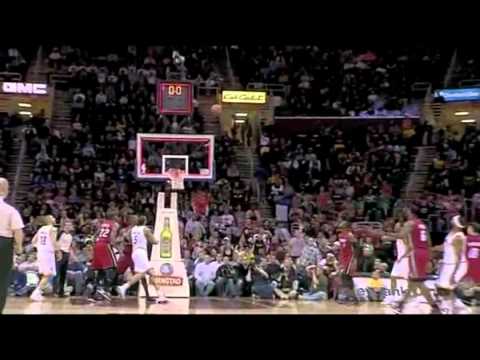
A 14-win team doesn’t have much to play for this time of year, but give the Cavs credit, they showed up on Tuesday night to face LeBron, riding a thirsty crowd to a 102-90 victory.

The Cavs led by 23 points with 5:06 remaining in the third quarter, but the Heat went on a 22-4 run to close the quarter and cut Cleveland’s lead to five at the break.

Mike Bibby’s seventh three-pointer of the game tied the score at 83-83, but the Cavs went on a 12-0 run (sparked by Luke Harangody of all people) that included four points from Ryan Hollins and six points from Anthony Parker.

LeBron finished with a 27-10-12 triple-double, but the Cavs had the last laugh, breaking the Heat’s five-game winning streak and knocking Miami out of a tie with Boston for the #2 spot in the East.

As a side note, Chris Bosh had another clunker, shooting just 5-of-14 from the field for 10 points to go along with four rebounds and four assists. He was thoroughly outplayed by J.J. Hickson (21 points, 12 rebounds) and Hollins (13 points, three blocks). Bosh was coming off seven double-doubles in his last eight games, but his performance in tough environments on the road is something to keep an eye on.

Here are the highlights:

Your quick and dirty Final Four preview

Butler Bulldogs head coach Brad Stevens encourages his team playing against the Florida Gators in the second half during their NCAA Southeast Regional college basketball game in New Orleans, March 26, 2011. REUTERS/Sean Gardner (UNITED STATES – Tags: SPORT BASKETBALL)

Butler vs. VCU

Spread: Butler -2.5; Sagarin: Butler -1.45; Pomeroy: Butler 55.3%
Butler is the slight favorite, and if this game comes down to the final few possessions, I have to give the Bulldogs the edge due to their amazing ability (fortune?) to triumph in close games. However, Butler has only won their four tournament games by a total of 13 points, so they have hardly been as dominating as the Rams, who have beaten #1 Kansas, #3 Purdue, #6 Georgetown and #11 USC by an average of 14.8 points. Their lone tight game was against #10 Florida State, which went to overtime.

The key for the Rams has been their lights-out three-point shooting. They have hit 44% of their attempts in the tourney, after shooting just 36% during the season. Will this hot shooting continue in a football stadium against Butler, which very good at defending the three-point line (32.4%)? If the Rams hit 40%+ from long range, they have a chance for a 10- to 15-point win, especially if they use their depth to press, something that has rattled the Bulldogs in this tournament.

My pick: VCU

Kentucky vs. UConn

Spread: UK -2; Sagarin: UK -2.32; Pomeroy: UK 58.4%
After watching UConn play in a tough environment against both SDSU and Arizona, there’s no doubt that the Huskies are mentally tough enough to leave Houston with a title. Kentucky has the more talented rotation, but the key to this game will be how the Wildcats defend Kemba Walker and Jeremy Lamb. Against both SDSU and Arizona, Walker carried the Huskies early, but at some point in the second half, Lamb stepped up with several big shots to help to put those two games away.

If you go with the “best player on the floor” argument, UConn probably has the edge because of Walker. He’s lightning quick and can usually get a good look at the basket whenever he wants. The Wildcats have more balance, with four players averaging double-digits and two more averaging 7.9 ppg or more. Brandon Knight has hit some clutch shots and UConn hasn’t had to wrangle a guard of his caliber so far in the tournament.

In the end, the Wildcats have the edge. They own the 4th-best Pomeroy rating and look more like a national championship-caliber squad with their elite (#7) offensive efficiency and more than capable defense (#20). That said, if Walker and/or Lamb get hot, this will be a close game.

My pick: Kentucky

What kind of point guard WAS he?

My post from a few days ago was relatively well-received at reddit, and one of the readers there said that he’d like to see the same graph for some of the all-time great point guards.

So with a little help from Basketball-Reference.com, I compiled a list of (all?) the Hall of Fame point guards: Oscar Robertson, Lenny Wilkens, Bob Cousy, Jerry West, John Stockton, Isiah Thomas, Magic Johnson, Dennis Johnson, Tiny Archibald, Calvin Murphy, Pete Maravich and Walt Frazier. Unfortunately, the NBA didn’t start keeping track of turnovers until the 1977-78 season, so there’s no assist-to-turnover data for the first four (Robertson, Wilkens, Cousy, West) and the data for Archibald, Murphy, Maravich and Frazier is incomplete, so I could only use their post-1977 numbers.

I also compiled a list of the top non-HOF point guards who are both retired and still active: Jason Kidd, Mark Jackson, Steve Nash, Gary Payton, Rod Strickland, Maurice Cheeks, Terry Porter, Tim Hardaway, Andre Miller, Muggsy Bogues, Kevin Johnson, Derek Harper, Stephon Marbury (yes, Stephon Marbury), John Lucas, Norm Nixon, Mookie Blaylock, Sam Cassell, Avery Johnson, Baron Davis, Nick Van Exel, Allen Iverson, Chauncey Billups and Mike Bibby. All of these players have at least 5,400 career assists, which seemed to be the cutoff for players I was interested in using for this study.

Lastly, I added seven of the top current point guards who have yet to break the 5,400-assist barrier: Tony Parker, Stephen Curry, Russell Westbrook, Rajon Rondo, Derrick Rose, Deron Williams and of course, Chris Paul.

I first tackled this subject two years ago, and settled on the shot-to-assist ratio to determine whether a player is “pass-first” or “shoot-first.” The higher the number, the more of a “shoot-first” player he is. To determine whether or not a player is “turnover-prone,” I calculated each player’s assist-to-turnover ratio. The higher the number, the better the player is at taking care of the ball, relative to what he’s asked to do as a playmaker for his team. The graph takes a gentle downward slope because assists are part of both calculations. (Note: While I do like FGA/A as the criteria for shoot-first/pass-first, I am not completely sold on A/TO as the criteria for turnover-prone. Perhaps (A+FGA)/TO would show shoot-first guards in a better light? Maybe I’ll try that next year.)

Continue reading »

« Older posts Newer posts »