Tag: NBA free agency (Page 9 of 22)

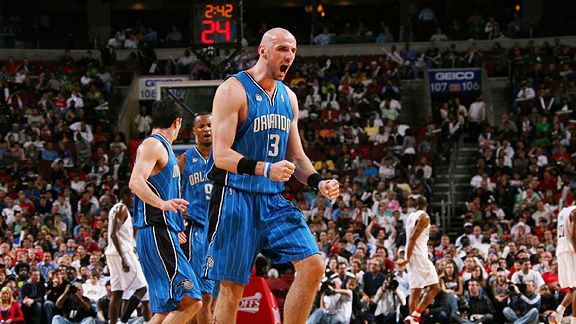
Surprisingly, Orlando matches offer sheet for Gortat

When the Mavs signed backup center Marcin Gortat, it seemed like a done deal that the Magic would let him go. But Orlando elected to match the offer.

The Orlando Magic will keep Marcin Gortat by matching the five-year, $34-million offer sheet extended to him by the Dallas Mavericks, the Orlando Sentinel first reported Monday.

“Having quality big men is an absolute must in our league, and Marcin has worked very hard to fit into that category,” Magic general manager Otis Smith said in a statement. “He provides tremendous depth to our frontcourt and we’re happy to bring him back.”

Gortat’s agent, Guy Zucker, told the Dallas Morning News his player is “very, very disappointed.”
The decision is a bold and costly one for the Magic, who will plunge further into luxury-tax territory than many rivals anticipated after their recent trade for Vince Carter by first signing Brandon Bass away from Dallas to a four-year deal worth a reported $18 million and then matching on Gortat.

Retaining Gortat and adding Bass will likely take the Magic’s payroll into the $80 million range for next season, which would force Orlando to cut a luxury-tax check of more than $10 million in July 2010 barring roster moves between now and June 30 of next year to lower that figure.

I don’t get it. They’re willing to give Gortat almost $5 million a season, but they refused to give Hedo Turkoglu — the player mainly responsible for handling and distributing the ball during the Magic’s run to the Finals — the $10 million per season that he was asking for? I don’t mind the Gortat signing by itself, but the Magic may have ruined a good thing by trading for Vince Carter (and in the process, trading away Courtney Lee) and letting Turkoglu get away. Clearly, they are willing to spend — why not keep the most consistent star and main ball handler from last year’s conference champs?

But back to Gortat. It’s understandable why he would be upset. He was penciled in as the starter for the Mavs, but now he has to play behind Dwight Howard for the foreseeable future, limiting the upside of his next contract. But whining through his agent isn’t going to do him any good, is it?

The Magic really screwed the Mavs over on this one. They took their sweet time to match Gortat’s offer sheet, and at the same time they agreed to terms with Brandon Bass, ensuring that Dallas wasn’t going to be able to sign either player. This is a huge blow to the Mavs’ title hopes and is more evidence that the NBA should shorten the time span for a team to match an offer sheet for a restricted free agent.
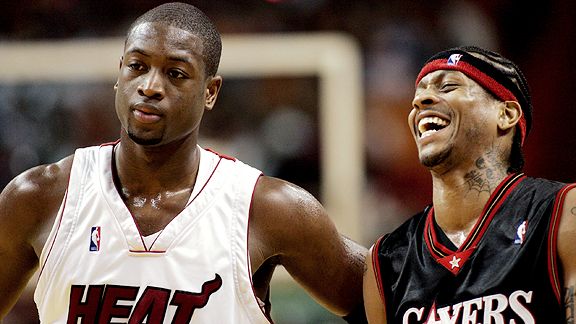

Allen Iverson struggling to find a home


Allen Iverson continues to explore his options on the free agent market, but it’s not like he has teams tripping over each other for his services. There’s mutual interest between AI and the Heat, but Miami doesn’t want to pony up.

Allen Iverson asked for the $5.8 million midlevel exception from the Heat in a one-year deal, but Miami has been reluctant to pay him much more than $2 million, if that. Iverson also is exploring Memphis and Charlotte, but Miami would be his preference if money is equal. The Heat spoke with the agent for Andre Miller — who’s in a stalemate with Philadelphia — but hasn’t pursued a sign-and-trade, and Miller wants more than the midlevel.

Memphis is also interested and Grizzlies owner Michael Heisley speculated about why the Heat aren’t willing to offer Iverson a mid-level deal.

Heisley indicated Sunday that Iverson is “only looking for a one-year contract,” which actually would mesh with Miami’s intent to add no players with contracts stretching past next season to preserve maximum flexibility to re-sign Wade and land him at least one marquee teammate in the summer of 2010. Yet it’s believed that the Heat are reluctant to come close to the $5 million for next season that the Grizzlies are reportedly prepared to pay, since Miami is already in luxury-tax territory.

The Heat are sitting at about $69.86 million which is a hair below the threshold of $69.92 million. If they sign Iverson, they’ll go into luxury tax territory and will have to essentially pay a dollar-for-dollar tax on AI’s entire salary. Not only would they miss out on the reward for being under the luxury tax, but they’d have to pay the tax themselves. Therefore, a contract worth $2 million could perhaps cost the Heat $5.5 million (or more), depending on how many teams are over the threshold and how big the payout turns out to be.

It’s strange to see a player of Iverson’s stature fighting for table scraps on the free agent market. He was once a franchise player, but his disastrous stint in Detroit (resulting from his distaste for coming off the bench) and his ball-dominant style has created an environment in which most teams are extremely leery of utilizing his services. True contenders don’t want to participate in an experiment that has a good chance of backfiring while the lower echelon playoff teams don’t see Iverson as the game-changer needed to put them over the top.

He has proven that he is not willing to what’s best for the team (by coming off the bench), so why would a good team want to add him? The Heat are interested because he’ll put butts in the seats and would probably add a few wins, which might help to convince Dwyane Wade to stay in Miami.

Blazers sign Millsap to offer sheet

Portland is making a push for Utah forward Paul Millsap.

The Portland Trail Blazers elected Friday not to wait on trade possibilities, deciding instead to offer Utah Jazz restricted free agent Paul Millsap a four-year contract worth an estimated $32 million-to-$36 million, according to sources with knowledge of the Blazers’ plans.

This is more compelling than your average, run-of-the-mill restricted free agent signing because a few days ago the Blazers were rumored to be involved in a three-way trade involving Chicago and Utah where the Bulls would have acquired Carlos Boozer, sending Kirk Hinrich to Portland and Tyrus Thomas to Utah.

But those trade talks stalled in part because the Bulls were not prepared to surrender Hinrich and Tyrus Thomas (who would have been Utah-bound) without getting back promising Portland guard Jerryd Bayless in return in addition to Boozer.

Since the Blazers didn’t want to give up Bayless, they’ve made the decision to extend an offer to Millsap, which puts the pressure on the Jazz to move Boozer. The contract is frontloaded, so if Utah were to have both players on the roster it would put the team deep into luxury tax territory.

Another interesting thing about this move by the Blazers is that Millsap plays the same position as LaMarcus Aldridge, so either they (1) plan on playing Aldridge at center, (2) plan on bringing Millsap off the bench or (3) aren’t optimistic that they can keep Aldridge, who is eligible for an extension this summer. The bad news for the Blazers is that the Jazz have seven days to decide whether or not they’ll match the offer, and during that time Portland’s cap space is tied up, so they can’t make an offer to another free agent. But other than Lamar Odom, Allen Iverson and Andre Miller, there isn’t much out there in the way of unrestricted free agents, so it doesn’t make sense to hold onto the cap space if they aren’t going to use it elsewhere.

If the Blazers can pry away Millsap for $8-$9 million per season, it will be a great move. That’s a good value for a young power forward has proven that he has a potential to be an All-Star-caliber player. But I’d expect that the Jazz will be able to trade Boozer and get a good young player (of Tyrus Thomas’s caliber) in return. There are a number of teams that are interested, including the Bulls, Pistons, Heat and Knicks.

I’d also expect this deal to bring David Lee’s contract expectations back to Earth. I think he and Millsap are about on the same level value-wise, with Millsap having a small edge due to his ability to score in the post.

David Lee looking for $12 M per season?

Wondering why David Lee is still on the restricted free agent market? It might be because his asking price is a whopping $12 million per season.

The Knicks have not made a formal offer but are hoping to keep Lee for about $7 million to $8 million per season.

It could take much longer to determine the fates of Lee and Robinson. They are restricted free agents, making them a gamble for rival teams. Lee’s asking price may also be a big obstacle. His agent, Mark Bartelstein, is seeking $12 million per season, according to an executive whose team is pursuing Lee.

But Bartelstein made a strong argument that Lee is a unique and valuable player. He led the league in double-doubles last season, his fourth in the N.B.A., averaging 16 points and 11.7 rebounds, and shot 54.9 percent from the field. He is just 26 and still improving as a shooter and passer.

But at 6 feet 9 inches, Lee is also undersized for a power forward and center, and he does not block many shots or provide stiff interior defense. He scores in bunches, but he cannot create his own shot. Lee could make an All-Star team but he is not viewed as a franchise player, which is why the Knicks want to keep his salary in the single-digit millions.

Bartelstein sounded frustrated at the lack of a deal.

“It’s a shame David’s not done yet,” Bartelstein said. “The Knicks have the ability to get him signed. The other teams don’t, because they don’t know if the Knicks will match or not, or go through a sign-and-trade.”

Here’s what I wrote about Lee in our preview of this year’s crop of restricted free agents

Continue reading »

NBA announces 2009 salary cap, warns about 2010

The new salary cap figure is out, and it dipped slightly from last season.

The new figures for 2009-10 just announced by the league have set the salary cap at $57.7 million per team — down $1 million from $58.7 from 2008-09 — and the luxury-tax threshold at $69.9 million.

More importantly, the league is projecting a much bigger drop (as much as $8 million) heading into the 2010 season.

The official league memorandum, obtained by ESPN.com, forecasts a dip in basketball-related income in the 2009-10 season of 2.5 percent to 5 percent, which threatens to take the 2010-11 cap down some $5 million to $8 million from last season’s $58.7 million salary cap.

A significant drop for the luxury-tax threshold is also projected going into the summer of 2010. If basketball-related income drops by 2.5 percent in 2009-10, league officials are projecting a 2010-11 salary cap of $53.6 million and a luxury-tax line of $65 million. If BRI, as it is referred to in the NBA, decreases by five percent, teams would be looking at a $50.4 million salary cap and a luxury-tax line of $61.2 million in 2010-11.

What does this mean? Well, a team like the New York Knicks, who are projected to have a payroll of about $23 million heading into 2010 would have had about $35 million to spend had the cap stayed at $58 million. That’s plenty of money to sign to superstars. If the cap drops $5-$8 million, it means that they’re projected cap space will be in the $27-$30 million range. That makes signing two “max” players quite tough.

This is probably good news for teams looking to retain their superstars, since they can go over the cap to re-sign players. If the cap does indeed drop to $50 million, it would increase the chances of LeBron James, Dwyane Wade and Joe Johnson staying put.

« Older posts Newer posts »