Tag: March Madness (Page 19 of 24)

Filling out your bracket? I’m here to help. (Updated 3/18)

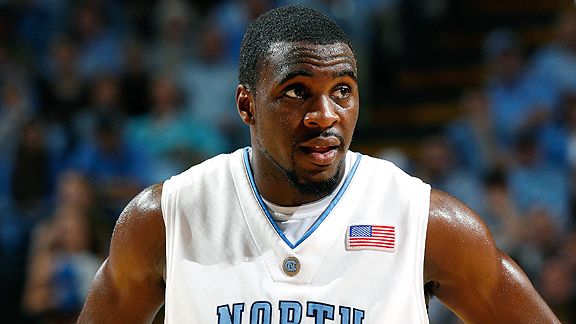
3/18 Update: I’ve modified a few picks with the news that Ty Lawson may not be able to go tomorrow because of the injury to his toe. This news casts serious doubt about just how healthy he can get over the next three weeks, and I no longer see North Carolina as a Final Four team. I have modified my picks so that North Carolina loses to Gonzaga in the Sweet Sixteen. I project the Bulldogs to go on and beat Syracuse in the Elite Eight, which means that Gonzaga is now one of my Final Four teams. (I know, I can’t believe it either.)

This column is dedicated to the millions of Americans that will be filling out their March Madness brackets over the next few days.

You might be thinking — why should I bother listening to this joker?

Well, this is the third time that I’ve written this column and in the previous two seasons (2007, 2008), I successfully picked the winner both times.*

* Past performance is no guarantee of future results.

I’m still tweaking my method, but the crux of it is simple: Start with Jeff Sagarin’s computer rankings and go from there. Over the past two seasons, teams that had a 2+ point advantage in Sagarin’s “Predictor” category went a combined 82-15 (85%). That’s a good place to start. Even when the teams are closely seeded (within 1-3 seeds), Sagarin’s ratings are solid. Last year, in games that were closely seeded, teams with a 2+ point Sagarin advantage went 14-2 (88%). In 2007, they went 8-4 (67%). So over the last two seasons, that’s a combined 22-6 (79%). Not bad.

LOCATION

Last year, there were five games where tight (< 2 point) Sagarin matchups were won by teams with a distinct location advantage. Davidson beat Gonzaga in Raleigh, Mississipi State beat Oregon in Little Rock, Kansas State beat USC in Omaha, Stanford beat Marquette in Anaheim and Texas beat Stanford in Houston. In fact, there weren’t any tight matchups that were won by the team that was at a distinct geographical disadvantage. This year, I am going to make this my first tiebraker for tight Sagarin matchups.

SEED DIFFERENTIAL

Seed differential is also a consideration, as teams with a four- to nine-seed advantage win at about a 75% clip. The data for the previous 16 seasons was compiled by BostonSportsHub, but since they are no longer updating their site, I added the seed records for the 2008 tournament. Here is a summary of the 17 years worth of data.
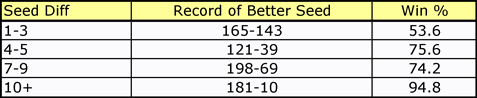
So if Sagarin calculates that the teams are within two points, and there are no geographical considerations, then the next thing I look at is seed. If the differential is four or more, I am going with the better-seeded team barring some overriding factor. In 2008, this methodology was 2-1, winning the Oklahoma/St. Joseph and Purdue/Baylor matchups, while losing the USC/Kansas St. matchup. (Interestingly, all three winners had a slight advantage according to Sagarin, even #11-seed KSU.) Had I gone with KSU’s location advantage, this part of the system would have gone 2-0.

POMEROY RATINGS

Last season, I used Points Per Shot (PPS) to pick seven games and went 3-4. I still believe that PPS is a vital stat, but it doesn’t take into account turnovers, which is key when trying to determine just how good a team is. Ken Pomeroy has offensive and defensive efficiency stats that take into account pace and strength of schedule, and those are compiled to calculate his Pythagorean Winning Percentage.

Here’s how the last few winners were ranked at the end of the tournament in this statistic: Kansas (1), Florida (2), Florida (1), North Carolina (1) and Connecticut (2). Clearly, when picking the overall winner, we don’t want to stray too far from this ranking.

Let’s take a look at the Final Four participants for the last five years and see how they finished, keeping in mind that their final ranking does take into account how they performed during the tournament.

2008: Kansas (1), Memphis (2), UCLA (3), North Carolina (4)
2007: Florida (2), Ohio St. (4), Georgetown (5), UCLA (6)
2006: Florida (1), UCLA (3), LSU (10), George Mason (23)
2005: North Carolina (1), Illinois (2), Louisville (5), Michigan State (7)
2004: UConn (2), Georgia Tech (7), Duke (1), Oklahoma St. (3)

So, excluding the outlier (George Mason), the average Pythagorean ranking for Final Four teams over the last five years has been 3.6. I wish the site showed the pre-tourney rankings, because it would be helpful to know where these teams were ranked when they started the tournament. Since all we have to go by is where they stand now, it would seem unwise to pick a team outside of the top 10 to reach the Final Four.

I used the Pythagorean method back in 2007, and through the second round of the tournament, it had picked 37 of 48 winners. I stopped using it at that point, and I’m not sure why. This year, I’ll keep track of its accuracy throughout the end of the tourney, though I think it’s important to use the static, pre-tourney rankings because that’s all we have to go by when we fill out our bracket.

We’ll see how much I use this statistic as we dig into the bracket.

So, without further ado…
Continue reading »

Ty Lawson’s big toe is a big problem

North Carolina is supposed to march to the Final Four, but they’re going to have a tough time if they’re without ACC Player of the Year Ty Lawson.

Coach Roy Williams says the Atlantic Coast Conference player of the year must practice Tuesday and Wednesday in order to play in Thursday’s NCAA matchup against Radford. Lawson has been hobbled since injuring his right big toe before the regular-season finale against Duke, an injury that sidelined him at last weekend’s ACC tournament.

Williams says Lawson’s recovery is going slower than he had expected. Lawson said at the ACC tournament that he was feeling better after several days of rest.

The good news is that the Tar Heels play their first two games in Greensboro, which is only about an hour away from campus. Lawson doesn’t have to travel, which can take its toll on a player’s health.

“Williams says Lawson’s recovery is going slower than he had expected.”

Boy, it’s a bad sign when the words “recovery” and “slower” appear in the same sentence. Even if he can play, there’s a substantial risk of re-injury. North Carolina can’t win a title without him. And if he’s not practicing now, and it doesn’t look like he’s going to be ready to go tomorrow, I highly doubt that he’s going to get to that 90-95% threshold required to get the Tar Heels over the hump.

In my annual bracket column, I had North Carolina going through to the Final Four because all (or was it most?) of the signs pointed to Lawson being ready to go. If he’s hobbled, I don’t think North Carolina gets past Gonzaga in the Sweet Sixteen.

It looks like I have to go change my picks…

Four observations about the South Region

1. North Carolina has a tough road ahead.
With Ty Lawson at less than 100%, the Tar Heels could be in trouble as soon as Saturday. The LSU/Butler winner is capable of springing the upset, and if both teams advance, #4 Gonzaga could give UNC all it can handle in the Sweet Sixteen. Later on, potential matchups with Syracuse or Oklahoma loom large. With Lawson healthy, they shouldn’t have a problem, but if the ACC POY is gimpy, don’t be surprised if UNC goes down before the Final Four. In fact, expect it.

2. This might be Gonzaga’s best team yet.
Stat guru Ken Pomeroy has the Bulldogs pegged as the fifth best team heading into the tournament, ahead of bigger names like Pittsburgh and Duke. Gonzaga goes eight deep, but Mark Few relies mainly on six players who all average at least 9.2 points per game. Those six players are all legitimate three-point threats as well, with four shooting better than 39% from long range on the season. The Bulldogs are extremely efficient both offensively and defensively, which is why Pomeroy loves them so much.

3. Syracuse/Arizona State should be a doozy.
If they both manage to win their first round games, a second round Orangemen/Sun Devils matchup should be fun. Despite losing to Louisville in the Big East Championship final, Syracuse is one of the hottest teams in the country, but only time will tell if the 35 overtime minutes they played against Syracuse and West Virginia eventually takes its toll. Since they play so much zone defense, it shouldn’t be much of a factor, and it’s not like point guard Jonny Flynn gets tired anyway. ASU has been up and down lately, but they played well in the Pac-10 tournament before blowing a 15-point lead in a loss to USC. The Sun Devils depend on James Harden (20.8 ppg) to score, so it will be interesting to see if Syracuse’s zone can slow him down. Regardless, Herb Sendek has done a terrific job in his short tenure at ASU. I wonder if NC State regrets letting him go…

4. The Illini should be aware of the long ball.
Western Kentucky’s A.J. Slaughter and Orlando Mendez-Valdez average better than 5.0 made threes per game between them, and along with Steffphon Pettigrew, the Hilltoppers’ top three scorers all shoot at least 37% from long range. If Illinois comes out and lays an offensive egg like they did against Minnesota (36 points) and Penn State (33 points) earlier in the year, Western Kentucky will pull the upset.

How are the officials assigned for March Madness?

As part of Pat Forde’s latest column, he describes how the NCAA coordinator of officials assigns referees to work each game.

The Minutes caught up with NCAA coordinator of officials John Adams (48) last week to see how he will be viewing the tournament and his refs’ role in it.

On Friday at 5 p.m., the NCAA e-mailed the 96 officials who will be working the tournament to tell them they’re in. At 5:45 p.m. Sunday, Adams got an advance copy of the bracket and began slotting in crews for individual games — he’d already decided which crews were going to which sites. The job of matching crews to specific games is largely an effort to ensure there is no potential conflict of interest — putting two refs who do a preponderance of SEC games on an LSU game, for instance.

On Sunday night, the tournament site managers will get on the phone and call the officials coming to their subregion, informing them whether they’re working just one day or two. Adams, who wants to get some new blood moved into the elite ranks of officiating, said at least 10 rookies will get the call.

On Tuesday at 6 p.m., Adams will have a conference call with his refs. He’ll go over general issues and protocol — when it’s OK to look at a monitor, when it’s not, etc. And he’ll remind them of the points of emphasis that have been in place all season: traveling, illegal screens, block/charge calls, etc. He’ll reiterate that they should keep conversations with coaches to a minimum.

“We’ve spent all year getting ready for this,” said Adams, who has seen 67 games in person and countless more on TV.

Then the refs go do their thing, and Adams hunkers down in Indianapolis with NCAA staffers Greg Shaheen and Tom Jernstedt in front of a bank of televisions to watch them work. In concert with tournament administrators at every site, they’ll determine which refs keep working and which go home.

The on-site administrators will fill out rating cards on every ref with one of three judgments: strongly recommend to advance; recommend to advance; do not recommend to advance. Those cards will be sent to Adams.

The group will be cut from 96 to 48 to 36, and ultimately to nine for the Final Four — three for each game. Just like the teams, they’re all striving to advance.

“It’s very competitive,” Adams said. “They’re all trying to get to Detroit.”

Adams will be watching to see who handles the pressure of close games and heavy scrutiny. He knows basketball officials are subject to more second-guessing than ever.

“It’s hard to keep a secret anymore,” he said. “If you make a mistake, everyone sees it replayed. The media and so many people can see these games, and so many are close.

“To some people it’s rarely the kid who screws up, it’s the referee. It works better that way.”

In many ways it’s a thankless task, but it has its rewards. For nine men, the reward is a trip to the Final Four. Adams is watching to determine which nine earn it.

It’s interesting how the competition for the officials mirrors that of the players. It also seems that the officiating on the college level is far superior than that of the NBA. Why is that?

Hunting for giant killers

ESPN’s Peter Keating lists a few upset possibilities…

No. 13 Portland State (17.6 percent) vs. No. 4 Xavier (62.7 percent)

Portland State, whose adjusted statistics are only about as impressive as Iowa State’s or St. John’s, isn’t the ideal killer. But Xavier is a textbook example of a giant waiting to be slain by just about anyone: The Musketeers turn the ball over considerably more often than they generate turnovers (21.9 percent vs.18.9 percent of possessions). They are heavily reliant on making more free throws than opponents (9.1 FT margin per 100 possessions), which is always a concern in a one-and-done scenario. And they don’t score enough to blow past their flaws (adjusted offensive efficiency of 111.3). Considering everything working against Xavier, and the fact that Portland State at least has a puncher’s chance, according to our model, this is as good an upset pick as you’ll find in the first round.

No. 11 Temple (32.6 percent) vs. No. 6 Arizona State (27.9 percent)

The Sun Devils play sloooow (61.2 possessions per game, by far the fewest among giants), which means James Harden (20.8 ppg) is even more impressive than he looks. But ASU doesn’t grab offensive rebounds (30.6 percent of possessions, 250th in the country). And they give opponents too many open looks from 3-point land (27.4 percent of all field goals). Temple, on the other hand, keeps foes off the offensive glass, doesn’t turn the ball over and doesn’t rely on free throws to outscore opponents. Also, our model can’t distinguish between dominating scorers who can carry a team through the postseason and those who can be stopped as soon as they run into a good opponent, but senior guard Dionte Christmas certainly was the former in the Atlantic 10 tournament.

I don’t advocate picking either of these underdogs. Arizona State is playing good basketball and I think Xavier will have enough to get past the first two rounds. But it’s interesting to see that someone has developed a formula to predict these upsets. We’ll see how it fares.

« Older posts Newer posts »