Tag: Fantasy football draft strategy (Page 15 of 20)

How to pick your keepers

As more and more keeper leagues pop up, August has become the month where fantasy owners have to decide which players they will keep. Sometimes this is an easy decision, but at other times, it may seem impossible.

I’ve been in the same keeper league for almost 10 years. Every summer we can freeze four players (with no draft pick penalty) as well as a prospect, which is defined as a player entering his second or third year in the league who has not finished in the top 20 at his position in his career. To freeze a prospect, we have to give up a 4th round pick.

Some owners are too forward-looking with regard to keepers. This is a great trait to have in dynasty leagues, where you holdover your roster from year to year, but in a keeper league where you only carry 2-4 players, being too forward-looking is a handicap. There’s one owner in our league who is always a year or two too early on a player. He picks players that will eventually be stars, but they won’t be on his roster when stardom finally hits.

Continue reading »

2009 Fantasy Football Preview: PKs

All 2009 Fantasy Articles | 2009 Position Rankings

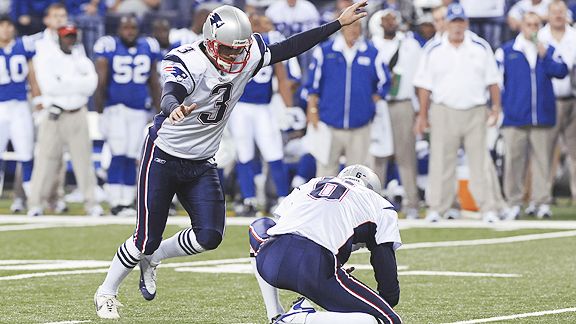
When the topic of fantasy kickers come up, it makes us feel like Allen Iverson when someone asks him about practice: “Kickers? You want to talk about kickers?”

Still, championship-caliber fantasy teams usually have a good kicker, so it is important to stay awake in the final rounds of your fantasy draft to ensure that you get someone decent.

We generally approach the kicker position with the following strategy:

1. Pick players that kick for teams with a good offense.
Good offense means touchdowns, and with TDs come extra points. Players who kick a lot of extra points are generally more consistent week-to-week than kickers who get more of their scoring from field goals. It’s better to have someone who is going to score four XPs every week than it is to have a guy that may or may not get 2-3 field goals.

2. Pick players that kick in good weather (or indoors).
There are plenty of good players who kick in bad weather. It’s fine to draft Mason Crosby or Robbie Gould, but do you really want to run them out there in Week 16 when there are 30 mph crosswinds in Green Bay or Chicago? If you want to pick a kicker and pretty much forget about the position, grab a guy that plays in warm weather or, better yet, kicks indoors. If you do pick a bad weather kicker — and we’re going to recommend two good ones — be prepared to make a change late in the season.

The top 10 offenses of 2008 belonged to the Saints, Broncos, Texans, Cardinals, Patriots, Falcons, Giants, Packers, Eagles and Panthers. Eight of those teams had kickers who finished in the top 13: Stephen Gostkowski, David Akers, John Carney, Jason Elam, Mason Crosby, Kris Brown, John Kasay and Matt Prater. The Saints had three kickers throughout the season and the Cardinals were in the bottom 10 in field goal attempts.

The other kickers in the top 13 – Rob Bironas (TEN), Rian Lindell (BUF), Matt Bryant (TB), Ryan Longwell (MIN) and Josh Brown (STL) – played for teams that fought through suspect play out of the quarterback position. These are teams that didn’t have a very dynamic offense, so they had trouble punching the ball into the endzone. Moreover, Tennessee and Minnesota were both in the top 7 in total rushing yards, while Buffalo and Tampa Bay were #14 and #15 in that category, respectively. These teams could move the ball, but they couldn’t finish off drives very well.

Keeping all of this in mind, here are a few guys that should have top 10 years but won’t cost you much on draft day. Savvy fantasy owners shouldn’t even think about the kicker position until the 15th round, so we’ll limit this list to guys that are going that late.

Continue reading »

2009 Fantasy Football Preview: TEs

All 2009 Fantasy Articles | 2009 Position Rankings

As more and more leagues have moved to a point per reception (PPR) format, the tight end position has become increasingly important in fantasy circles. This is compounded by the NFL’s movement towards the utilization of pass-catching tight ends (i.e. players who can block a little, but are primarily on the field for their pass-catching ability).

Sometimes people scoff when we recommend drafting the top TE in the third round, but savvy fantasy owners who follow the principles of Value Based Drafting know that the top TE often carries 2nd round value at a 3rd round (or even a 4th round) price. This is the definition of value, and if that player performs to expectations, his fantasy owner is going to have a significant weekly advantage at the TE position. This translates to wins.

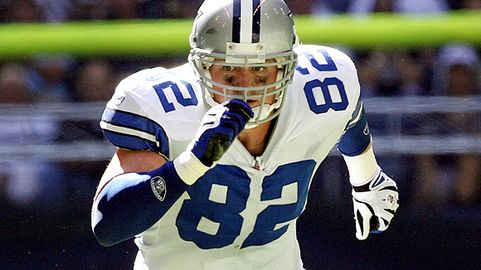
One nice thing about drafting a TE in the early to middle rounds is that it’s not too hard to pick out the good ones. Tony Gonzalez and Antonio Gates have both finished in the top 4 in each of the last three seasons. Jason Witten finished as TE1 in ’07 and TE2 in ’08, and with Terrell Owens gone, Tony Romo should be looking his way even more this season. Barring injury, Witten, Gates and Gonzo are a good bet to finish in the top 5 in 2009.

But don’t fret if you miss out on one of the premier guys. There are several players who have emerged in recent years as very dependable options. Chris Cooley was TE5 in each of the last two seasons (and TE7 the year before), Owen Daniels is just 26 and has two top 7 finishes in the last two years, Dallas Clark finished as the TE6 in ’07 and TE3 in ’08, and should have a solid ’09 with the departure of Marvin Harrison. And, of course, you could always roll the dice on Kellen Winslow, who had a disappointing ’08 (TE17) after finishing in the top 4 the previous two seasons.

And then there are the young, upside guys – Greg Olsen, John Carlson, Zach Miller, Dustin Keller and Kevin Boss – who have shown flashes of fantasy stardom and are all in their early- to mid-twenties.

Since most tight ends hold more value than their respective average draft positions, it’s tough to say which players are a good value and which ones aren’t. Instead, we’re going to list a few TEs and discuss when each player becomes a nice value. This assumes a 12-team PPR league where a starting TE is required. If your league doesn’t award a point per reception or doesn’t require a TE, then the position is tremendously devalued. (In other words, wait a while before burning a pick on a tight end.)

Jason Witten in the late-3rd/4th
Witten was a little dinged up in the middle of last season, but he got off to a great start and finished strong for his owners. We like him ahead of Gates and Gonzo because injuries aren’t really a concern and he’s still playing in a great situation with Tony Romo (and without Terrell Owens).

Continue reading »

2009 Fantasy Football Preview: DTs, DTBC

All 2009 Fantasy Articles | 2009 Position Rankings

Defenses are tough to predict year to year, so fantasy owners are generally better off using their middle round picks to build depth at the skill positions. An emerging strategy is to utilize a Defensive Team By Committee (DTBC) approach, which involves drafting two late-round defenses whose schedules combine well. The idea is to get top 5 or top 10 DT performance at a much cheaper price.

Last year, we provided three recommended DTBCs: 1) SEA/BUF, 2) BUF/NO and 3) BUF/GB.

Seahawks/Bills was our top recommendation, and while the combo didn’t set the world on fire, they performed well. Under a high performance scoring system, the duo combined for 132 fantasy points over the first 16 weeks, which outscored all but the top 6 defenses in 2008. However, when we account for the bye week fill in by adding the average points per game of DT13-DT32 (5.4 per game), DT7 (Minnesota) would have also outscored the Seahawks/Bills combination. Still, getting DT8 performance with two late round picks is nothing to sneeze at. The duo also performed well in Week 15 (9 points) and Week 16 (14 points), when it mattered most.

Our second recommendation (and also the Footballguys’ recommendation, one of the first sites – if not the first – to outline this approach) was the Bills/Saints. Unfortunately, this combo did not perform well, posting 112 points over 16 weeks, mostly due to the Saints’ struggles. The duo would have finished the season as DT15, which is pretty bad considering that the Bills alone finished DT17.

Our final recommendation – Packers/Bills – posted 144 points, which would have been good for DT5 in 2008. This duo didn’t perform particularly well in the playoffs, scoring just 10 points over the last three games, but on the whole, this was a terrific DTBC last year.

Looking ahead to this season, Footballguys recommends a Cardinals/Packers combo, and while it certainly looks like a good one, we have another that we’d recommend first. FBG factors for home/away advantage/disadvantage, but they only go so far. Two years ago, we looked at home/away as it relates to DTBC, and found that middling defenses (ranked #6-#25) scored at a 31% better clip when playing at home. In the 2008 season, that number fell to 7%. This is a much smaller impact, but still significant.

Continue reading »

2009 Fantasy Football Preview: WRs

All 2009 Fantasy Articles | 2009 Position Rankings

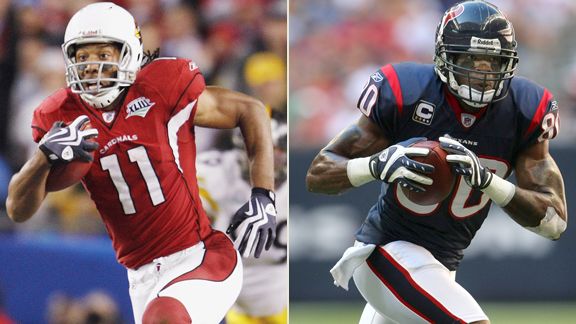
As more and more leagues have tweaked their rules to try to even out the importance of other positions with respect to running backs, wide receivers have become increasingly valuable in the last few years. In leagues that award one point per reception, it’s a completely legitimate strategy to draft a WR in the back half of the first round. In fact, after the top five or six PPR backs – Maurice Jones-Drew, Adrian Peterson, Steven Jackson, Matt Forte, LaDainian Tomlinson and Frank Gore – are off the board, we wouldn’t snicker at someone who decided to pull the trigger on Larry Fitzgerald or Andre Johnson instead of going choosing a player from the second tier of RBs. (If you’re wondering about Michael Turner, we love the guy, but he isn’t going to catch any passes and it doesn’t look like he’ll approach 376 carries again this season.)

Wide receivers are a little dicey because of the inconsistency that is intrinsic to the position. WRs have to depend on plays being called for them and on their QB to deliver the ball. There’s a better chance that a top RB will get his 20 touches (handoffs, dump offs) than there is that a top WR will get his 7-8 catches. As an example, last year’s top RB, Matt Forte, only had one game where he scored fewer than 14 fantasy points, and that was in Week 17, when it didn’t really matter. Conversely, the top WR, Andre Johnson, had four games where he scored fewer than 10 fantasy points (including Week 16, when it really mattered).

This year there appear to be a group of 12 stud fantasy wideouts: Fitzgerald, A. Johnson, Steve Smith, Calvin Johnson, Reggie Wayne, Randy Moss, Wes Welker, Anquan Boldin, Greg Jennings, Roddy White, Dwayne Bowe and Marques Colston. These are proven players that are in stable situations, or saw their situations improve over the summer (i.e. Matt Cassel in for Tyler Thigpen is an upgrade for Bowe). Anyone not on this list changed teams (T.J. Houshmandzadeh, Laveranues Coles), had a downgrade at QB (Brandon Marshall, Jerricho Cotchery), has an attitude problem (Braylon Edwards, Chad Ocho Cinco), or some combination of all three (Terrell Owens).

This, coupled with the relative depth at the RB position – there are a number of backs going in rounds 3-5 that are good bets to crack the top 20 or top 15 – makes this a year when drafting a WR or two in the first three rounds a pretty compelling strategy. Would it be better to have Steve Slaton, Brian Westbrook and Terrell Owens or Larry Fitzgerald, Reggie Wayne and Ronnie Brown? We’d feel better about that second group.

Regardless, it’s always good to have a few guys targeted in those middle rounds (5-9) so that you can build depth and maybe even find a guy that develops into a starter-caliber WR. There is a tendency now to always look young at wideout, and this is causing some proven veterans to slip further than they should.

Continue reading »
« Older posts Newer posts »