Tag: Dwyane Wade (Page 27 of 31)

The NBA’s Top 10 Franchise Players

Every so often, I’ll be sitting at a bar, throwing back a few adult beverages with a buddy or two and I’ll pose the following question:

If you could have one current NBA player to build your franchise around, with the goal of winning a NBA title in the next five years – who would it be?

Since the 2009 NBA Playoffs are in their infancy, it seems to be as good of a time as any to kick around this question. My criteria are simple – a franchise player has to be able to carry his team, while being reasonably young and injury-free.

We’ll count down from #10 to #1. My top nine guys were pretty easy to list, but #10 was a bitch. Maybe you can help me decide. Feel free to provide your own top 10.

HONORABLE MENTION

Yao Ming, Rockets (28 years-old)
I love Yao’s post up game, and he is a skilled passer, but the chances are only 60/40 that he’ll be healthy for any given playoffs and those odds are only going to decrease as time wears on. He’s like Robert Downey, Jr. — he’s great at what he does, but you just don’t know if he’s going to be there when you need him.

Chauncey Billups, Nuggets (32)
He seems to be more responsible than ‘Melo for the Nuggets’ great play this season, but he’s 32 years old. Still, his effectiveness depends more on strength, steady play and good shooting than it does his (somewhat limited) athleticism, so he should be able to play into his late thirties.

Al Jefferson, Timberwolves (24)
Jefferson is one of the few young, back-to-the-basket post players in the league. He averaged 23/11 on a bad team, which leads me to believe he could post 19/10 on a playoff team, and should only get better with age.

Amare Stoudemire, Suns (26)
He’s four years younger than our next guy, but he’s already had two serious injuries in his career so one wonders if this is a trend. He also seems to be a little bit on the selfish side and has a rep for being a bad defensive player.

Continue reading »

Pistons’ struggles can be traced back to 2003

With the second pick in the 2003 NBA Draft, the Detroit Pistons select…

Darko Milicic.

This is the blackest mark on GM Joe Dumars’ otherwise solid record guiding the Pistons, but six years later, the Milicic pick is having a domino effect on the franchise. While Dumars did successfully dupe the Magic into trading a first round pick for Milicic in 2006 (which resulted in the selection of Rodney Stuckey in the 2007 draft) the Milicic pick still haunts this franchise. Just take a look at the next few selections in that 2003 draft…

3. Nuggets: Carmelo Anthony
4. Raptors: Chris Bosh
5. Heat: Dwyane Wade
6. Clippers: Chris Kaman
7. Bulls: Kirk Hinrich
8. Bucks: T.J. Ford

Granted, guys like Kaman, Hinrich and Ford are solid starter types, but ‘Melo, Bosh and Wade are superstars. The Pistons would have been better off with anyone on this list, but had they drafted one of the next three guys, they’d have a player to build around right now.

I understand why Dumars passed on Anthony. He had just drafted Tayshaun Prince and the team was happy with his progress. The word in 2003 was that Detroit was worried about Carmelo coming in and screwing with the Pistons’ vaunted chemistry. Fine.

I understand why Dumars passed on Wade. The Pistons already had a very solid shooting guard in Richard Hamilton who averaged almost 20 points per game the previous season. In 2003, Rip was just 25 and entering his prime. Plus, Wade surprised a lot of people with how good of a pro he became. His jumper wasn’t up to snuff and he hadn’t yet revealed just how good he was at taking the ball to hole. Fine.

But I have no Earthly clue why Joe Dumars passed on Chris Bosh. At the time, he was a one-and-done, 6’10”, 19 year-old who played at Georgia Tech. He averaged 15.6 points, 9.0 rebounds and 2.2 blocks in the best collegiate conference in the country, earning All-ACC 2nd Team honors. Moreover, he led the conference with 56% field goal shooting, becoming only the second freshman (Antawn Jamison) ever to do so.

That’s not the longest resume, but it’s damn impressive. It’s certainly better than anything Milicic brought to the table. Dumars fell in love with Milicic’s international mystique and it cost him. Big time.

In 2003, Rasheed Wallace and Ben Wallace were the Pistons’ post players. Both guys were getting older and the franchise needed a big man. Bosh would have been a perfect fit. Had the Pistons gone that route, they would have been serious contenders heading into this season and wouldn’t have had to trade their best player — Chauncey Billups — away to clear cap space for a free agent run this summer or next.

Everyone knows that the Milicic pick was a huge mistake, but Dumars gets a pass because he built a great team that went on to win the 2004 NBA championship. He also managed to turn Milicic into Stuckey, who looks like a solid player.

But he’s no Chris Bosh. How many championships would the Pistons have won with Bosh in tow? They lost in seven games to the Spurs in 2005, and the 2006 Finals featured two flawed teams in the Heat and the Mavs. They probably would have represented the East in the 2007 Finals as well. (The Cavs were swept by the Spurs that year.)

Detroit could have won one, two, or maybe even three (or more) titles. They might have been a dynasty.

The Pistons are currently 25-27 and have lost eight straight games. Dumars has cap space to use this summer or next, so he could conceivably land a big man like Carlos Boozer, Amare Stoudemire or…(gulp)…Chris Bosh.

Keep your fingers crossed, Pistons fans.

D-Wade’s former business partner throws him under the bus

Dwyane Wade seems like a stand up guy, so I loathe to pass this along, but his former business partner, Richard Von Houtman, is making some serious allegations. Keep in mind that anyone with the word “Von” in their name is generally not to be trusted, and he might very well be making this all up.

Richard Von Houtman claims he provided a condo to Wade that the Miami Heat star soon turned into a personal party bungalow. Wade and his friends held numerous gatherings there, which featured sex with random women and marijuana use. Van Houtman said he twice saw Wade smoking a joint in the house but wasn’t in attendance for the orgies that Wade allegedly helped arrange.

“They (Wade and childhood friend Marcus Andrews) both made it clear to me how their goal in life is to have sex with as many women as possible,” Von Houtman said.

The two also went in together on a restaurant chain bearing Wade’s name. Needless to say, things didn’t end well.

“Dwyane and Marcus would show up in the Fort Lauderdale location and round up the waitresses they thought were pretty. They’d disappear with them, leaving the restaurant short-staffed,” Von Houtman said. “They were sexual harassment lawsuits waiting to happen.

“Dwyane wanted us to built a VIP room in the Aventura branch (which never opened) that would be totally segregated, with its own bathroom and chaise-lounges. For what? We were serving food, not sex.”

I’m not sure what to make of this, so I’m not going to try. Let’s see if Wade responds.

Which NBA teams project to have the most cap space over the next two years?

In previous columns, I ranked the top 10 free agents of 2010 and identified several players with expiring contracts that might be moved before the Feb. 19 trade deadline. Now it’s time to talk about cap space.

We’ve been hearing a lot lately about how teams are “clearing cap space” so that they can sign a big-name free agent in the summer of 2010 (or in some cases, 2009). But what exactly does this mean?

The NBA has a “soft cap” which is currently set at $58.7 million. Teams that are over the cap can’t sign a free agent from another team for more than the mid-level exception, which usually starts at around $5 million per season. Teams that are under the cap can offer free agents whatever cap space they have up to the level of a max contract, which starts at about $14 million per season under current conditions.

HoopsHype has all the salary data for each team, but I thought it would be useful to compile it all into one table so we can easily see who will have money to spend over the next two summers.

First, my assumptions:

– Given the current state of the economy, the salary cap is likely to stay at about $59 million over the next two seasons, so I used the current cap ($58.7 million) to calculate each team’s cap space.

– Certain players have already indicated that they’re planning to “opt out” of the final year of their contracts so that they can enter free agency. For those that have not announced, I used my best judgment to determine whether or not a player is likely to opt out. For example, LeBron James is very likely to opt out of his contract in the summer of 2010, but Michael Redd, who stands to make more than $18 million that same season, is likely to play out the final year of his deal because he’s not going to get anything close to that kind of money on the open market.

– I’ll also list the major (and some minor) decisions that each franchise will have to make over the next two seasons. These are typically decisions about whether or not to re-sign a player whose contract is up (or is entering restricted free agency). For example, if the Knicks decide to sign David Lee to a long-term deal, it’s going to have an impact on the team’s available cap space.

Without further ado, here’s the table, sorted by total projected cap space in the summer of 2010.
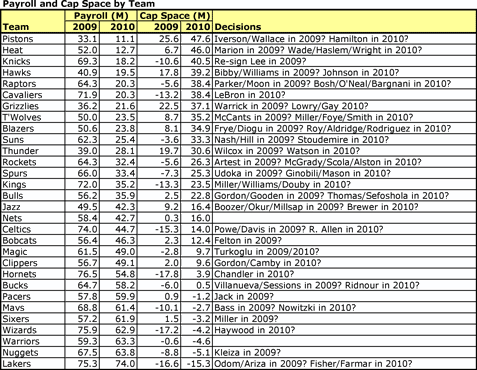
The data is interesting. If teams didn’t spend another dime until the summer of 2010, there would be seven teams capable of signing one player to a max-type contract and 11 teams capable of signing two players to max deals. This isn’t realistic, however, as most teams are going to re-sign their current players when they enter restricted or unrestricted free agency, and that’s going to take a bite out of their cap space. Plus, there are a number of stars – Carlos Boozer, Shawn Marion, Allen Iverson – and several starter-quality players that will sign free agent deals this summer. That’s going to gobble up cap space as well.

Of the four teams that have significant cap flexibility this summer – Detroit, Memphis, Atlanta and Oklahoma City – only two, the Pistons and the Hawks, have major decisions to make this summer. The Hawks have to decide whether or not the 30 year-old Mike Bibby is worth a significant long-term deal. If they do sign him to a contract averaging, let’s say, $10 million per season, it is going to reduce their cap space for the summer of 2010 by that amount. They can always re-sign Joe Johnson (because he is “their” free agent), but they may not have enough space to sign another top tier player. That space would be reduced further if they elect to sign Marvin Williams to a long-term deal.

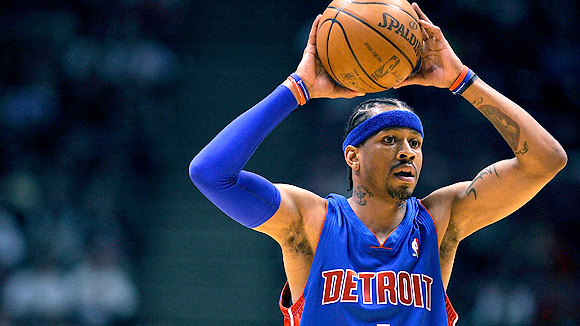
The Pistons have to make a decision about Allen Iverson and Rasheed Wallace. Both players are getting on in age, so I wouldn’t be surprised if the Pistons allow both contracts to expire and use the new cap space this summer or next, building around Rodney Stuckey and Tayshaun Prince.
The Grizzlies have a ton of projected cap space over the next two years, but their challenge is not the money – it’s attracting a top-tier free agent to a small city and a bad team. No one really thinks that Memphis has a shot at any of the top five free agents of 2010 – LeBron, Dwyane Wade, Amare Stoudemire, Chris Bosh and Joe Johnson – though there’s a slim chance that Amare or Bosh might want to play with O.J. Mayo and Rudy Gay. Small market teams like Memphis that are struggling to win are going to have to overpay for second-tier free agents. The Thunder, Timberwolves, Raptors and Kings are four other teams that will have significant cap space over the next two seasons but are unlikely to attract a top-tier free agent.

These numbers will obviously change over the next two seasons as teams make trades and sign free agents (and draft picks). However, I can’t remember a time when this many teams had this much cap space. Under normal circumstances, it would lead to a frenzy of spending in the short term, but with the current state of the economy, teams may be quite a bit more cautious as they open those checkbooks.
« Older posts Newer posts »