Tag: 2009 NFL Draft (Page 20 of 26)

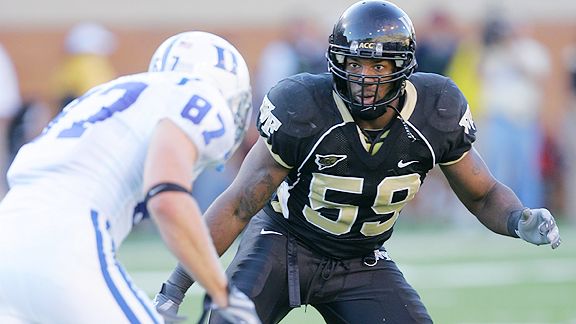
Athlete Profile: Aaron Curry

Aaron Curry, a 6’2″, 250-pound linebacker out of Wake Forest University, has parlayed his physical tools, a great senior season and an eye-opening combine workout to make himself the can’t-miss pick in April’s upcoming NFL draft.

What a difference two years makes.

Back in 2007, Curry returned to Fayetteville, N.C. after a season that saw him finish second in team tackles with 83, only to find out that his mom, Chris, had been evicted from their family home.

After telling his family story during last week’s scouting combine, NFL teams know now that in addition to all of his football skills, Curry is a resilient and family-oriented young man. He says that his no. 1 priority after signing his pro contract is to buy a house for his mom.

Curry’s physical tools are astounding. He’s bulked up to a formidable 250 pounds after weighing under 200 coming out of high school (a big reason why he only received scholarship offers from Wake Forest and East Carolina University – he picked Wake for its academics). He’s a playmaker as much as he is a consistent run-stopping force. During his junior year, he returned three interceptions for touchdowns, bringing back the picks for a school-record of 226 total yards.

In a “three questions” interview with ESPN.com’s Kevin Seifert, Detroit Lions Head Coach Jim Schwartz (the man helping to decide who the Lions will pick with the draft’s no. 1 overall pick) described Curry’s unique skill set.

“He plays ‘Sam,’ but it was interesting at Wake. He played an on-the-ball ‘Sam’ linebacker, which not a lot of people play anymore. You have to be really strong. But they also put him out in space … almost like a nickel back. Those are two almost mutually exclusive skill sets.”

Curry’s versatility, coupled with his fortitude, athleticism and undeniable playmaking ability has NFL scouts salivating, and in a draft littered with uncertainty, the Wake linebacker is becoming more and more of a hot commodity. For teams picking at the top of the draft that might have reservations about say, Georgia QB Matthew Stafford or Texas Tech WR Michael Crabtree, the reliable Curry could emerge as the preferred option.

Regardless of where he lands in the draft, or how fat his rookie contract is, don’t expect Curry to forget about his challenging days after his sophomore year, when he crashed at friends’ houses after learning of his mom’s eviction. He described it as a motivating factor to reporters at the combine.

“Those are the moments you think about in the fourth quarter when there’s a play that needs to be made and you have the opportunity to provide for your family for the rest of their lives.”

The latest on Curry

Almost every draft expert has Curry going in the top 5 picks, although where exactly he will land is up for debate.

SI.com’s Don Banks has him going no. 1 to the Detroit Lions

Todd McShay of ESPN’s Scouts Inc. predicts Curry will be the third pick, going to the Kansas City Chiefs in his Mock Draft for ESPN Insider.

ESPN’s Mel Kiper Jr. has the Cleveland Browns taking him at no. 5

Curry on the web

ESPN.com profile

Wake Forest profile

NFL.com profile

Wikipedia page

DraftCountdown’s scouting report

Curry’s web diary for SI.com

ESPN.com’s “Three Questions” with Curry and Jim Schwartz

Feature story on Curry’s background

Video of INT return for TD vs. N.C. State in 2007

2008 highlight video

Did OSU’s Malcolm Jenkins cost himself the top 10 at the combine?

Ohio State cornerback Malcolm Jenkins, who many scouts feel is the best defensive back in the draft, might have cost himself an opportunity to be a top 10 pick after a poor showing at this year’s scouting combine.

Malcolm JenkinsJenkins, mentioned as a possible selection of the Browns at No. 5, ran unofficial times of between 4.53 and 4.58 at Indianapolis’ Lucas Oil Stadium. He also dropped some passes in the ball drills, prompting Deion Sanders of the NFL Network to proclaim that Jenkins and a couple of the other DBs were “killing themselves.”

“His value will be affected by his time, like it or not,” said Mayock. “But there’s a lot of good tape on him and a lot of Cover 2 teams are going to love him at corner.”
Or perhaps at another position.

“Some people think day one he’s a Pro Bowl free safety,” said Mayock. “He’s got the size and the strength and the physicality to play the position.”

Most of the analysts were more concerned about Jenkins’ shaky performance in the ball drills.
“He kind of followed up [the 40 time] with an average at best — and probably not even average — performance for his skill-set,” said Mayock.

I watched the combine yesterday on the NFL Network and Jenkins’ performance was as bad as the article suggests. He’s a good player and he had a tremendous collegiate career at Ohio State. The combine doesn’t mean everything, but it’s hard to shake off a bad 40-time when you’re a corner – especially when you’re projected to go in the top 10. Most safeties run n the mid 4.5’s, so this isn’t good for Jenkins’ draft stock.

What’s interesting about Jenkins being labeled a Cover 2 corner by Mayock is that some say that’s a knock. But the fact of the matter is that most defenses run a variety of coverages (Cover 2, man to man, Cover 4, etc.) and outside of Denver’s Champ Baliey and Oakland’s Nnamdi Asomugha, there aren’t any true cover corners left in the NFL anymore. So Jenkins being labeled as a Cover 2 corner isn’t a bad thing and chances are he’ll still be a top 15 pick.

Illinois’ Vontae Davis ran a 4.49 at the combine and is a physical marvel. The knock on him is that he freelances too much in coverage, but he might have done enough at the combine to leapfrog Jenkins as the top corner selected in April.

Teams would be wise not to pass on Crabtree

One of the bigger stories surrounding the NFL scouting combine this week (besides the ongoing antics of Alabama’s Andre Smith, that is) is the foot injury that has caused Texas Tech wideout Michael Crabtree to skip workouts. He’ll need to have surgery to repair the slight fracture in his foot and therefore won’t be able to run the 40-yard dash at his Pro Day in March.

When players require surgery before the draft, the notion among some pundits is that their stock will fall. Hopefully teams aren’t that stupid in the case of Crabtree because anyone that has seen him in game action knows how dynamic he can be.

We live in a time where the 40-yard dash seems to rule all. A couple pundits were sporting wood last week when Baylor offensive tackle Jason Smith ran a 5.22 forty, which blew away every O-linemen at the combine. Besides displaying great athleticism, I don’t know why anyone would get overly excited about an offensive tackle running a fast forty. Unless a team plans on him being a combo left tackle/tight end, nobody should flip their lid over Smith (or any offensive tackle for that matter) running a 5.22 forty.

That said, Crabtree not being able to run the forty means very little. He wasn’t even supposed to run a fast time anyway, so nothing changes. He’s still a top 10 pick, he’s still one of the best overall prospects in the draft and he’ll still be the best wideout available come April. Darrius Heyward-Bey, Percy Harvin and Jeremy Maclin are all fantastic receiving prospects. But Crabtree beats them all – good 40-time or not.

Gruden has high remarks for linebacker prospect Laurinaitis

Ohio State linebacker James Laurinaitis drew high praise from former Buccaneers head coach Jon Gruden, as well as several scouts at the NFL scouting combine this week.

“I think sometimes these guys that play four years and have great success as freshmen and sophomores and you sense a little decline there, sometimes overanalysis hurts these guys,” Gruden said during the NFL Network’s coverage this afternoon. “I would love to have Laurinaitis on my team. He’s going to be a factor for you.”

The Cleveland Plain Dealer went on to compare 40-times for linebackers and noted how Laurinaitis ran a smidge faster than USC’s Rey Maualuga.

Laurinaitis ran a 4.80 and a 4.81. The fastest time for USC’s Maualuga’s was 4.83, according to the Network. Maualuga aggravated what he said had been a lingering hamstring injury running the 40. Those two are expected to be the first two inside linebackers taken, and they are very different animals than the outside linebacker prospects who put up faster times.

The problem Laurinaitis faces at the next level is that he often struggled with shedding blockers in college and he isn’t overly aggressive. For having decent size (6’3”, 240 pounds), he’s not that explosive of a hitter and some scouts actually feel that he doesn’t have much upside. But as Gruden points out, Laurinaitis is a blue collar-type of athlete, with excellent football instincts and does have the ability to work through traffic. Depending on what defensive scheme he’s drafted into, he could excel and the bottom line is that he’s a football player through and through.

As for Maualuga, forget the 40-time – this guy is an absolute beast. Most NFL teams want a middle linebacker that has the ability to meet a blocker head on, shed them quickly and get to the ball carrier. That’s Maualuga. He’s aggressive, explosive and he’s a big time hitter and that’s why he’ll be taken ahead of Laurinaitis. Maualuga just fits what most coaches look for in a middle linebacker at the pro level and outside of a lingering hamstring injury, there’s nothing but upside for the USC product.

Quarterback class struggles at combine

Teams in need of a quarterback this offseason might not want to pass on what’s available on the free agent market because the QB class at the NFL scouting combine had a rough weekend.

Georgia’s Matthew Stafford might have been on to something when he didn’t workout this weekend at the combine, because his quarterback brethren didn’t fair too well according to the NFL Network’s Mike Mayock and Paul Burmeister. In fact, the quarterback who impressed the most during drills was West Virginia’s Pat White, who might not even project as a QB in the NFL. White apparently showed the best arm strength of any QB on out routes and also looked very comfortable on a whole.

Scouts said that Mark Sanchez’s (USC) throws were strong and powerful, although his release looked elongated. I had the chance to watch the combine on the NFL Network and I would say his accuracy wasn’t up to snuff, either (or at least not for a quarterback prospect expected to be selected in the first round).

Among the quarterback prospects that really struggled were Alabama’s John Parker Wilson, Texas Tech’s Graham Harrell and Kansas State’s Josh Freeman. Wilson and Harrell were going to be late round projects no matter how they fared at the combine, but Freeman was supposed to have the best physical tools of any QB in the draft. Apparently his first round projection in some mocks was way off.

Stafford’s gamble to not workout might have paid off. Sanchez was the only guy that could have unseated Stafford as the top quarterback prospect and while he was okay in drills, he was far from spectacular.

Teams might be better off waiting for Oklahoma’s Sam Bradford and Texas’s Colt McCoy to come out next year because outside of Stafford and maybe Sanchez, most of the quarterbacks in this year’s class are developmental projects at best.

« Older posts Newer posts »