Page 923 of 2957

Top 10 active innings eaters

Chances are, you need a few pitchers on your fantasy baseball roster that can eat up innings. You know, that silly rule that prevents you from loading up on closers? Well, here is a list you could use, especially if your team if floundering and you need some steady pitchers to deliver quality innings of work. This is the list of active leaders in innings pitched. Some of the names will surprise you, but certainly not all of them:

1. Jamie Moyer, Philadelphia Phillies (3966 innings)—Remember when Jamie Moyer pitched for the Cubs? Yeah, neither does anyone else. He was a rookie in 1986, the year Mookie Wilson hit the ball through Bill Buckner’s legs. I know, most of you don’t remember that, either.

2. Andy Pettitte, New York Yankees (2984)—Though it’s early, Andy Pettitte is having a career year at age 38. And I’m just glad I had the foresight (errr, luck) to draft him for my fantasy team.

3. Tim Wakefield, Boston Red Sox (2980)—Remember when Tim Wakefield pitched for the Pirates? Seriously, he started out there in 1992 and joined the Sox in 1995. And dude is still beloved by the chowder heads.

4. Livan Hernandez, Washington Nationals (2795)—Two things are baffling. One, that Livan’s age is listed as 35. Thirty-freaking-five! Um, no. And two, that this guy is still getting hitters out with that blistering 80 mph fastball of his.

5. Javier Vasquez, New York Yankees (2532)—So this guy has banked $92 million in his career to date for losing as many games as he wins (145-144). That’s proof right there that innings eaters are worth something, but still sounds like highway robbery to me.

6. Jeff Suppan, Milwaukee Brewers (2437)—He’s relegated to the bullpen for the most part, but still racking up innings of work.

7. Kevin Millwood, Baltimore Orioles (2382)—Remember when Kevin Millwood was the fourth starter behind Smoltz, Maddux and Glavine in Atlanta? That was in 1997 but seems like it was 50 years ago.

8. Derek Lowe, Atlanta Braves (2191)—He may have peaked a few years ago, but this guy still has some of the nastiest stuff in the game.

9. Tim Hudson, Atlanta Braves (2124)—Through all of the injuries, it’s truly amazing that Tim Hudson has pitched that many innings. And hey, Javier, put this in your pipe and smoke it—a 153-79 career record.

10. Roy Halladay, Philadelphia Phillies (2123)—This dude just keeps winning, but even he’s only got 154 wins to date. Does that seem right?

Source: Baseball Reference

ECF Game 6: Celtics close out the Magic

Paul Pierce led the way with 31-13-5 and four other Celtics scored in double figures — including a timely 13-point second quarter from Nate Robinson while Rajon Rondo was sidelined with a bad back — as Boston closed out Orlando, 96-84.

I wrote earlier about how the Magic needed to get to the line (30+ times) and shoot reasonably well from long range (8+ threes) and they failed in both areas tonight. They shot just 27 free throws and hit just 6-of-22 threes.

Vince Carter 17-7-3 was more aggressive than in the last two games, but he shot just 6-of-15 from the field and shot just 37% in the series. I think it’s safe to say that the trade backfired on the Magic.

Jones not ready to give up on Roy Williams

According to Dallas Morning News columnist Kevin Sherrington, Cowboys’ owner Jerry Jones isn’t ready to admit that he made a mistake by trading for Roy Williams two years ago.

Will the Cowboys really release Patrick Crayton, a decent #3 receiver and punt returner with experience and keep Roy Williams just because of his contract? When you put it that way, no, it doesn’t seem fair. Crayton is more versatile than Williams. But Jerry’s not ready to admit he made such a big mistake on Roy. If he could ever play to his potential, Roy’s a weapon. Jerry would like to think he’s finally going to get that now. Nothing motivates like a contract year or competition for your position.

I don’t think there’s any question that trading for Williams was a mistake given what Jones parted with (a first, a third and a sixth round pick) in order to acquire him. He also signed Williams to a six-year, $54 million contract with $26 million in guaranteed money and the receiver hasn’t come anywhere close to honoring that deal with his production on the field.

Unlike some Cowboy fans, I don’t think Williams is useless but it’s hard to argue that Jones didn’t make a mistake in acquiring him from Detroit and paying him that much money. The other problem is that Williams is probably the fourth best receiver on Dallas’ depth chart behind Miles Austin, Dez Bryant and Crayton. Fifty-four million is a lot of money to be paying a fourth receiver.

At some point, I think Jones will have to cut his losses and move on. I don’t think it’ll be this year, but chances are Williams won’t see the end of his contract.


Photo from fOTOGLIF

Is pace the difference in the Magic/Celtics series?

After Orlando came back to win the last two games in the Eastern Conference Finals, I’ve been hearing/reading a lot about how Orlando’s insistence in pushing the ball is giving the Magic the advantage in the series.

I wasn’t able to find actual pace statistics game by game, so I came up with a somewhat crude method to estimate the tempo for a team in any given game.

Tempo = FGA + FTA/2 – OR + TO

FTA/2 assumes that every time a player makes a trip to the line that he shoots two free throws. This is obviously not true for three-point plays, but those are the exception and not the rule. (Remember, I said this was somewhat crude.) I subtract offensive rebounds because those are additional possessions that show up later as additional field goals, free throws or turnovers, and have nothing to do with how quickly the team is pushing the ball up court. Finally, I add turnovers because those are possessions where the team fails to get a shot at the basket or a trip to the free throw line.

So, for the first five games, here is how Orlando’s “tempo” has looked:

G1: 93
G2: 94
G3: 88
G4: 89 (pre-overtime)
G5: 89.5

If anything, Orlando has slowed the pace a bit since Game 1 and Game 2. While I agree that the Magic should try to run, the tempo of the game hasn’t had anything to do with whether or not Orlando has won the game.

In the two wins, Orlando has shot at least 30 free throws (in regulation) and made at least eight three pointers. In the three losses, they failed to reach this benchmark in one or both of these categories. During the season the Magic were 17-5 in games where they shot 30+ free throws and made at least eight three pointers. In the postseason, they are 6-0 when those two criteria are met.

Tonight, I’m looking for the Magic to feature Dwight Howard early and often. With Glen Davis and Rasheed Wallace banged up, the Celtics are suddenly very thin on the front line. Ideally, when Kendrick Perkins is in the game, the Magic need to run action that gets Howard the ball deep inside the lane. Perkins does a nice job keeping Howard at bay when he catches the ball on the block or the extended block. If they can get Howard the ball deep, it will put Perkins in a bad position and he’s more likely to get into foul trouble. If that happens, and Perkins is forced to the bench, Howard can pretty much have his way inside.

Other than that, the Magic just need to hit some threes. That means crisp passing and good shot selection.


Photo from fOTOGLIF

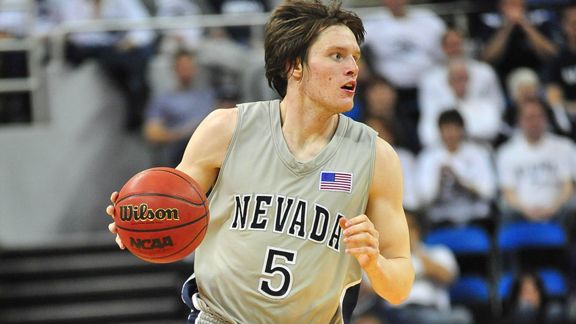
Luke Babbitt on the rise

Chad Ford writes that this year’s Tyler Hansbrough is Nevada forward Luke Babbitt.

Babbitt measured around 6-9 in shoes with an 8-9 standing reach. That doesn’t blow you away. However, he had an impressive 6-11 wingspan and essentially measures up with Griffin (6-10 in shoes, an 8-9 standing reach and a 6-11 wingspan).

But Griffin is way more athletic, you say? Not according to the combine numbers.

Babbitt had a 37.5-inch max vertical, a 3.2-second sprint and an impressive 10.98 lane agility score. Griffin’s numbers were 35.5, 3.28 and 10.95, respectively.

Griffin clearly had the strength advantage, benching a 185-pound bar 22 times to Babbitt’s 15. But 15 reps is still an impressive number.

What about production on the court? Griffin clearly had Babbitt bested here. Griffin averaged 22.2 ppg and 14.1 rpg in 32 mpg his sophomore year. Babbitt averaged 21.9 ppg and 9 rpg in 37 mpg his sophomore year. However, Babbitt does bring two things to the table that Griffin doesn’t — 3-point shooting and ball-handling ability. Babbitt shot a blazing 43 percent from beyond the arc this past season and showed excellent ball-handling skills for a big man in the combine.

Of course, Babbitt isn’t as good of a prospect as Griffin was. That’s why we’ve had Babbitt No. 12 on our mock draft for two straight weeks. However, we might have him too low. Based on what I’m hearing, Babbitt could be in play as high as No. 9 to the Jazz.

There’s a difference between averaging 22-14 in 32 mpg against Big 12 competition and averaging 22-9 in 37 minutes in the WAC. Ford’s point is that athletically, Babbitt is right there with Griffin.

Here is what DraftExpress had to say about Babbitt back in February:

On the offensive end, Babbitt possesses an extremely high skill level to go along with an outstanding feel for the game, assets which allow him to score easily and efficiently from all over the floor. The smooth left-handed shooter is hitting with deadeye accuracy from the free-throw (89%) and three-point lines (41%), while also showing strong ability off the dribble, namely with his mid-range jumper.

Using a combination of ball fakes and jab steps along with rangy strides with the ball and excellent footwork, Babbitt does a very good job getting separation for his jumper in spite of his limited athletic ability. Getting open inside the arc, he shows very good ability to hit jumpers on the move, going left and right, with a hand in his face, and fading away from the basket.

Babbitt’s shot has consistent mechanics and a high release point, while he also has NBA three-point range. His ability to hit shots in a variety of situations if very impressive for a player his age, though there are concerns about how his off-the-dribble shots will translate to the next level against longer, more athletic defenders.

I put those two phrases in bold because it seems Babbitt’s athleticism has always been something of a concern. I wonder — is it because he’s white? Maybe scouts see a white player and automatically start to question his athleticism until proven otherwise.

But Babbitt showed at the combine that he’s every bit the athlete Blake Griffin is, at least according to the numbers. Given his ability to score and basketball IQ, this will make him an interesting name to watch in the first round.

« Older posts Newer posts »