Page 1812 of 2957

Four observations about the South Region

1. North Carolina has a tough road ahead.
With Ty Lawson at less than 100%, the Tar Heels could be in trouble as soon as Saturday. The LSU/Butler winner is capable of springing the upset, and if both teams advance, #4 Gonzaga could give UNC all it can handle in the Sweet Sixteen. Later on, potential matchups with Syracuse or Oklahoma loom large. With Lawson healthy, they shouldn’t have a problem, but if the ACC POY is gimpy, don’t be surprised if UNC goes down before the Final Four. In fact, expect it.

2. This might be Gonzaga’s best team yet.
Stat guru Ken Pomeroy has the Bulldogs pegged as the fifth best team heading into the tournament, ahead of bigger names like Pittsburgh and Duke. Gonzaga goes eight deep, but Mark Few relies mainly on six players who all average at least 9.2 points per game. Those six players are all legitimate three-point threats as well, with four shooting better than 39% from long range on the season. The Bulldogs are extremely efficient both offensively and defensively, which is why Pomeroy loves them so much.

3. Syracuse/Arizona State should be a doozy.
If they both manage to win their first round games, a second round Orangemen/Sun Devils matchup should be fun. Despite losing to Louisville in the Big East Championship final, Syracuse is one of the hottest teams in the country, but only time will tell if the 35 overtime minutes they played against Syracuse and West Virginia eventually takes its toll. Since they play so much zone defense, it shouldn’t be much of a factor, and it’s not like point guard Jonny Flynn gets tired anyway. ASU has been up and down lately, but they played well in the Pac-10 tournament before blowing a 15-point lead in a loss to USC. The Sun Devils depend on James Harden (20.8 ppg) to score, so it will be interesting to see if Syracuse’s zone can slow him down. Regardless, Herb Sendek has done a terrific job in his short tenure at ASU. I wonder if NC State regrets letting him go…

4. The Illini should be aware of the long ball.
Western Kentucky’s A.J. Slaughter and Orlando Mendez-Valdez average better than 5.0 made threes per game between them, and along with Steffphon Pettigrew, the Hilltoppers’ top three scorers all shoot at least 37% from long range. If Illinois comes out and lays an offensive egg like they did against Minnesota (36 points) and Penn State (33 points) earlier in the year, Western Kentucky will pull the upset.

Julius Peppers unlikely to become a Patriot

Despite a report yesterday by NFL.com’s Vic Carucci, the NFL Network’s Adam Schefter and NBCSports’ Tom Curran says that the Panthers are unlikely to trade Julius Peppers to the Patriots.

Julius PeppersCommunicating with two sources close to the “Peppers to Patriots” sandstorm that blew up suddenly Monday afternoon, I’ve learned…

1. Julius Peppers would indeed be interested in playing for the Patriots.
2. It’s a virtual certainty that he will not.

The sources, obviously coming from different sides of the issue, didn’t go into greater detail beyond what I’ve shared .. no talk about contracts, salary cap, compensation back to Carolina or fits in the Patriots defensive scheme. That is, as they say, what it is.

While the unlikelihood of the pieces falling together was something I looked at last night, Adam Schefter of NFL.com and the NFL Network was a morning guest on Boston’s WEEI and poured the first bucket of ice water on the notion.

Turns out – as it often does – Schefter was pretty accurate.

I wrote yesterday that since NFL.com was reporting the rumor, that the deal would likely get done. But I guess if it doesn’t come out of Schefter’s mouth, it probably isn’t true. Carucci doesn’t come off looking to good here.

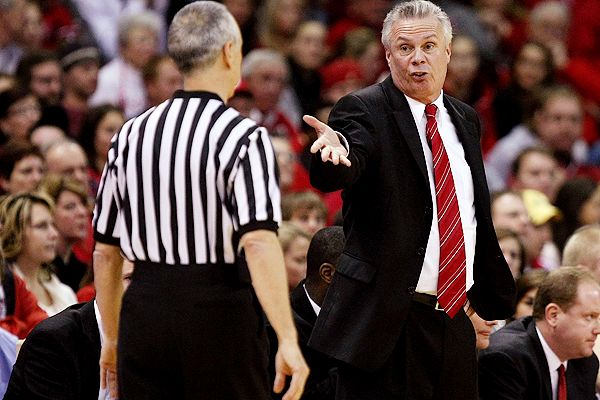
How are the officials assigned for March Madness?

As part of Pat Forde’s latest column, he describes how the NCAA coordinator of officials assigns referees to work each game.

The Minutes caught up with NCAA coordinator of officials John Adams (48) last week to see how he will be viewing the tournament and his refs’ role in it.

On Friday at 5 p.m., the NCAA e-mailed the 96 officials who will be working the tournament to tell them they’re in. At 5:45 p.m. Sunday, Adams got an advance copy of the bracket and began slotting in crews for individual games — he’d already decided which crews were going to which sites. The job of matching crews to specific games is largely an effort to ensure there is no potential conflict of interest — putting two refs who do a preponderance of SEC games on an LSU game, for instance.

On Sunday night, the tournament site managers will get on the phone and call the officials coming to their subregion, informing them whether they’re working just one day or two. Adams, who wants to get some new blood moved into the elite ranks of officiating, said at least 10 rookies will get the call.

On Tuesday at 6 p.m., Adams will have a conference call with his refs. He’ll go over general issues and protocol — when it’s OK to look at a monitor, when it’s not, etc. And he’ll remind them of the points of emphasis that have been in place all season: traveling, illegal screens, block/charge calls, etc. He’ll reiterate that they should keep conversations with coaches to a minimum.

“We’ve spent all year getting ready for this,” said Adams, who has seen 67 games in person and countless more on TV.

Then the refs go do their thing, and Adams hunkers down in Indianapolis with NCAA staffers Greg Shaheen and Tom Jernstedt in front of a bank of televisions to watch them work. In concert with tournament administrators at every site, they’ll determine which refs keep working and which go home.

The on-site administrators will fill out rating cards on every ref with one of three judgments: strongly recommend to advance; recommend to advance; do not recommend to advance. Those cards will be sent to Adams.

The group will be cut from 96 to 48 to 36, and ultimately to nine for the Final Four — three for each game. Just like the teams, they’re all striving to advance.

“It’s very competitive,” Adams said. “They’re all trying to get to Detroit.”

Adams will be watching to see who handles the pressure of close games and heavy scrutiny. He knows basketball officials are subject to more second-guessing than ever.

“It’s hard to keep a secret anymore,” he said. “If you make a mistake, everyone sees it replayed. The media and so many people can see these games, and so many are close.

“To some people it’s rarely the kid who screws up, it’s the referee. It works better that way.”

In many ways it’s a thankless task, but it has its rewards. For nine men, the reward is a trip to the Final Four. Adams is watching to determine which nine earn it.

It’s interesting how the competition for the officials mirrors that of the players. It also seems that the officiating on the college level is far superior than that of the NBA. Why is that?

Hunting for giant killers

ESPN’s Peter Keating lists a few upset possibilities…

No. 13 Portland State (17.6 percent) vs. No. 4 Xavier (62.7 percent)

Portland State, whose adjusted statistics are only about as impressive as Iowa State’s or St. John’s, isn’t the ideal killer. But Xavier is a textbook example of a giant waiting to be slain by just about anyone: The Musketeers turn the ball over considerably more often than they generate turnovers (21.9 percent vs.18.9 percent of possessions). They are heavily reliant on making more free throws than opponents (9.1 FT margin per 100 possessions), which is always a concern in a one-and-done scenario. And they don’t score enough to blow past their flaws (adjusted offensive efficiency of 111.3). Considering everything working against Xavier, and the fact that Portland State at least has a puncher’s chance, according to our model, this is as good an upset pick as you’ll find in the first round.

No. 11 Temple (32.6 percent) vs. No. 6 Arizona State (27.9 percent)

The Sun Devils play sloooow (61.2 possessions per game, by far the fewest among giants), which means James Harden (20.8 ppg) is even more impressive than he looks. But ASU doesn’t grab offensive rebounds (30.6 percent of possessions, 250th in the country). And they give opponents too many open looks from 3-point land (27.4 percent of all field goals). Temple, on the other hand, keeps foes off the offensive glass, doesn’t turn the ball over and doesn’t rely on free throws to outscore opponents. Also, our model can’t distinguish between dominating scorers who can carry a team through the postseason and those who can be stopped as soon as they run into a good opponent, but senior guard Dionte Christmas certainly was the former in the Atlantic 10 tournament.

I don’t advocate picking either of these underdogs. Arizona State is playing good basketball and I think Xavier will have enough to get past the first two rounds. But it’s interesting to see that someone has developed a formula to predict these upsets. We’ll see how it fares.

2009 MLB Preview: #29 Washington Nationals

Click Here to see Previews of all 30 MLB Teams

Offseason Movement: Perhaps the Nats’ biggest addition was 1B/OF Adam Dunn, who will add some pop to the lineup, as well as a fair amount of strikeouts. Washington also acquired OF Josh Willingham and LHP Scott Olsen in a trade with the Marlins and signed free agents Daniel Cabrera, Alex Cintron and Javier Valentin. In the deal to land Willingham and Olsen, the Nationals agreed to send 2B Emilio Bonifaci, INF Jake Smolinski and RHP P.J. Dean to Florida.

Top Prospect: Jordan Zimmerman, RHP
Zimmermann is a serious Rookie of the Year candidate and is turning in a fantastic spring. As of this writing, he has allowed only six hits, two walks and has struck out 16 batters over 12 1/3 scoreless innings. He seems to be over shadowed on a national level, but that’s mostly because the Nationals have yet to officially hand him a spot in the starting rotation. But that should change soon and as long as he doesn’t let the bright lights of the Big Leagues eat him alive, the 22-year old could be a future star.

Continue reading »

« Older posts Newer posts »